The Cache-Aided MIMO Broadcast Channel
From Error-Free Link to Wireless Reality
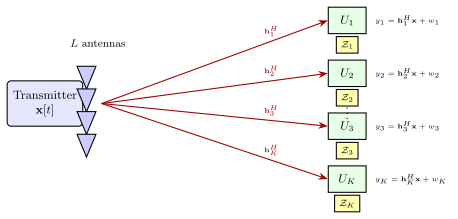
Chapters 1–4 worked with an error-free, infinite-capacity shared link. In wireless systems the shared link is replaced by a multi-antenna broadcast channel, with a transmitter equipped with antennas and single-antenna users. The link is noisy, bandwidth-limited, and has frequency-selective behavior.
Here is the question this chapter answers: how does the coded caching gain combine with the multi-antenna spatial multiplexing gain? A first-guess answer might be multiplicative — after all, both gains compress traffic. But the striking result of Lampiris, Caire, et al. (2017+) is that they are additive: the degrees of freedom satisfy , with . The two gains come from fundamentally different mechanisms and should not be expected to compound.
Definition: Cache-Aided Gaussian MIMO Broadcast Channel
Cache-Aided Gaussian MIMO Broadcast Channel
The cache-aided MIMO broadcast channel consists of:
- A single transmitter with antennas, holding a library .
- single-antenna users, each equipped with a cache of size bits.
- User has channel vector ; the observation per channel use is with transmit power constraint . Define .
The system operates in two phases: (i) placement — populate each user's cache off-peak; (ii) delivery — on demand vector , the transmitter emits signals over channel uses so each user can decode its requested file.
The CSIT assumption (channel state information at the transmitter) is non-trivial: in this chapter we assume perfect CSIT for the derivation of the result. Chapter 7 extends to fading channels with limited CSIT.
Definition: Delivery Rate and Degrees of Freedom
Delivery Rate and Degrees of Freedom
An scheme delivers bits of demand (one file per user) in channel uses, with
The sum degrees of freedom is capturing the high-SNR slope of the sum-rate. In DoF terms, each user's file is a 1-DoF object (full MUD would satisfy users with — but of course the shared-link constraint limits this via cache size).
Recap: The Non-Cached MIMO BC
Without caches, the Gaussian MIMO BC with transmit antennas and single-antenna users achieves via zero-forcing beamforming (or dirty-paper coding for strict capacity). With , (pure multicast or time-shared unicast). With , the transmitter can serve all users in parallel.
Coded caching adds a new DoF resource: the aggregate cache size . Lampiris-Caire's theorem says these two resources stack additively.
Cache-aided MIMO BC topology
DoF vs Memory Ratio for Various
The cache-aided MIMO DoF as a function of , for varying number of antennas . Solid blue is the chosen ; dashed red is the single-antenna MAN baseline ; dotted green is full cooperation . Observe the additive structure: at , (pure MIMO); at , trivially; and in between grows linearly in both the caching gain and the antenna count.
Parameters
Example: DoF Computation: , , ,
Compute the DoF of the cache-aided MIMO BC for the parameters above. Decompose the gain into caching and spatial contributions.
Caching gain
.
Spatial gain
.
Total DoF
(since ).
Decomposition
Without caching (): DoF = 3 (ZF beamforming with 3 antennas serves 3 users in parallel). Without antennas (, single-antenna multicast): DoF = (MAN coded multicast, each XOR serving 3 users). With both: DoF = . The gains add.
Operational interpretation
A per-channel-use delivery can be viewed as serving users simultaneously: via spatial multiplexing and via coded multicasting from cached side information. The point is that these two mechanisms are orthogonal in information-theoretic terms — the joint scheme achieves their sum.
Key Takeaway
Caching gain and spatial multiplexing gain are ADDITIVE, not multiplicative. . Doubling antennas or doubling caches each add to DoF independently; they do not compound into a multiplicative gain. This asymmetry is the central message of the multi-antenna coded caching program.
CSIT: The Achilles' Heel
The DoF result assumes perfect channel state information at the transmitter (CSIT). In practice, CSIT is obtained through pilot transmissions, uplink feedback, or reciprocity in TDD systems. Imperfect CSIT degrades the DoF substantially:
- No CSIT ( effective = 1): collapses to — caching gain survives, spatial multiplexing gain is lost entirely.
- Partial CSIT (estimation variance ): approximately. The spatial contribution scales linearly with CSIT quality.
- Overhead cost: acquiring CSIT costs pilots (fraction of channel uses), reducing effective rate.
The CommIT group has published extensively on low-CSIT coded caching (e.g., Lampiris-Caire 2018 on no-CSIT regimes). A key result: coded caching partially substitutes for CSIT — the pre-stored cache is effectively "CSI-independent" signaling.
- •
5G NR requires CSIT acquisition every ~1 ms at sub-6 GHz
- •
mmWave CSIT is more expensive (narrow beams, blockage)
- •
Perfect-CSIT assumption simplifies DoF but overstates practical gain
- •
FDD systems have higher CSIT cost than TDD (no reciprocity)