The Degraded Broadcast Channel with Caches
Why Heterogeneous Channels Matter
The symmetric MIMO BC of Chapter 5 assumes every user has the same (up to rotation) channel. Real systems are asymmetric: users at the cell edge face weaker channels than users near the base station; high- mobility users face additional fading; indoor users experience penetration loss. In short, the channel qualities differ substantially across users in any deployed system.
This asymmetry has immediate operational consequences for coded caching. Multicasting — the natural delivery mode of MAN — is bottlenecked by the worst user. Transmitting a single coded message at rate means users with stronger channels waste their capacity. This chapter studies how caching interacts with channel heterogeneity and what the optimal delivery strategy looks like.
Definition: Degraded Gaussian Broadcast Channel
Degraded Gaussian Broadcast Channel
The degraded Gaussian broadcast channel with users and a single-antenna transmitter has observations with (equivalently, , where is user 's received SNR at transmit power ).
The channel is called "degraded" because user 2's observation can be constructed from user 1's observation by adding independent Gaussian noise — every downstream user sees a noisier version. User 1 is the strongest user; user is the weakest.
Many deployed wireless channels are approximately degraded: line-of-sight users with good SNR receive everything the non-line-of-sight users receive (modulo the residual noise difference). In a multi-antenna setting, "degradation" is more subtle — users with orthogonal channels are not degraded versions of one another. Chapter 6 focuses on the degraded scalar BC.
Definition: Cache-Aided Degraded Broadcast Channel
Cache-Aided Degraded Broadcast Channel
The cache-aided degraded BC adds to the preceding model:
- A library at the transmitter.
- Per-user cache of size bits, populated in the off-peak placement phase.
- Demand vector revealed at delivery time.
The objective is the per-user symmetric rate — the common rate at which all users can be served. In the worst-case-demand framework, this is the relevant figure of merit. Alternative metrics (sum-rate, weighted sum-rate) apply in different settings.
Theorem: Capacity Region of the Degraded BC (No Caching)
For the -user degraded Gaussian BC with user SNRs , the capacity region is The region is achieved by superposition coding with rate-split parameters .
Superposition coding layers messages for different users. The strongest user decodes everything; each subsequent user decodes only its layer, treating higher layers as noise. The rate-split determines how power is allocated across layers.
Achievability via superposition
Let , where are independent. User decodes layers successively. Layer 's rate is .
Converse via cut-set
The degraded BC capacity region equals the superposition coding region by Cover's classical result — no other scheme (DPC, etc.) achieves more for degraded BC. Converse via EPI + chain rule.
Example: Two-User Degraded BC Capacity
For dB, dB, compute the capacity region and identify the sum-rate-maximizing and symmetric-rate-maximizing operating points.
Linearize SNRs
, . bits. bits.
Capacity region
With split : approximately (high-SNR). (low-SNR limit).
Sum-rate max
: all power to user 1. . (User 2 gets nothing; not symmetric.)
Symmetric max
Find such that : . Solving numerically: , bits — both users get this rate. Compare to multicast: bits.
Observation
Symmetric operation via BC coding (2.26 bits) beats pure multicast (2.06 bits) by about 10%. This is the gain from channel-aware scheduling.
Degraded Gaussian Broadcast Channel with Caches
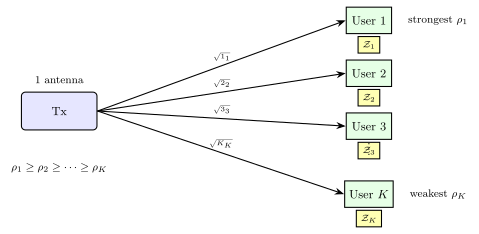
The Caching Challenge on Heterogeneous BC
Coded caching's delivery phase in Chapter 2 sends XOR messages at a single rate. On a degraded BC, this single rate must be the worst-user rate — otherwise the weakest user cannot decode. Hence the naive cache-aided BC rate is Stronger users are unused.
Two possible fixes: (i) layered delivery — superposition coding with one coded-caching layer per user class; (ii) user grouping — cluster users by channel quality and run MAN within each group. Both exploit the non-degenerate structure of the BC.
The full theoretical characterization — including the case of mixed cacheable + uncacheable content — was established by Joudeh, Lampiris, Elia, and Caire (2019), a CommIT contribution treated in §6.3.
Key Takeaway
Channel heterogeneity is the new bottleneck. On a homogeneous channel (Ch 5), DoF = . On a degraded channel, the naive MAN-multicast rate is limited by the weakest user. The research question: can we design a cache-aided delivery that gracefully handles heterogeneous channels? Answer: yes, via superposition + JLEC separation (CommIT 2019).
Channel Heterogeneity in Deployed Systems
In 5G NR deployments the per-user SNR typically spans 20–30 dB across a cell. Causes:
- Distance / path loss. Cell edge vs cell center, up to 20 dB.
- Shadowing. Building penetration, up to 10 dB.
- Multipath fading. Short-term fluctuations, up to 10 dB.
- Blockage (mmWave). Can be 30+ dB.
- Mobility-induced Doppler. Indirect effect via CSIT aging.
Scheduling policies (PF, MaxWeight) already exploit this heterogeneity for uncoded delivery. Cache-aided delivery adds a new dimension: the cache content is shared across users but the delivery rate is channel-dependent.
The JLEC 2019 framework addresses this in a clean asymptotic regime (GDoF). Realistic-SNR schemes are an active research area.
- •
Per-user SNR spread in 5G NR: 10–30 dB typical, 40+ dB at mmWave
- •
Proportional-fair scheduling is the baseline for heterogeneous BC
- •
Cache contents cannot adapt to instantaneous CSI in the placement phase
- •
Cache-aided delivery must balance multicast efficiency with user fairness