The Cache-Aided Fading Broadcast Channel
Why Fading Changes Everything
Chapters 5–6 worked with a static MIMO BC: the channel was fixed and perfectly known to the transmitter. Real wireless channels are neither. They vary on the coherence timescale and are known only approximately (via pilots) or not at all. These two realities interact with coded caching in interesting ways.
The key observation: caching is pilot-free. Coded caching's gain comes from the pre-placed cache contents and XOR multicasting, neither of which requires channel knowledge at delivery time. By contrast, MIMO's spatial multiplexing gain collapses without CSIT. On a CSIT-expensive channel — high-mobility, FDD, mmWave with aging beamforming — caching becomes disproportionately valuable. This chapter formalizes this intuition.
Definition: Cache-Aided Block-Fading Broadcast Channel
Cache-Aided Block-Fading Broadcast Channel
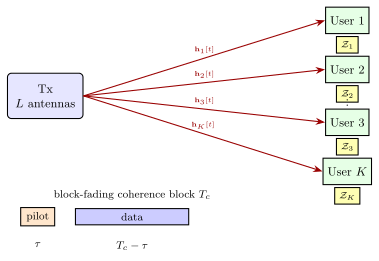
The cache-aided block-fading BC extends the MIMO BC of Chapter 5 to a time-varying channel. Per coherence block of channel uses:
- The channel vector for user and block is drawn i.i.d. from .
- The channel is constant within a block, independent across blocks.
- Each coherence block allocates channel uses to pilots (for CSIT estimation) and channel uses to data.
The received signal at user , channel use of block : , transmit constraint , .
The library, caches, and delivery structure are as in Chapter 5.
The coherence block length depends on user mobility and carrier frequency. At 2 GHz, m/s gives symbols at typical symbol rates. At 28 GHz (mmWave), the same velocity yields — much shorter. This makes CSIT acquisition progressively more expensive as we move up the spectrum.
Definition: CSIT Regimes
CSIT Regimes
We distinguish three regimes based on CSIT quality:
- Full CSIT. The transmitter knows exactly before each block's data phase begins. This is the Chapter 5 assumption; DoF = .
- Partial CSIT (estimation variance ). The transmitter has with . DoF scales as .
- No CSIT. The transmitter knows only statistics. Spatial multiplexing collapses; DoF = (caching gain only).
The tradeoff parameters are the coherence time , the pilot allocation , and the feedback quality (in FDD) or reciprocity noise (in TDD).
Theorem: DoF under Imperfect CSIT
For the cache-aided -antenna BC with estimation error variance : with saturation at . The bound is achieved by the Lampiris-Caire scheme with suitably degraded beamforming.
Imperfect CSIT degrades zero-forcing: residual interference at each null scales with . Effective per-beam SINR reduces, shrinking spatial DoF by a factor . Caching gain is unaffected because XOR cancellation does not use channel information.
Interference leakage
With estimate , zero-forcing beam nulls but not . Residual interference power at user from another beam: .
Per-beam effective SINR
For transmit power , each beam's effective SINR is approximately
Spatial DoF
High-SNR scaling: per beam. Summing over beams: effective spatial DoF = .
Caching gain survives
The caching gain is realized via XOR cancellation at the receivers — no CSIT required. Hence up to saturation .
Effective DoF vs CSIT Error Variance
Plot the cache-aided MIMO DoF as a function of CSIT estimation error variance . Blue: combined DoF = . Green dashed: CSIT-free caching baseline DoF = . Red dotted: pure MIMO (no caching). Notice that the combined scheme is always above both baselines; in particular, at (no-CSIT regime), the combined curve drops to the level, matching the pure-caching baseline.
Parameters
Cache-aided fading BC topology
CSIT Degradation:
Key Takeaway
Caching gain is CSIT-independent; spatial gain is not. On a CSIT-poor channel, the Lampiris-Caire DoF degrades from to — a large loss for but still non-trivial. Caching provides a floor guarantee: no matter how bad the channel knowledge, the coded-multicast gain is retained.
The Cost of CSIT in Real Systems
CSIT is expensive in several concrete ways:
- Pilot overhead. In a symbol block with antennas, pilots consume 0.8% of capacity — modest. At (mmWave, high mobility) and (massive MIMO), the overhead becomes infeasible.
- Feedback overhead (FDD). Users must send CSIT back to the transmitter, consuming uplink capacity proportional to and the required precision.
- Age of CSI. Between pilot and data phases, the channel has aged. At mmWave and high velocity, the aging can be 30%+ of the channel within a single coherence block.
- Quantization. Practical CSI feedback uses finite-rate codebooks; 3GPP Type II codebooks consume ~50 bits per RB per user at .
All of these conspire to make the no-CSIT regime increasingly relevant. Coded caching's CSIT-free caching gain is a practical lever against this. The CommIT group has argued in several papers that coded caching should be viewed as "free" spatial DoF in CSIT-poor settings.
- •
5G NR Type II codebook: up to 64 bits CSI feedback per slot
- •
mmWave coherence: 20-100 symbols at v=30 m/s, fc=28 GHz
- •
FDD LTE/NR CSI feedback period: 5-40 ms
- •
Massive MIMO pilot contamination bottleneck when L = K
Historical Note: The CSIT Research Thread
2012–2021The CSIT-DoF question has a long history in MIMO-BC research. Davoodi and Jafar (2016) characterized the DoF of the MIMO BC under various CSIT assumptions (full, delayed, alternating); Yang, Kobayashi, Gesbert, Yi (2013) gave the delayed-CSIT schemes; Maddah-Ali-Tse (2012) proved the optimality of their "retrospective" scheme. All of this pre-dates coded caching.
The coded-caching extension came from the CommIT group: Lampiris, Caire and collaborators (2017+) showed that the caching gain survives the CSIT degradation, giving coded caching a unique robustness property. The 2021 paper of Lampiris-Bhattacharjee-Caire (in IEEE TWC) is the clearest statement of this idea in the fading context.
A related thread is imperfect CSIT pre-coding (Clerckx-Joudeh et al.); rate-splitting MA inherits the CSIT-dependence but provides finer-grained tradeoffs than time-sharing.