The Cloud-RAN Architecture with Edge Caching
Why Cloud-RAN Needs Caching
Cloud-RAN (C-RAN) is the dominant architecture for 5G/6G networks: lightweight edge nodes (ENs, formerly called RRUs — remote radio units) are connected to a central cloud (BBU pool) via high-capacity fronthaul links. The cloud handles baseband processing (coding, precoding); the ENs are thin, radio-only. Pre-caching is added as a sensible extension: put some content at the edge to reduce fronthaul load and delivery latency.
The question: what is the optimal tradeoff between cache size and fronthaul capacity? A cloud-heavy architecture has large and small ; a cache-heavy one has large and small . The Simeone group's NDT framework characterizes this tradeoff information-theoretically. This chapter is the CommIT-adjacent deep dive into that framework.
Although the NDT framework was initially developed by Simeone- Sengupta et al., the CommIT group has extended it in several directions: mixed-traffic C-RAN (Park-Caire), fog-based massive MIMO (Lampiris-Caire), and privacy-constrained C-RAN (Wan-Caire). We treat the unified framework here.
Definition: Cloud-RAN with Edge Caching
Cloud-RAN with Edge Caching
The cache-aided cloud-RAN consists of:
- A central cloud with the full library and infinite compute.
- edge nodes (ENs), each with a cache of size files.
- A fronthaul link connecting the cloud to each EN, of capacity files per channel use on the wireless downlink.
- single-antenna users, each served by the ENs.
- A wireless downlink from ENs to users (modeled as MIMO BC with the ENs as cooperating transmitters).
The placement phase populates EN caches off-peak. In the delivery phase, with demand vector : (i) ENs serve cached content directly; (ii) the cloud transmits non-cached content to ENs via fronthaul, at rate per EN per channel use; (iii) ENs forward received content to users over the downlink.
The fronthaul is the "slow" link. In practice, CPRI fronthaul of a 5G mid-band system handles 10-25 Gbps per RRU; user-plane data typically utilizes 1-5 Gbps. The C/R ratio is 2-5x; caching reduces the required ratio further.
Cloud-RAN topology with edge caching
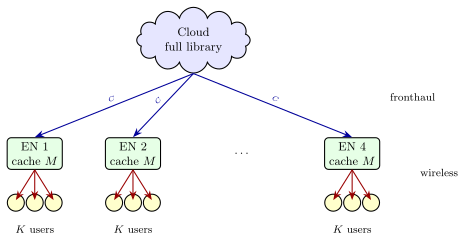
Cloud-RAN Topology with Edge Caching
Definition: Aggregate Caching Gain
Aggregate Caching Gain
In the cloud-RAN model, the aggregate caching gain is This plays the same role as in the shared-link model: it measures how many library copies are distributed across the EN caches. If , the full library is cached at the edge and no fronthaul is needed.
The distinction from Chapter 2 is that caches are at the ENs, not at individual users. Users can be served by multiple ENs; ENs can serve multiple users. This changes the delivery-phase structure and the converse bounds.
Example: A Netflix-Edge CDN Thought Experiment
A 5G mid-band cell has RRUs serving users during peak. Library size titles, per-RRU cache (10%). Fronthaul capacity files/use (asymptotically, at high SNR). Compute the aggregate caching gain and discuss cache-vs-fronthaul sufficiency.
Aggregate caching gain
. Less than 1: most demand must come from fronthaul. Specifically, only 40% of the library is cached at the edge in aggregate (since different ENs may cache different content).
Fronthaul sufficiency
Demand per channel use: (1 file) = 50 files. Without cache: fronthaul carries 50 files/use; per-EN × = 20 aggregate files/use available. Not enough: 30 files/use shortfall → delivery impossible within one channel use. With cache (assuming worst-case alignment): effective fronthaul demand files/use. Aggregate fronthaul (20) roughly meets demand — the cache makes the system feasible.
Engineering takeaway
The cache-fronthaul tradeoff is operationally real. A 10% cache per RRU converts an infeasible cloud-only design into a workable system. More cache (or more fronthaul) improves latency further.
Definition: Delivery Time
Delivery Time
The delivery time is the number of channel uses required to deliver the demanded files to all users. It depends on SNR: higher SNR allows higher-rate coding, shorter delivery. For a baseline system (no cache, unicast, fronthaul), the delivery time is — the single-user MU-MIMO baseline.
Delivery time is a natural latency metric but is SNR-dependent. The NDT (defined next) normalizes it to remove the SNR dependence and focus on the cache-fronthaul tradeoff.
Why This Matters: From C-RAN to Fog Massive MIMO
The C-RAN model is tightly related to fog massive MIMO, a 6G architecture where many ENs cooperatively serve users with both caching and distributed precoding. The CommIT group's ongoing work (Lampiris-Caire-Bhattacharjee 2022+) treats this as a generalization of Chapter 5's Lampiris-Caire scheme with additional fronthaul constraints. The NDT framework provides the analytical language.
C-RAN and Fronthaul in 5G NR
Deployed 5G NR C-RAN systems:
- Fronthaul types. CPRI (legacy) is 10-25 Gbps per RRU but rigid. eCPRI (Rel-15+) is more flexible, 25-100 Gbps with IP encapsulation. Open Fronthaul (ORAN) uses eCPRI + O-RU interface.
- Functional split. 7.2x split (ORAN standard) keeps iFFT at RU; 6 split keeps MAC at DU; 2 split (PDCP-RLC) is most cloud-heavy.
- Caching extensions. 3GPP Rel-17 added cache support at DU/CU levels. Rel-18+ study items include cache-aided multicast.
- Fronthaul economy. At Gbps per RRU, cache at the DU/RU can reduce backbone load substantially for popular content. Video-heavy traffic (70% of mobile) is the main target.
The NDT framework informs architectural decisions: what fraction of storage should be at RRU (fast access) vs. DU (cheaper, slower) vs. cloud (coldest)?
- •
5G NR eCPRI fronthaul: 25-100 Gbps per RU
- •
ORAN 7.2x split: iFFT at RU, rest in DU
- •
Cache at DU levels: O(10 TB) typical
- •
Cache at RU levels: O(100 GB) typical (smaller, faster)