Combining Coded Multicasting with D2D
Can We Have Both?
Chapter 2 showed that coded multicasting provides a factor improvement in single-server content delivery. Chapter 10 showed that D2D caching alone delivers per-user throughput via spatial reuse. A natural question:
If we combine both mechanisms — use MAN-style coded delivery within D2D clusters — do the gains multiply? Intuitively, one might hope for a throughput of — superlinear in .
The Ji-Caire-Molisch 2015 answer is more subtle. At the scaling- law order, the two gains do not cumulate. Both the uncoded and coded schemes achieve per-user throughput; the coded scheme improves only the constant factor, not the order. This is a surprising result that deserves careful explanation.
Definition: Coded D2D Caching Network
Coded D2D Caching Network
A coded D2D caching network is a D2D network (Chapter 10) with two modifications:
- MAN-style placement. Users cache according to the MAN combinatorial scheme (within local clusters of size ). Each file split into subfiles; each user caches of them.
- Coded XOR delivery. On demand, neighbors exchange XORs of subfiles (following the MAN delivery pattern) instead of unicasting raw content.
The interference model, random demands, and scaling assumptions are the same as in Chapter 10.
"Local cluster" means a set of users within D2D range of each other, so that MAN delivery can be executed with all users participating. Typically for random deployments.
Coded D2D Delivery Protocol
Complexity: Per cluster: XOR transmissions. Across clusters: clusters, each running in parallel with spatial reuse. Total time: dominated by per-cluster cost.The key design parameter is the cluster size . Larger gives larger MAN gain per cluster but requires more transmissions per cluster (worse scaling in cluster).
Coded D2D clustered topology
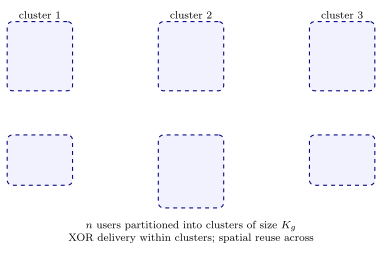
The Two Mechanisms in Tension
Let us name the two gain mechanisms clearly:
Spatial reuse (Gupta-Kumar / Ji-Caire-Molisch 2016): concurrent short-range D2D links can coexist. Each link has capacity . Aggregate throughput: . Per-user: — if every user has content in a neighbor's cache.
Coded multicasting (Maddah-Ali-Niesen): within a group of users sharing cached content, one coded XOR message simultaneously serves users. Gain factor per cluster.
If we naively multiply: . But this is not right. The issue is that the mechanisms compete for the same resource: concurrent transmissions. A cluster running MAN uses its airtime internally; it cannot also be silently coexisting with concurrent external transmissions.
The correct analysis: per-cluster throughput scales as but per-cluster airtime scales as messages. Normalized: effectively per user. The MAN gain is "absorbed" into the coding overhead at the scaling order.
Example: Cluster-Size Design
In a D2D network of users, , choose cluster size . Compare throughput scaling for each.
$K_g = 10$
Per-cluster MAN gain: . Per-cluster airtime: XOR messages per delivery round. Number of clusters: . With spatial reuse across clusters: aggregate throughput . Per-user: — constant factor 2 above uncoded.
$K_g = 50$
MAN gain: . Airtime: — astronomical. In practice subpacketization bounds the feasible cluster size.
$K_g = 100$
MAN gain: . Subpacketization astronomically large; infeasible.
Practical choice
The sweet spot is moderate — enough to capture the coded gain, not so large that subpacketization kills it. Typically - in practice.
Key Takeaway
Coded multicasting and D2D spatial reuse are in tension at the scaling-law level. Cluster-based MAN within a D2D network improves the constant factor but not the scaling order. The order is for both uncoded and coded schemes. The coded scheme wins on the constant — a practically meaningful but not asymptotically dominant gain.