The Demand Privacy Model
Why Privacy Matters in Coded Caching
Traditional coded caching has a subtle privacy issue: in the MAN delivery, each user must know the full demand vector to decode its own file. User 1 XOR-cancels using from its cache — but to do so, it must know the file index . User 1 therefore learns what users 2, 3, ..., K are watching.
For a CDN operator, this may seem innocuous (users knowing each other's anonymous demands). But in real deployments, demands can reveal personal information: viewing habits, medical searches, political preferences. Information-theoretic privacy requires that the delivery mechanism leaks zero information about others' demands to any individual user.
Remarkably, the Wan-Caire CommIT result shows that demand privacy can be achieved at zero rate cost in the shared-link setting. The MAN rate remains achievable, with privacy added via shared randomness. This is the central message of Chapter 12.
Definition: Information-Theoretic Demand Privacy
Information-Theoretic Demand Privacy
A coded caching scheme achieves demand privacy if, for every user , the received delivery message together with user 's cache and own demand is statistically independent of the other users' demands : Equivalently: user 's posterior over given its observations equals the prior.
This is a strict information-theoretic privacy definition. No amount of computation can reveal from and . It is stronger than cryptographic privacy (which only limits polynomial-time adversaries).
Definition: Adversary Models
Adversary Models
The privacy guarantee depends on who the adversary is:
- Single-user adversary. One user tries to learn from its cache + received message. (Most common setting; Wan-Caire 2021.)
- Coalition of colluding users. A group , , jointly tries to learn demands of non-colluding users. (D2D setting; Wan-Sun-Ji-Tuninetti-Caire.)
- Server adversary. The server itself tries to learn users' demands. In the shared-link model, the server has the demand vector by construction, so this is not applicable. In D2D or cloud-RAN models, it can matter.
- Eavesdropper adversary. An outside observer who sees the broadcast messages but not any cache. Simpler to analyze; typically achieved by trivial encryption.
Chapter 12 focuses on (1) and (2) — the interesting cases.
Why the MAN Scheme Leaks
In the standard MAN delivery of Chapter 2, user 1's decoding of from requires knowing the indices . From these indices, user 1 learns exactly what other users are watching. Concretely:
- User 1 sees the message for .
- To recover , user 1 needs to XOR out and .
- User 1 knows which file each summand is (it read the "label" to find the right subfiles in its cache).
Hence the MAN scheme leaks to each user — not zero leakage.
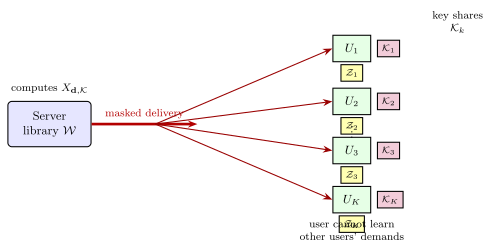
The Wan-Caire scheme avoids this by masking the summand labels with shared randomness. We develop this in §12.2.
Example: Quantifying Leakage in MAN
For , , under standard MAN delivery with user 1 observing and its cache, compute the leakage .
User 1's observations
User 1 sees all 3-subset XOR messages containing user 1, which involve all other users 2, 3, ..., 10 as "participants" — revealing their demands .
Leakage
.
Numerical
With 9 other users each choosing one of 100 files (independent, uniform): bits. User 1 learns ~60 bits about others' demands.
Wan-Caire private scheme
With the CommIT private scheme: leakage is reduced to 0 exactly. User 1 learns nothing.
Private coded caching setup
Key Takeaway
Demand privacy is free in the information-theoretic sense. The Wan-Caire 2021 result establishes that the MAN rate is achievable with zero leakage about other users' demands. The cost is only in the shared-randomness setup, which is asymptotically negligible for large file sizes. This is a remarkable positive result: privacy and rate are not in tension.
Information-Theoretic vs Cryptographic Privacy
A key distinction:
- Information-theoretic privacy. Adversary has unbounded computation. Security is absolute — no amount of computation can break it. Requires shared randomness as long as the private content.
- Cryptographic privacy. Adversary bounded to polynomial time. Security assumes hardness of some math problem (factoring, discrete log, etc.). Public-key encryption, RSA, etc. require no shared randomness but are breakable with enough compute.
Information-theoretic privacy is stronger but more expensive (shared randomness per message). For coded caching, the Wan- Caire scheme uses the fact that shared randomness is essentially free in the placement phase — users establish keys offline; keys cost no delivery bandwidth.
For applications where post-quantum security matters (where cryptographic assumptions might eventually fail), information- theoretic privacy is preferred despite the shared-randomness overhead.
- •
Shared randomness ~ K log(N) bits per delivery round
- •
Pre-distributed via key exchange (Diffie-Hellman typical)
- •
Wan-Caire achieves zero leakage with no delivery overhead
- •
Cryptographic schemes (AES, RSA) easier but break under quantum adversary