The Spectral-Efficiency Plane
A Map of All Communication Systems
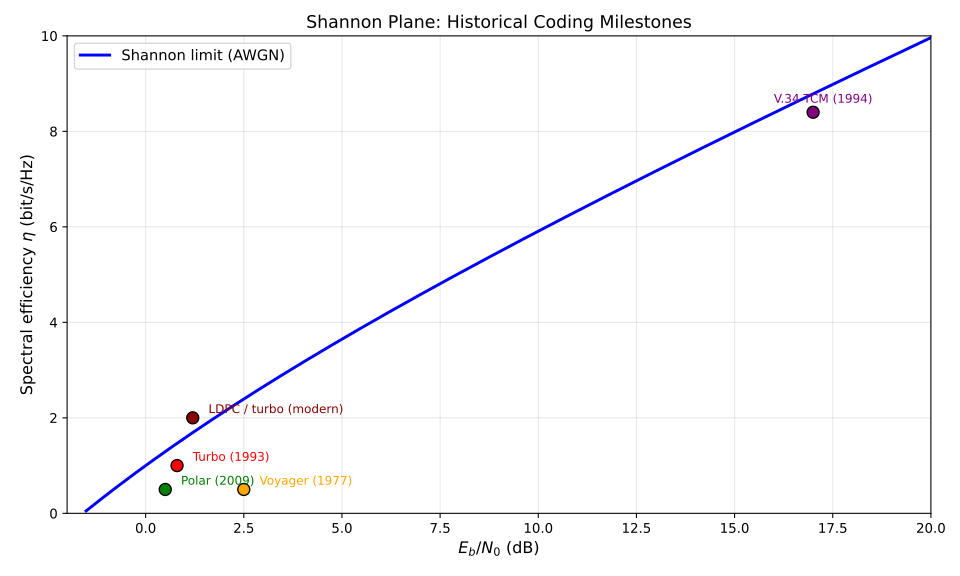
The point is that every bandwidth-limited coded-modulation scheme — BICM in LTE, turbo codes in 3G, orthogonal signaling for deep-space links, modem standards like V.34 — sits at a single point on a two-dimensional plane whose axes are spectral efficiency and required . This plane is bounded above by the Shannon limit, and every practical scheme is at some distance below it. The distance is what we call the gap to capacity, and the structure of this plane organizes more or less every design decision in digital communications.
Now here is the key observation: the Shannon curve partitions the plane into "achievable" and "not achievable" regions, but it is agnostic about what the scheme looks like. A point could be realized by countless schemes — what matters is only whether it lies below the curve.
Definition: The Shannon Limit on the Spectral-Efficiency Plane
The Shannon Limit on the Spectral-Efficiency Plane
Consider the real AWGN channel at spectral efficiency bits per 2D dimension. Writing and using , the capacity formula inverts to
This is the Shannon limit curve on the spectral-efficiency plane. A coded modulation scheme at efficiency requires an strictly greater than this value to achieve an arbitrarily small error probability.
Two asymptotic regimes:
- Power-limited. As , the limit approaches dB.
- Bandwidth-limited. As , the limit scales as , i.e., 3 dB of additional per extra bit/2D for large .
The Spectral-Efficiency Plane with Shannon Bound
The yellow curve marks the Shannon limit . Choose a target rate and an operating , and the marker shows where the scheme sits. Points to the left of the curve are impossible for any scheme of that rate; points to the right are achievable but leave gap to be closed by better coding. Toggle the 1 dB margin band to see the region where modern LDPC/turbo systems typically operate.
Parameters
Target spectral efficiency
Operating SNR
Theorem: The dB Limit
For any code achieving arbitrarily small error probability on the AWGN channel at spectral efficiency ,
Taking , the right-hand side approaches , which in decibels is dB. Hence no reliable communication is possible below dB of , at any spectral efficiency.
Think of this as saying that each bit of information requires at least joules of signal energy, no matter how much bandwidth you are willing to spend. This is the "ultimate currency exchange rate" between energy and information on a Gaussian channel, and it is why orthogonal signaling with repetition codes was the first coding scheme to come within 1-2 dB of capacity — it operates near .
Start from the capacity formula and substitute .
Invert to solve for as a function of .
Take the limit using (or equivalently L'Hôpital's rule).
Start from the AWGN capacity formula
The capacity per channel use is where . For reliable communication at rate bits per use we need , equivalently .
Convert to $E_b/\ntn{n0}$
Using , the condition becomes
Take the low-$\eta$ limit
As , expand . Dividing by gives
In dB: dB. For , the limit is strictly larger than , and grows without bound as .
Example: Locating Classic Schemes on the Plane
Compute the required Shannon for an AWGN channel at each of the following spectral efficiencies, and compare with a common target for modern wireless: uncoded, or modestly coded.
(a) bit/2D (e.g., uncoded BPSK benchmark). (b) bits/2D (uncoded QPSK, or rate- code on 16-QAM). (c) bits/2D (uncoded 16-QAM, or rate- code on 256-QAM). (d) bits/2D (uncoded 64-QAM).
Evaluate the Shannon limit at each $\eta$
Using :
| (bits/2D) | dB | |
|---|---|---|
| 1 | 1 | 0.00 dB |
| 2 | 1.5 | 1.76 dB |
| 4 | 3.75 | 5.74 dB |
| 6 | 10.5 | 10.21 dB |
Compare to uncoded performance
Uncoded BPSK needs dB of for , uncoded QPSK the same, uncoded 16-QAM dB, and uncoded 64-QAM dB. The gap to capacity is therefore roughly dB respectively — this is the budget that coding and shaping will have to recover. Notice that the gap is largest around QPSK and smallest at very high-rate constellations.
Read off the operational takeaway
In the bandwidth-limited regime (), uncoded QAM sits at 7-8 dB above capacity. A strong LDPC plus a well-chosen QAM order can close this gap to about 1 dB; the remaining 1 dB requires shaping. In the power-limited regime (), the uncoded gap is 10+ dB and is reduced by powerful binary codes that expand bandwidth — a qualitatively different design.
Locations of Historical Coding Milestones on the Spectral-Efficiency Plane
Historical Note: Shannon's 1948 Paper and the Curve That Changed Communications
1948Claude Shannon's A Mathematical Theory of Communication (1948) established the capacity formula for the bandlimited AWGN channel as part of a broader program that also introduced entropy, mutual information, and the notion of a channel code. For two decades after its publication, coding theorists worked primarily in the power-limited regime — the regime in which Shannon's limit is most dramatic, because the gap between uncoded and capacity is more than 10 dB. It took until Ungerboeck's 1982 paper on TCM before the bandwidth-limited regime received a coding-theoretic treatment at the same depth, and until the 1993 invention of turbo codes before within-1-dB-of-capacity became routine. The spectral-efficiency plane as a diagnostic tool crystallized in the Forney-Ungerboeck 1998 review, which remains the canonical reference.
Common Mistake: Capacity per channel use vs. capacity per second
Mistake:
Confusing in bits per channel use with capacity in bits per second, or conflating the two notions of "spectral efficiency" (bits/2D vs. bits/s/Hz).
Correction:
The expressions bits per channel use and bits/s describe the same channel; the second is just the first multiplied by the symbol rate. For a system using two real dimensions per complex symbol at one symbol per Hz, bits/2D equals bits/s/Hz numerically. For real-baseband systems or systems with fractional pulse-shaping rolloff, be careful: the conversion between "per dimension" and "per hertz" depends on how the spectrum is counted.
How Standards Populate the Spectral-Efficiency Plane
An LTE/NR MCS table is a discrete approximation of a small region of the spectral-efficiency plane. Each MCS index selects a constellation and an LDPC code rate, yielding an operating pair. Good table design produces approximately equal 0.5-1 dB vertical spacing between adjacent MCS entries so that link adaptation can track channel variation in finite steps without wasting too much of the fast fading budget. The table also encodes a latency-vs-reliability tradeoff: lower MCS entries carry extra redundancy for HARQ retransmissions, while higher entries are thinner codes used when the channel is known to be good.
- •
5G NR Rel-15 Table 5.1.3.1-1 covers MCS indices 0-27 spanning to bits/s/Hz
- •
Each MCS corresponds to a spectral-efficiency-plane point; adaptive MCS selection is a quantized linkage between channel estimate and this plane
- •
Outer HARQ and CQI reporting control the vertical granularity of the linkage
Key Takeaway
The plane (spectral efficiency, ) is the dashboard of coded modulation. The Shannon curve cuts it in two; the target is to sit as close as possible to the curve at your chosen . Power-limited systems live on the flat part near dB; bandwidth-limited systems live on the steep part where each extra bit of costs 3 dB. Coding gain measures how much of the 7-10 dB uncoded gap you can recover.
Shannon limit
The minimum that any scheme transmitting reliably at spectral efficiency bits per 2D dimension must satisfy: . Tends to dB as and grows as for large .
Related: Capacity Gap, Coding Gain, Spectral Efficiency
Quick Check
A turbo code operating at bit/2D achieves at dB. How far is this from the Shannon limit at the same ?
about dB, i.e., below capacity
about dB from capacity
about dB from capacity
about dB from capacity
At , , which is dB. Operating at dB of puts the scheme exactly 1 dB above the Shannon bound — a textbook near-capacity result.
Why This Matters: Link Adaptation as Walking Along the Shannon Curve
When the wireless channel varies over time, the base station adapts by moving its operating point along the spectral-efficiency plane: at high channel SNR it selects a high- MCS to extract more bits, at low SNR it drops to a lower and trusts the stronger code. The trajectory traced by link adaptation is (in steady state) a shadow of the Shannon curve — the system follows the capacity curve at a fixed 1-2 dB below it, so long as the channel estimate is reliable. This is what we mean operationally when we say that modern wireless systems are "within 1 dB of capacity."