Signal-Space Detection and the Minimum-Distance Decoder
Why Signal Space?
Continuous-time passband signals live in — an infinite-dimensional Hilbert space. Detection in such a space looks hopelessly abstract. The key structural result of this section is that only an -dimensional subspace matters. By projecting the received waveform onto an orthonormal basis of this subspace, we reduce detection of waveforms in function space to detection of vectors in (or ) — the latter is exactly the setting of Section 3.1. This reduction is the theoretical backbone of every digital demodulator.
Definition: M-ary Signal Detection in AWGN
M-ary Signal Detection in AWGN
Let be a finite set of finite-energy real (or complex baseband) waveforms on with . Under the received signal is where is white Gaussian noise with two-sided PSD . The average symbol energy is and the SNR is .
The signals need not be orthogonal and need not have equal energy; we will handle the general case below.
Theorem: Existence of an Orthonormal Signal-Space Basis
For any set of finite-energy waveforms there exist orthonormal functions with such that each can be written as and the map is an isometry: . The dimension equals the rank of the Gram matrix .
This is exactly the Gram-Schmidt procedure from finite-dimensional linear algebra, applied in the Hilbert space . The isometric embedding means that inner products, norms, and distances all survive the reduction from waveforms to vectors.
Construct basis by Gram-Schmidt
Set (assuming ; otherwise skip). For define If , let ; otherwise skip (this lies in ). The collection with is orthonormal by construction.
Expand each $s_m$ in the basis
By construction , so with coefficients . The matrix of coefficients has rank .
Isometry
By Parseval, . Likewise inner products are preserved: .
Theorem: The Projection Vector is a Sufficient Statistic
Define the projection coefficients for and the "tail" process . Then and is independent of and has the same distribution under every . Consequently is a sufficient statistic for detection: no decision rule using the full waveform can outperform the optimal rule based on .
White noise has independent components in any orthonormal basis. The "in-subspace" components carry all the signal information; the infinitely many "out-of-subspace" components carry only noise whose distribution is identical under every hypothesis — hence irrelevant.
Gaussianity of projections
The map is a continuous linear functional on a Gaussian process, so is jointly Gaussian under each hypothesis. Its mean under is and its covariance is .
Independence from the tail
Similarly, is a Gaussian process and for any and , after straightforward expansion, using the white-noise covariance . Jointly Gaussian and uncorrelated implies independent.
Sufficiency via Neyman-Fisher factorization
The density of (interpreted via Radon-Nikodym with respect to the reference white-noise measure) factors as where depends on only through and does not depend on . The Neyman-Fisher theorem then gives sufficiency of .
Definition: Minimum-Distance (ML) Decoder
Minimum-Distance (ML) Decoder
Under the sufficient statistic with , the ML decision rule is — i.e., decide in favor of the constellation point closest in Euclidean distance to the received vector. With equiprobable signals of equal energy , this is also the MAP rule.
Expanding the squared distance gives an equivalent correlator form: . When energies are unequal the term is the energy correction.
Example: QPSK: Decision Regions and Equivalent Scalar Statistic
Apply the minimum-distance decoder to QPSK with and for . What are the decision regions, and how does the decoder simplify?
Equal-energy constellation
All four points have , so the decoder reduces to , which is an angular decision: the angle of is quantized to the nearest .
Voronoi cells
The four perpendicular bisectors meet at the origin and split the plane into four quadrants: , etc.
Separable I/Q detection
Because the boundary lines are the coordinate axes, the decision reduces to sign decisions on and separately. QPSK is therefore two parallel BPSK channels, and its symbol error probability follows from the BPSK result by a union bound (tight up to cross-errors).
Voronoi Decision Regions for 16-QAM
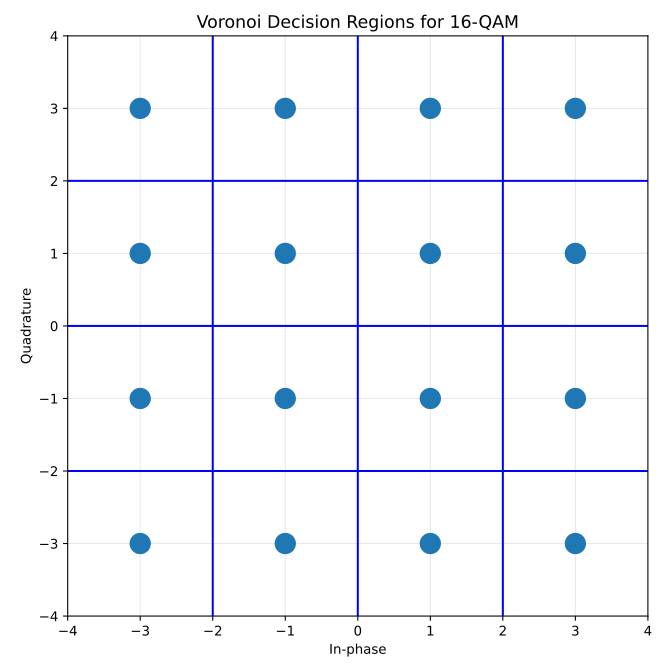
QAM Demapping Complexity and the I/Q Shortcut
A naive ML demapper for -QAM requires squared-distance computations per received symbol. For 1024-QAM (used in 5G NR with high-rank MIMO) this becomes prohibitive — multiplications per symbol at hundreds of millions of symbols per second. The key optimization: a square QAM constellation is the Cartesian product of two independent PAM constellations, so I and Q can be demapped separately in operations each, bringing the total to rather than . Modern soft-output demappers additionally use the max-log approximation to avoid exponentials.
- •
3GPP NR supports constellations up to 1024-QAM (Rel-17) — demapping must fit in microseconds per transport block
- •
Soft LLR output requires the second-nearest point per bit, not only the nearest
Received Samples and Minimum-Distance Decoder
Transmit random constellation symbols through an AWGN channel, color received samples by their ML decision, and compare against the true (transmitted) label to count errors. Adjust the SNR to see how the noise cloud shrinks and errors become rare.
Parameters
Common Mistake: Forgetting the Energy-Correction Term
Mistake:
A student writes the ML decoder as — correlation — and applies it to a non-uniform constellation like a PSK subset with amplitude-modulated symbols.
Correction:
Pure correlation is optimal only when is constant across . For unequal-energy constellations (e.g. APSK, amplitude-and-phase-shift keying) you must include the energy correction: . The geometric intuition: correlation finds the point with the largest projection, which biases decisions toward high-energy symbols.
Voronoi Cell
For a finite point set in Euclidean space, the Voronoi cell of is — the set of points closer to than to any other point in the set. ML decision regions for AWGN with equiprobable, equal-energy symbols are exactly Voronoi cells.
Related: Decision Region, Minimum Distance Decoder
Quick Check
Three orthogonal waveforms of unit energy are used for 3-ary signaling in AWGN. What is the dimension of the signal space, and what is the Euclidean distance between every pair?
,
,
,
,
Three orthogonal unit-energy vectors span a 3-D space, and the distance between any pair is .
Why This Matters: Signal-Space View of OFDM and CDMA
OFDM and CDMA are both instances of the signal-space framework with different basis choices. OFDM picks — complex exponentials separated in frequency. CDMA picks as time-translates of a PN sequence — separated in a code domain. The minimum-distance decoder of this section is then matched-filter demodulation in each case, and the analysis below applies directly.
See full treatment in Chapter 14