Steady-State Kalman Filter and the DARE
Why Steady State?
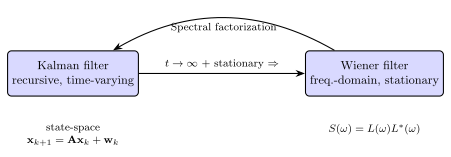
In the time-invariant LGSS model — , , , , all constant — the Kalman gain depends on only through , and the latter evolves through a deterministic matrix recursion (the Riccati recursion). Under mild conditions this recursion has a unique stable fixed point , and the gain itself converges to a constant . The steady-state Kalman filter uses this constant gain from the start: it is an LTI system, requires no on-line covariance computation, and — crucially — coincides with the causal Wiener filter for state-space signals. This is the bridge that unifies the frequency-domain machinery of Chapter 9 with the recursive machinery of Section 10.2.
Definition: Discrete-Time Riccati Recursion
Discrete-Time Riccati Recursion
For the time-invariant LGSS model, the prediction covariance satisfies the recursion This is the discrete-time (filter) Riccati recursion on the cone of positive semidefinite matrices.
The bracketed term is ; the outer conjugation by then pushes it forward, adding fresh process noise. Compactly, .
Definition: Discrete Algebraic Riccati Equation (DARE)
Discrete Algebraic Riccati Equation (DARE)
A positive semidefinite matrix is a solution of the DARE for the quintuple if A solution is stabilising if the closed-loop matrix is Schur-stable (all eigenvalues strictly inside the unit disc), where .
Theorem: Existence and Uniqueness of the Stabilising DARE Solution
Assume the pair is detectable and the pair is stabilisable. Then:
- The DARE has a unique positive semidefinite stabilising solution .
- For any initial condition , the Riccati recursion converges to as .
- The closed-loop matrix is Schur-stable.
Detectability guarantees that every unstable mode of is reflected in the observations, so the filter can eventually "see" and correct it. Stabilisability guarantees that the process noise excites every mode you need excited — i.e., there is no coordinate where the filter thinks it knows the state exactly while the truth drifts. Together, these two conditions are exactly what is needed to prevent the Riccati recursion from blowing up or from getting stuck on a degenerate fixed point.
Monotonicity from zero initial condition
Start from . The map defined by the right-hand side of the Riccati recursion is monotone: if then (this follows from the matrix inversion lemma and the concavity of the map on the PSD cone; see Exercise 9). So the sequence is monotone non-decreasing in the Loewner order.
Boundedness from detectability
Detectability gives an observer gain such that is Schur-stable. Plugging this suboptimal gain into the Joseph form produces a sequence that upper-bounds and converges to the solution of a Lyapunov equation — which is bounded. Hence is bounded above, and (monotone + bounded) implies it converges to some .
Identification as the DARE solution
Passing to the limit in the Riccati recursion gives that satisfies the DARE. Stabilising-ness of is a consequence of stabilisability: the closed-loop eigenvalues are the "antistable inverted" zeros of the symplectic pencil associated with the DARE, which lie strictly inside the unit disc when stabilisability holds.
Uniqueness
If and are two stabilising solutions, their difference satisfies a Stein (discrete-time Lyapunov) equation with two stable matrices; the unique solution of that Stein equation is . So the stabilising solution is unique.
Arbitrary initial condition
Comparison with both (monotone from below) and a suitable upper-bounding sequence shows that for any , the recursion is eventually squeezed between two sequences that both converge to .
Theorem: Steady-State Kalman Filter = Causal Wiener Filter
For the time-invariant LGSS model with detectable and stabilisable , the steady-state Kalman filter is an LTI system whose transfer matrix from to is and this transfer matrix equals the causal Wiener filter (in the sense of Chapter 9, Theorem 9.5) for the jointly stationary output and state induced by the model.
The Kalman filter is the causal Wiener filter — but expressed recursively in state-space form rather than through spectral factorization. This is why the Kalman filter is optimal in steady state even when judged against the broader class of linear filters allowed in Chapter 9: it is the optimal causal linear filter, just written differently.
Take z-transforms of the recursion
With constant gain , the filter's state evolution is The filtered output is . Taking -transforms yields the stated transfer matrix.
Causal Wiener solution matches
Apply the causal Wiener formula of Chapter 9 to , , where is the state covariance generating matrix. The spectral factorization of has the innovations-representation form (this is the content of the spectral-factorization theorem via Riccati, see Kailath §9.6). Substituting produces the same transfer matrix as in Step 1.
Convergence of the Riccati Recursion
The scalar Riccati recursion converges monotonically to a fixed point from both sides. The figure shows the recursion starting from several initial conditions and the staircase diagram revealing the map's structure.
Parameters
Example: Closed-Form Steady State for the Random Walk
For the scalar random walk of Example 10.2 (, , ), derive the steady-state prediction variance and the steady-state Kalman gain in closed form. Verify that the closed-loop pole lies inside the unit disc.
Set up the DARE
The scalar DARE reads which simplifies to , i.e., .
Solve the quadratic
Taking the positive root,
Steady-state gain and closed-loop pole
The gain is The closed-loop pole is . Since and , we have , so — inside the unit disc, as Theorem 10.5 guarantees.
Sanity limits
When : , , the filter converges to trusting the prior only (because there is no process noise to confuse things). When : , , the filter trusts the measurement completely. The non-degenerate trade-off lives at finite , and its closed form is exactly the formula above.
The Matrix Riccati Map Converges
Kalman-Wiener Duality Diagram
Common Mistake: Hidden Unstable Modes
Mistake:
A user applies the steady-state filter to an LGSS model in which has an eigenvalue on the unit circle (say a pure integrator) that is not reflected in . The filter "converges" to a steady-state gain but the true error covariance blows up.
Correction:
Before committing to the steady-state gain, verify detectability: for every eigenvalue of with , the matrix must have full column rank (PBH test). If not, the mode is undetectable and the DARE either has no stabilising solution or the "stabilising" one is inadequate — in practice the filter diverges in that subspace.
Quick Check
Under what conditions is the stabilising DARE solution unique?
Whenever is Schur-stable
When is detectable and is stabilisable
Whenever
Whenever the initial condition is
Correct. These are the standard sufficient conditions from Theorem 10.5.
Historical Note: Who Was Riccati?
18th century + 1960sJacopo Francesco Riccati (1676–1754) was a Venetian count and mathematician who studied the scalar nonlinear differential equation — what we now call the Riccati equation. The matrix generalisation governing optimal control and filtering is only indirectly Riccati's: Kalman and others christened it so because the quadratic structure mirrors the scalar case. It is a delightful coincidence that the same equation governing the solution curves of an 18th-century calculus problem also dictates the optimal gain of a 20th-century aerospace navigation filter.
Key Takeaway
For time-invariant LGSS models, the Riccati recursion contracts to a unique PSD fixed point under detectability + stabilisability. The resulting constant-gain filter is an LTI system and coincides exactly with the causal Wiener filter for the state-space signal. Kalman and Wiener are not rivals — they are the same estimator in different clothes.