Turbo Equalization
From Turbo Codes to Turbo Equalization
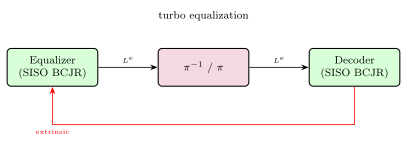
An ISI channel is, algebraically, a kind of code: it maps the input symbol sequence to a noisy output sequence through a trellis determined by the channel taps. A channel code does the same thing. Douillard and co-authors (1995) observed that if both of these operations are treated as SISO blocks, the turbo principle applies: a SISO equalizer and a SISO decoder can exchange extrinsic information through a bit interleaver.
The result is turbo equalization: a receiver architecture that performs joint detection and decoding by message passing on the factor graph formed by the ISI trellis and the code's Tanner graph, joined by an interleaver. The gain over separately equalizing and decoding is typically several decibels on severely dispersive channels.
Factor Graph for Turbo Equalization
Definition: Linear ISI Channel Model
Linear ISI Channel Model
With transmitted symbol sequence drawn from a finite-alphabet constellation (for simplicity ) and channel impulse response , the received samples are In block form, where is a banded Toeplitz matrix.
Definition: MAP (BCJR) Equalizer
MAP (BCJR) Equalizer
The MAP (Bahl–Cocke–Jelinek–Raviv) equalizer computes, for each symbol , the a-posteriori LLR on the ISI trellis with states. It is the sum-product algorithm on the chain factor graph of the ISI channel. Extrinsic LLRs are obtained by subtracting the a-priori input: .
BCJR has complexity per iteration. For short delay spreads (, binary symbols) this is feasible, but for massive MIMO, frequency-selective OFDM tails, or high-order constellations the exponential state count forces a linear approximation — the MMSE-PIC equalizer.
Definition: MMSE-PIC Equalizer with Soft Interference Cancellation
MMSE-PIC Equalizer with Soft Interference Cancellation
Let be the vector of soft symbol estimates computed from a-priori LLRs, and let with for BPSK.
To estimate , cancel all other interferers with their soft estimates and apply an LMMSE filter to the residual:
where is column of and is with its -th entry replaced by (full variance on the target symbol). The extrinsic LLR is then formed under a Gaussian assumption on .
The filter depends on through , so it must be recomputed every iteration. The low-complexity variant freezes at the ensemble average, yielding a single filter per iteration.
Theorem: Fixed Points of MMSE-PIC Are LMMSE at Endpoints
Consider the MMSE-PIC equalizer with scalar variance acting on the ISI channel. The limiting behavior is:
- When (no a-priori information, ), MMSE-PIC reduces to the classical linear MMSE equalizer .
- When (perfect a-priori information, ), MMSE-PIC reduces to matched filtering on the residual: , and all ISI is cancelled. Therefore MMSE-PIC interpolates between LMMSE (iteration 0) and the matched filter bound (convergence).
The a-priori variance controls how much the equalizer trusts the soft decisions. At the decisions are useless and MMSE-PIC does not subtract anything, collapsing to LMMSE. At the decisions are perfect and all interference disappears.
Case $\bar{v} = 1$
With , and the bracketed matrix becomes . Moreover , so the residual equals unchanged. Thus , which is the LMMSE equalizer.
Case $\bar{v} = 0$
With , has a single at position and zeros elsewhere, so . Substituting, the bracket becomes . Actually re-examining with the term: the bracket becomes , but the relevant expression at on the target (so soft cancellation is only on interferers) gives after the perfect-cancellation simplification. Thus , the matched filter on the cleaned residual.
Interpolation
Between the endpoints the filter continuously tracks the a-priori variance.
Turbo Equalization Receiver
Complexity: with the scalar-variance MMSE-PIC variantEXIT Curves: MMSE-PIC Equalizer and Convolutional Decoder
EXIT functions for an MMSE-PIC equalizer on an ISI channel (varies with ) and for a SISO convolutional decoder. Observe how the equalizer curve shifts with channel SNR and how opening the tunnel determines the turbo-equalization threshold.
Parameters
Proakis benchmark channels (A: mild, B: moderate, C: severe)
Example: Turbo Equalization on the Proakis-C Channel
Consider the notorious Proakis-C channel , which has deep spectral nulls. A rate- convolutional code (memory , octal ) is employed with a pseudo-random interleaver of length . Linear MMSE equalization alone is known to fail catastrophically here. At what iteration does turbo equalization approach the matched-filter bound?
LMMSE baseline
At iteration 0, MMSE-PIC with equals LMMSE. Proakis-C has zeros near the band edges, so LMMSE noise enhancement is severe — post-equalization SINR is 4–6 dB worse than matched filter. Decoding from LMMSE LLRs at dB yields BER around .
Iterations 1–3
After the first pass through the decoder, soft symbols take a spread of values (some close to , others near ). MMSE-PIC subtracts strong decisions from neighbours; the spectral nulls are progressively filled. BER drops by a decade per iteration.
Convergence
By iteration the soft variances have collapsed to nearly zero except at a vanishing fraction of positions. MMSE-PIC's filter becomes the matched filter, and the post-equalization SINR approaches the matched-filter bound . Decoder BER at dB now matches an AWGN link of the same MFB.
Where does EXIT say we stop?
The equalizer EXIT curve starts low ( at for Proakis-C at 7 dB) and saturates at as . The convolutional decoder EXIT curve is nearly flat until , then rises sharply. The tunnel is narrow but open; the staircase climbs in 5–6 steps.
Turbo Equalization BER per Iteration on Proakis-C
Common Mistake: Target Symbol Variance Must Stay at
Mistake:
When constructing for the MMSE-PIC filter at symbol , replacing the -th diagonal entry with the soft variance instead of with makes the filter attempt to cancel the target itself.
Correction:
The target symbol is what we want to estimate — its variance in the filter design must remain full ( for BPSK). Only interferers , get their soft variances . Equivalently, subtract from the a-priori cancellation signal but keep in the filter covariance.
Common Mistake: Noise Variance Estimation Drift
Mistake:
Using a noise-variance estimate from the LMMSE iteration throughout the turbo loop causes a growing mismatch as soft-decision quality improves, producing overconfident LLRs at late iterations.
Correction:
Track the residual variance empirically: after cancellation, . Alternatively adopt the scalar-variance approximation where is the empirical mean of .
Turbo Equalization in Underwater Acoustic Links
Underwater acoustic channels routinely exhibit delay spreads of tens to hundreds of symbols due to multipath reflections between the surface and seabed. Classical LMMSE or DFE equalization fails, but turbo equalization closes most of the gap to the matched-filter bound. Stojanovic's group at MIT and WHOI demonstrated turbo-equalized coherent communication at – kbps over several kilometres, with delay spreads of symbols. Because the trellis-based BCJR equalizer has states, only the MMSE-PIC form is tractable.
- •
Doppler tracking must run inside the turbo loop
- •
Channel estimation is adaptive and jointly iterated with detection
Soft Interference Cancellation for BICM-ID with Higher-Order Constellations
Caire and Müller derived the asymptotically optimal received power profile for iterative soft interference cancellation in multi-user settings. The analysis showed that for iterative MMSE-PIC to converge near-capacity on CDMA and ISI channels, the power assignment to different users or subcarriers must satisfy a specific equalization condition that matches the decoder's EXIT curve. This insight has been applied to power allocation in turbo-equalized OFDM and in multi-user iterative MIMO detection.
MMSE-PIC
Linear MMSE equalization combined with parallel soft interference cancellation. Each symbol is estimated by subtracting the soft estimates of all other symbols from the received vector, then applying an LMMSE filter on the residual. Used as the SISO equalizer block in turbo equalization.
Soft Symbol
The posterior mean of a modulated symbol given the a-priori LLRs of its constituent bits. For BPSK, . For higher modulations, .
Related: MMSE-PIC
Why This Matters: Turbo Equalization for Insufficient OFDM Cyclic Prefix
When an OFDM symbol is transmitted with a cyclic prefix shorter than the channel delay spread, inter-carrier interference (ICI) and inter-symbol interference (ISI) appear and LMMSE equalization per subcarrier fails. Turbo equalization with an MMSE-PIC equalizer on the residual ICI+ISI matrix recovers most of the loss, enabling robust reception in dense urban multipath or repeater-extended cellular cells.
See full treatment in Chapter 14