The Ziv-Zakai Bound
The Threshold Phenomenon
Many wireless estimation problems --- time-of-arrival, frequency, angle, Doppler --- exhibit a threshold effect: above a certain SNR, the mean squared error of the MLE follows the Cramer-Rao bound with remarkable accuracy; below that SNR, the MSE blows up toward the a priori variance of the parameter. The transition is abrupt, often spanning only a few dB, and it is invisible to the CRLB.
The reason is that the CRLB is a local bound --- it captures the curvature of the log-likelihood at the true , which corresponds to the main lobe of the ambiguity function. At low SNR, sidelobes of the ambiguity function dominate: the estimator mistakes one lobe for another, and the resulting gross error (an "outlier" that can be as large as the entire parameter range) dwarfs the local error the CRLB describes. This is the ambiguity regime.
The Ziv-Zakai bound captures exactly this phenomenon. It bounds the MSE by an integral of probabilities of error in binary hypothesis tests between neighbouring parameter values --- precisely the events that cause sidelobe confusion. At high SNR, the binary error probabilities are vanishingly small and ZZB asymptotes to the CRLB; at low SNR, they are order-unity and the bound explodes, matching the empirical threshold. For positioning and delay estimation, ZZB is the bound of choice whenever the CRLB looks suspiciously optimistic.
Definition: Minimum Error Between Parameter Hypotheses
Minimum Error Between Parameter Hypotheses
For two parameter values , consider the binary hypothesis test with equal priors. The minimum probability of error of the Bayes detector is In the Gaussian location model with common variance, .
This is exactly the detection problem of Chapter 1, now applied to pairs of parameter values as a diagnostic for how confusable they are given the observation model.
Theorem: Ziv-Zakai Bound (Bellini-Tartara Form)
Let be a scalar parameter with prior density of bounded support, and let be any estimator with finite Bayesian MSE. Then where is the valley-filling operator that replaces a function of with the smallest non-increasing function that upper-bounds it.
Think of the inner integral as a "confusion probability at separation ." At high SNR it decays rapidly with ; at low SNR it stays near for a long range, and that range contributes linearly to MSE via the factor in the outer integral. Valley-filling enforces monotonicity, which is necessary because the Chebyshev-like inequality underlying the bound requires a non-increasing integrand.
From MSE to tail probabilities
Start with . Taking expectations and interchanging order, The problem reduces to bounding from below for each .
Reduction to binary hypothesis testing
Fix and consider two parameters and . If is closer to than to when the true value is , we have . Averaging over weighted by , because any estimator gives a (possibly suboptimal) binary detector, and the Bayes detector achieves the minimum error.
Valley-filling for monotonicity
is non-increasing in , but the right-hand side of the previous step need not be. The tightest non-increasing lower bound is its valley-filled version . Substituting and using gives, after a change of variables, Combined with the first step, this gives the claim.
Remark on tightness
The bound is tight for the equi-prior Gaussian shift problem at both low and high SNR. At high SNR, a Taylor expansion of recovers the CRLB; at low SNR, the confusion probability saturates at and the bound reproduces the a priori variance, which is exactly the behaviour of the MLE in the ambiguity regime.
A Simpler Uniform-Prior Form
When is uniform on an interval of length and the likelihood is translation-invariant (so depends only on ), the inner integral evaluates to for , and the bound reduces to This is the form that appears in almost every practical application, from TOA estimation to delay-Doppler radar.
Example: Ziv-Zakai for Time-of-Arrival Estimation in AWGN
A transmitter sends a known pulse of bandwidth and energy . The receiver observes where is AWGN of PSD , and is uniform on an interval of length . Compute (and interpret) the ZZB for .
Binary error for two shifted pulses
The two hypotheses and correspond to pulses and . For translation-invariant matched-filter detection, the error probability is , where is the normalised autocorrelation of at lag .
Plugging into the bound
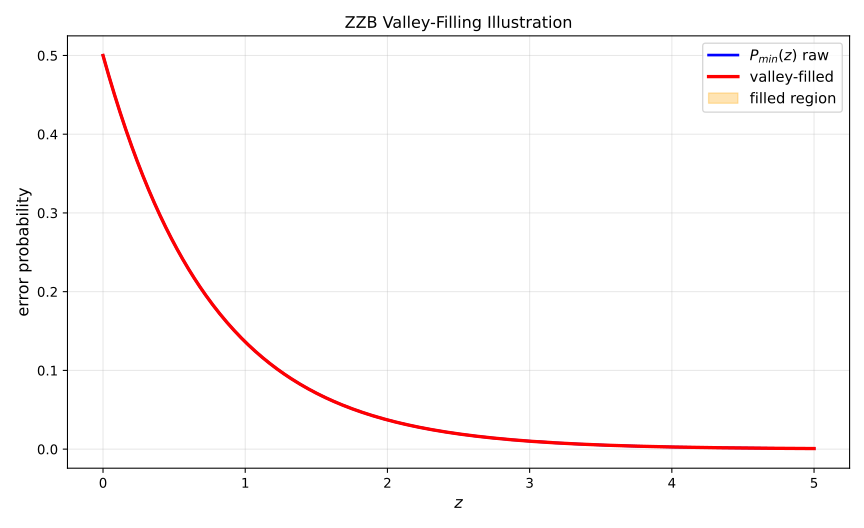
With a uniform prior and the simpler form, The valley-filling is the essential step: the raw oscillates as goes through its sidelobes, and valley-filling replaces those oscillations with a monotone envelope --- which physically captures the fact that a confusion at lag implies confusion at every sidelobe peak inside .
High-SNR asymptotic (CRLB regime)
For and small, where is the RMS bandwidth. Then , and the ZZB integral evaluates to --- exactly the CRLB for TOA estimation.
Low-SNR asymptotic (ambiguity regime)
When , for all , so --- the a priori variance of a uniform on . The bound recognises that at low SNR the estimator degenerates to "no better than a random guess within the support."
Ziv-Zakai vs. CRLB vs. Empirical MSE (TOA Estimation)
Sweep the signal-to-noise ratio for a bandlimited pulse with RMS bandwidth and uniform prior of width . The CRLB (red dashed) gives the slope but misses the threshold; the ZZB (blue) traces the threshold transition; empirical MSE of the MLE (green dots) follows ZZB closely. The threshold SNR is where the two bounds diverge.
Parameters
Prior support length (normalised units)
RMS bandwidth (normalised)
Animated Walk Through the Threshold Region
Why This Matters: 5G NR Positioning and the Threshold
3GPP Release 16 introduced positioning reference signals (PRS) designed to give cm-level accuracy with 100 MHz bandwidth. The CRLB analysis performed at the standardisation stage promised sub-metre accuracy everywhere --- but field trials showed a sharp threshold at around 0 dB SINR, below which the median error jumped to 10+ m. The explanation was the ambiguity regime: at low SINR, the maximum of the correlation magnitude landed on a sidelobe of the wideband PRS, producing an outlier several delay chips away from the true lag. ZZB analysis applied retroactively reproduced the observed threshold and is now the standard bound quoted in 3GPP positioning accuracy studies.
Why Radar Engineers Compute Both Bounds
A radar system is specified by a range-Doppler ambiguity budget, not by a single accuracy number. Engineers compute the CRLB to establish the in-lobe precision (a design parameter of the waveform's time- bandwidth product) and the ZZB to establish the threshold SNR (a coverage parameter). Failing to compute ZZB is how one ships a radar with glorious CRLB curves that becomes uselessly outlier-prone at the edge of its coverage cell.
- •
Compute ZZB over the full prior support, not just locally
- •
Use valley-filled binary error probability, not the raw curve
- •
Report the threshold SNR as the level where ZZB departs from the CRLB by 3 dB
Valley-Filling Illustration
Common Mistake: Forgetting the Valley-Filling Operator
Mistake:
Implementing ZZB by plugging the raw into the integral, obtaining a bound that oscillates with the autocorrelation sidelobes and is sometimes less than the CRLB.
Correction:
The valley-filling operator is essential --- it is what enforces to be non-increasing in , a property of any proper MSE tail. A numerical implementation applies a cumulative maximum to read from right to left, then integrates. Without valley-filling, the "ZZB" is not a valid lower bound.
Quick Check
For a uniform prior of width , which limit of the Ziv-Zakai bound is correct?
At very high SNR, .
At very low SNR, .
ZZB is always below the CRLB.
ZZB diverges at low SNR.
In the ambiguity regime, uniformly and , matching the variance of a uniform distribution and reflecting the estimator's inability to resolve within the support.
Historical Note: From a 1969 Letter to Modern Positioning
1969-presentJacob Ziv and Moshe Zakai published the original bound in a 1969 IEEE Transactions on Information Theory correspondence, motivated by waveform design for time estimation in radar. Carlo Bellini and Giorgio Tartara refined the bound in 1974 with the tighter valley-filled form we use today; Harry Bell, Joseph Steinberg and Yehoshua Shavit gave the modern general-prior formulation in the 1990s. ZZB sat in the radar literature for decades before being rediscovered by the wireless community when GPS and then 5G positioning made threshold effects a commercial pain point.
Threshold Effect
The abrupt transition of MSE from the CRLB-predicted slope to a saturated value as SNR decreases below a critical level. Caused by sidelobe ambiguity in nonlinear estimation problems; invisible to the CRLB, captured by the Ziv-Zakai bound.
Related: Ziv-Zakai Bound (Bellini-Tartara Form), Ambiguity Function, Cramer (1946), Rao (1945), and a Near-Simultaneous Discovery
Valley-Filling Operator
The operator that replaces a function of with the smallest non-increasing function that dominates it. Required in the Ziv-Zakai bound to enforce the monotonicity of the tail probability .