Channel Measurements: Sub-6 GHz and mmWave
Models Meet Reality: Channel Measurement Campaigns
All channel models in this chapter are validated against empirical measurements. Without measurements, models are untethered speculation. This section surveys what wideband MIMO channel measurements actually reveal at sub-6 GHz and mmWave — the two frequency regimes that define current 5G and near-future 6G deployments. The key message: the channel is fundamentally different at mmWave, and the design principles must adapt accordingly.
Sub-6 GHz vs. mmWave: Propagation Comparison
| Property | Sub-6 GHz (e.g., 3.5 GHz) | mmWave (e.g., 28 GHz) |
|---|---|---|
| Wavelength | cm | cm |
| Path loss exponent (NLOS) | – | – |
| Coverage range | Up to 2–5 km (macro) | 100–500 m (micro) |
| RMS delay spread | – ns | – ns |
| Angular spread (ASD) | – | – (sparse) |
| Number of clusters | – | – |
| Blockage sensitivity | Low (diffraction) | High (no diffraction) |
| Effective MIMO rank | Moderate (–) | Low (–) |
| Coherence bandwidth | kHz– MHz | – MHz |
| Doppler spread (60 km/h) | Hz | kHz |
| Penetration loss (concrete) | – dB | – dB |
| Dominant channel model | Correlated Rayleigh (Kronecker/one-ring) | Sparse geometric (few paths) |
Definition: Channel Sounding: Basic Measurement Methodology
Channel Sounding: Basic Measurement Methodology
A channel sounder measures the wideband channel impulse response by transmitting a known wideband probe signal and correlating the received signal. For MIMO channel sounding with transmit and receive antennas, sequential switching between antenna pairs measures the full matrix in approximately seconds.
Key measurement system parameters:
- Bandwidth : determines delay resolution
- Measurement repetition rate : must satisfy (Nyquist in time)
- Array aperture : determines angular resolution
- Dynamic range: needed path loss range (typically 80–110 dB)
What Sub-6 GHz Measurements Reveal
Key findings from large-scale sub-6 GHz massive MIMO measurement campaigns (Lund University, Bristol, Aalborg, TU Berlin, NYU):
1. Channel hardening and favorable propagation hold, but imperfectly: For and 12 single-antenna UEs, the measured effective SNR spread (channel hardening quality) was within 3 dB of the theoretical i.i.d. prediction. Favorable propagation held to within 6 dB of perfect orthogonality.
2. Spatial correlation is significant: Typical measured correlation coefficient between adjacent antenna elements at spacing: – in outdoor macro environments at 2.6 GHz.
3. Non-stationarity across large arrays: For arrays longer than 1 m (approximately 12 elements at 2.6 GHz), the channel statistics change measurably along the array — a precursor to the near-field effects in XL-MIMO (Chapter 17).
4. Capacity is model-sensitive: Using i.i.d. Rayleigh to predict sum-rate overestimates actual capacity by 15–40% in outdoor macro scenarios, depending on the angular spread distribution.
What mmWave Measurements Reveal
Key findings from mmWave channel measurement campaigns at 28 GHz, 39 GHz, 60 GHz, and 73 GHz (NYU Wireless, Samsung, Qualcomm, Ericsson, NTT DOCOMO):
1. Extreme sparsity: The number of significant propagation clusters is – in outdoor environments. The virtual channel often has fewer than 5 nonzero entries for a MIMO channel — meaning compressed sensing can recover the channel from as few as 10–20 pilots.
2. Severe blockage: The human body causes 15–30 dB attenuation. Vehicle blockage at 28 GHz causes link outages lasting 50–200 ms. This makes beam management a critical protocol function in 5G NR FR2 (Chapter 22).
3. Oxygen absorption at 60 GHz: At 60.0 GHz, atmospheric oxygen resonance causes dB/km additional attenuation — limiting outdoor range to m. This makes 60 GHz suitable only for backhaul or very dense indoor deployments.
4. Large arrays are not strongly correlated (on a per-element basis): Despite fewer paths, the small wavelength at mmWave means the array must be physically large (many elements) to achieve a given aperture. The correlation between elements at is similar to sub-6 GHz, but fewer effective channels coexist.
Coherence Time and Channel Aging in Massive MIMO
The coherence time constrains how long a channel estimate remains valid. For a UE moving at speed :
- Sub-6 GHz at GHz, km/h: Hz, ms.
- mmWave at GHz, km/h: Hz, ms.
For a 5G NR subframe of 1 ms with pilots:
- Sub-6 GHz: Pilot overhead (manageable).
- mmWave: Pilot overhead — significant.
This analysis explains why mmWave systems use beam-level tracking (slowly varying large-scale structure) rather than element-level tracking, and why angular-domain sparsity (few paths → few pilots needed) is critical for mmWave MIMO efficiency.
- •
5G NR FR1 (sub-6 GHz): coherence time ms at pedestrian speeds — standard TDD reciprocity works well
- •
5G NR FR2 (mmWave): ms at vehicular speeds — beam sweeping protocols essential
- •
3GPP requires beam management latency ms for UE mobility (TS 38.300)
Why This Matters: From Measurement to Massive MIMO Design Rules
The measurement findings above translate directly into massive MIMO design rules:
-
Sub-6 GHz outdoor macro: Use one-ring or Kronecker covariance with ASD 5–15°. Design precoding (JSDM) around the dominant eigenvectors of . Channel estimation benefits from covariance-based MMSE. Pilot contamination is a real problem — use covariance-based decontamination.
-
mmWave: Use sparse geometric model with paths. Compressed sensing estimation (Chapter 3) is feasible and necessary. Hybrid beamforming (Chapter 20) with RF chains is near-optimal. Near-field effects become significant for arrays larger than 5 cm × 5 cm.
-
Indoor: Use near-i.i.d. model (high angular spread). Pilot contamination is less severe but path loss limits range. Dense deployment of small arrays preferred.
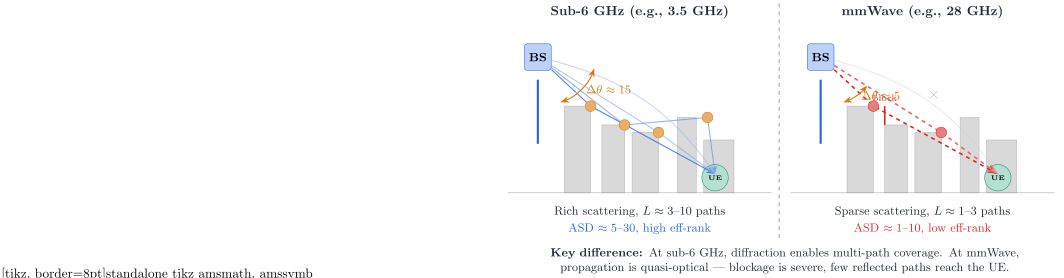
Sub-6 GHz vs mmWave Propagation Geometry
Common Mistake: Massive MIMO at mmWave Is Hybrid, Not Digital
Mistake:
Assuming that massive MIMO (large ) at mmWave uses fully digital processing with one RF chain per antenna, as in sub-6 GHz.
Correction:
At mmWave, the hardware cost and power consumption of fully digital architectures is prohibitive. A 64-antenna fully digital mmWave system at 28 GHz would require 64 ADC/DAC pairs at GHz sampling rate, consuming W in ADCs alone (vs W for the same at 3.5 GHz). In practice, mmWave massive MIMO uses hybrid beamforming with –16 RF chains and –256 antenna elements connected via phase shifters. The spatial multiplexing gain is limited to streams, not .
The sparse channel (few paths) aligns with this: with paths, RF chains are already sufficient to capture nearly all channel capacity.
Key Takeaway
Channel measurements are the ground truth. Sub-6 GHz outdoor channels are spatially correlated (ASD 5–15°, effective rank 3–10), confirming that the one-ring model is a reasonable approximation and that JSDM is practically motivated. mmWave channels are extremely sparse ( paths), making hybrid beamforming with a few RF chains near-optimal and compressed sensing channel estimation essential. The 3GPP TR 38.901 model captures both regimes with scenario-specific parameters.
Quick Check
At 28 GHz in an outdoor urban environment, a measured channel has dominant paths with angles of departure at and (in spatial frequency). For a ULA, approximately how many nonzero entries does the virtual channel have (per receive antenna)?
64
2 (approximately)
32
Each path concentrates energy in approximately one transmit angle bin. For paths and a 64-element ULA, the virtual channel has approximately 2 nonzero entries per receive antenna (plus some leakage to neighboring bins for off-grid paths).