Bello's Four System Functions
Four Views of the Same Channel
The discrete multipath channel is already a complete description. But depending on what we want to do with it — equalize, detect, estimate, sense — we want to look at it from different angles. Bello (1963) organized these angles into four equivalent functions, any two of which are related by a one-dimensional Fourier transform. The point is that the same channel looks simple in exactly one of these four views, and that view is the delay-Doppler spreading function — the subject of the next section. But to see why that is, we need all four pictures first.
Definition: Delay-Time Function (Time-Variant Impulse Response)
Delay-Time Function (Time-Variant Impulse Response)
The delay-time function is the time-varying impulse response: the output at time of the channel in response to an impulse applied at time . For a signal transmitted, the received signal is where is AWGN. The function captures how the channel's impulse response drifts with .
When the channel is time-invariant ( does not depend on ), this reduces to the familiar LTI convolution from Telecom Ch. 4.
Definition: Frequency-Time Function (Time-Varying Transfer Function)
Frequency-Time Function (Time-Varying Transfer Function)
Fourier-transforming with respect to the delay variable yields the frequency-time function: This is the "snapshot transfer function" at time : if we froze the channel at time , would be its frequency response. In OFDM, this is the coefficient that multiplies each subcarrier during one symbol.
Definition: Delay-Doppler Spreading Function
Delay-Doppler Spreading Function
Fourier-transforming with respect to the time variable yields the delay-Doppler spreading function: For the discrete multipath model, — a sum of Dirac impulses in the 2D delay-Doppler plane. This is the object around which the entire book is organized.
Definition: Output Doppler Spread Function
Output Doppler Spread Function
The fourth Bello function is obtained by Fourier-transforming with respect to time: This represents how each frequency component of the transmitted signal is spread in Doppler. It is related to by a Fourier transform in .
Theorem: Bello's Four-Function Diagram
The four system functions are connected by one-dimensional Fourier transforms: where is Fourier transform in delay (with conjugate variable ), and is Fourier transform in time (with conjugate variable ). All four functions are equivalent descriptions of the same channel.
Think of a 2D function indexed by . You can choose either variable in each slot, and moving across each axis swaps the two choices via a 1D Fourier transform.
Setup
Start from the definition . Apply (Fourier transform in delay): this is the definition of . Apply to : this is the definition of .
Commutativity
The two Fourier transforms act on independent variables, hence they commute: . Both expressions equal .
Inverses close the square
The inverse Fourier transforms provide the return arrows. Iterating around the square returns the original function, confirming self-consistency.
Bello's Four-Function Relationship Diagram
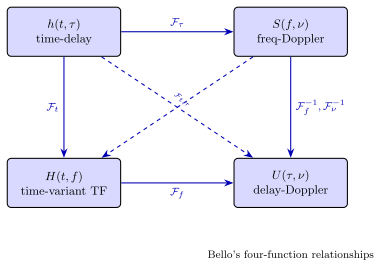
Example: The Four Functions of a Single Path
Consider a single path with complex gain , delay , and Doppler . Write down all four Bello functions.
Time-variant impulse response
By definition, the path produces a delayed, Doppler-rotating echo: Note the time-dependence is entirely in the phase .
Frequency-time function
Fourier-transform in : At every frequency the transfer function is a complex exponential in time — this is the channel's Doppler modulation, visible in the TF picture.
Spreading function
Fourier-transform in : A single Dirac impulse in the 2D plane. This is by far the simplest of the four representations — and it will be our workhorse.
Output Doppler spread function
Either route — of or of — gives For each Doppler, the transfer function is a pure exponential in .
When to Use Which Bello Function
| Function | Natural for | Pitfall |
|---|---|---|
| Physical modeling, ray tracing, system simulation | Time-varying — not diagonalized by any fixed basis | |
| OFDM / TF-domain analysis, subcarrier equalization | Loses the sparsity of the underlying channel | |
| OTFS modulation, DD-domain detection, sensing | Requires finite observation window; continuous-time idealization | |
| Doppler radar analysis, ambiguity function | Rarely used directly in communications |
Historical Note: Philip Bello's 1963 Paper
1963P. A. Bello, then at Adcom, Inc., published "Characterization of Randomly Time-Variant Linear Channels" in the June 1963 issue of the IEEE Transactions on Communications Systems — an astonishingly durable piece of work. Bello was motivated by the emerging need to model HF ionospheric and tropospheric scatter links, which were critical for long-range military communication before satellites took over. He did not foresee OFDM, let alone OTFS. What he did do was realize that the time-varying channel was best described by a family of functions related by Fourier duality, and that which member of the family one preferred depended on the physical question at hand.
The delay-Doppler spreading function was, for Bello, simply one corner of the diagram — useful for studying scatter-produced multipath in troposcatter links. Sixty years later, it would become the signal space of a candidate 6G waveform.
Why Is Time-Invariant
Notice a subtle but essential point: the spreading function has no time argument. Yet the physical channel is manifestly time-varying — reflectors move, paths come and go. How is this consistent?
The answer is that is the time-integrated signature of the channel over the observation window. Within that window, the channel's temporal variation is captured entirely by the Doppler axis . We trade a one-argument time-varying function for a two-argument static function . This is the same trick by which the Fourier transform converts a time-varying signal into a static frequency spectrum — except now we do it for the channel itself, and the "spectrum" is 2D.
Chapter 4 will show that input-output in the DD domain takes the form — a 2D convolution with a static kernel. This is precisely the formal sense in which OTFS turns a time-varying channel into a time-invariant one.
Common Mistake: Delay vs Time Ordering
Mistake:
Some references write — time-argument first — so that . This leads to sign confusion in Fourier transforms when converting between Bello functions.
Correction:
Throughout this book, and in the OTFS literature (Hadani 2017, Raviteja 2018), the convention is delay first: . Under this convention, the Fourier transform pair is via , and not (which would be a different function). When cross-referencing papers, always check the ordering convention before applying formulas.