The Scattering Function and WSSUS Channels
From Realizations to Statistics
The spreading function is a realization of the channel — a specific configuration of reflectors and velocities. For system analysis we also need statistics: the power distribution of a random channel ensemble, the typical delay spread, the typical Doppler spread. The right tool is the scattering function, which is simply the power spectrum of the spreading function. It is the object that underlies the WSSUS model used throughout fading analysis.
Definition: WSSUS Channel
WSSUS Channel
A time-varying channel is wide-sense stationary with uncorrelated scatterers (WSSUS) if, for all , The first property (wide-sense stationary in time) says that the channel statistics do not drift over the observation window. The second property (uncorrelated scatterers in delay) says that different paths are statistically independent. Together they give the spreading function a "white" structure in both and , with power density .
WSSUS is an idealization. Real channels have correlated scatterers (a single large reflector can span many resolution cells) and non-stationary behavior (moving from line-of-sight to non-line-of-sight). In OTFS analysis WSSUS is nonetheless the baseline assumption because it admits clean closed-form expressions.
Definition: Scattering Function
Scattering Function
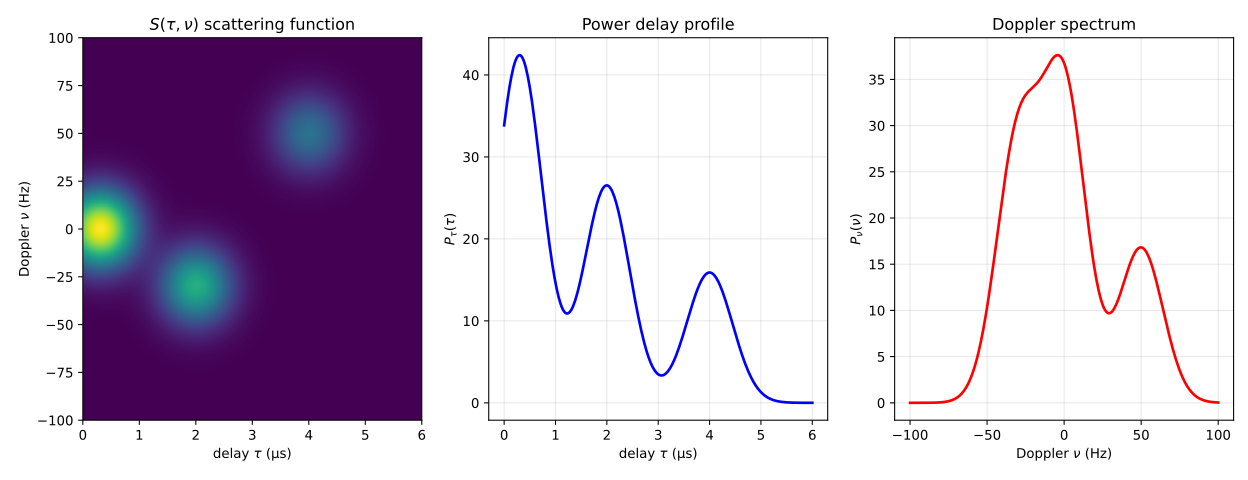
For a WSSUS channel, the scattering function is the joint power distribution of the channel in delay and Doppler: Marginalizing over Doppler gives the power delay profile (PDP): and marginalizing over delay gives the Doppler power spectrum:
Theorem: Fourier Relation Between Scattering Function and TF Correlation
For a WSSUS channel, the scattering function and the time-frequency correlation function form a 2D Fourier pair:
Power spectra and correlation functions are always Fourier pairs — this is the Wiener–Khinchin theorem. What is special here is that the "spectrum" lives in the 2D plane while the "correlation" lives in the 2D plane, because the channel is two-dimensional.
Start from the TF correlation
is related to by 1D Fourier transforms in both variables: (combining the two Fourier steps from Section 2).
Compute the correlation
Substitute into and exchange expectation and integrals.
Apply WSSUS
The WSSUS property collapses one of the double integrals, leaving exactly the claimed Fourier transform.
Scattering Function and Its Marginals
Explore how the power delay profile and the Doppler spectrum combine into a full scattering function . The two marginals specify the delay and Doppler spreads. When the scatterers are uncorrelated (WSSUS), the scattering function factors as . Vary the RMS delay spread and Jakes model parameters to see how coherence time and coherence bandwidth emerge.
Parameters
Definition: Coherence Bandwidth and Coherence Time
Coherence Bandwidth and Coherence Time
The coherence bandwidth is the frequency separation over which the channel transfer function is approximately constant: The coherence time is the time interval over which the channel is approximately constant: These are the Fourier duals of the delay and Doppler spreads.
Example: Coherence Time in a High-Speed Train
A high-speed train travels at km/h along a track at 5 GHz. What is the coherence time? How many OFDM symbols (subcarrier spacing kHz, symbol duration ) fit within one coherence time?
Doppler spread
Hz.
Coherence time
.
Symbols per coherence time
. The channel changes significantly within roughly 10–11 OFDM symbols. The point is that tracking a time-varying channel of this speed requires pilot symbols at least every symbols — a significant overhead. In the DD domain, by contrast, the same channel is described by a handful of triples that do not change at all over a full OTFS frame (typically – Doppler bins, or many hundreds of ). The point is that the DD representation is time-invariant by construction; the channel-tracking burden disappears.
Underspread vs Overspread Channels
A channel is called underspread if and overspread otherwise. Underspread channels allow classical TF-domain communication because the time-frequency cell fits many data symbols; overspread channels break OFDM entirely because ICI and ISI become simultaneously significant.
Typical parameters:
- Pedestrian at sub-6 GHz: , Hz. Product: — deeply underspread.
- Vehicular at 5 GHz: , Hz. Product: — mildly underspread.
- HST at mmWave: , kHz. Product: — stressed.
- LEO satellite at 10 GHz: ms (propagation), kHz. Product: — overspread. OFDM is fundamentally inadequate.
OTFS works in both underspread and overspread regimes because its analysis does not require the TF cell to fit the symbol — only that the DD grid resolution be finer than the channel's path spacing.
- •
Underspread condition: (Bello)
- •
LEO channels are overspread by orders of magnitude
- •
Coherence cell area
Power Delay Profile and Doppler Spectrum as Scattering Function Marginals
Why This Matters: Scattering Function in Telecom Ch. 6
The scattering function also appears in Telecom Ch. 6, where it is used primarily to derive coherence time and coherence bandwidth. There, the focus is on single-carrier and OFDM signaling — both of which use only the marginals of . OTFS is the waveform that actually signals directly on the full 2D support of .