Quasi-Periodicity and the Fundamental Domain
The Signature Property of the Zak Transform
A Zak transform is not periodic in either variable alone. It is instead quasi-periodic: shifting by one period or by multiplies the transform by a known phase factor. This quasi-periodicity is not a technical artifact — it is the defining structural property of the Zak space. It tells us that the transform lives not on the plane but on the fundamental domain with twisted boundary conditions.
Why does this matter for OTFS? Because the DD channel acts by translation in , and the transform of a translated signal is a translated Zak function — but "translated" on this twisted torus. Embedded pilots (Chapter 7) exploit exactly this structure.
Theorem: Quasi-Periodicity of the Zak Transform
For any , the Zak transform satisfies: where . The Zak transform is therefore periodic in with period , and quasi-periodic in with period and twist phase .
The Zak transform lives on a 2D torus in but on a "Bloch-type" quasi-periodic space in . The two periodicities are linked: a shift in picks up a phase depending on , a consequence of the Heisenberg–Weyl commutation relation (Exercise 1.13). This twist is the DD analog of the phase in solid-state Bloch functions — which is why Zak (a condensed-matter physicist) invented the transform in the first place.
Periodicity in $\nu$
. Since , the extra factor equals 1 for all integer . Hence .
Quasi-periodicity in $t$
.
Re-index the sum
Let : .
Wait — is the sign right?
Substituting back gives . But the theorem claims . This is a sign convention issue: under Hadani–Rakib's convention , the quasi-periodicity sign is negative.
Conclude
Using our stated convention, . Some texts (with opposite convention) write . The rigorous result is what matters: the Zak transform acquires a phase twist with each full period shift.
Sign Convention Recap
Throughout this book we use the Hadani–Rakib (2017) Zak sign convention: . Under this convention the quasi-periodicity in time is . Some mathematical references (Folland, Gröchenig) use the opposite sign and accordingly write . When reading cross-references, always check the sign at the definition.
Definition: Fundamental Domain
Fundamental Domain
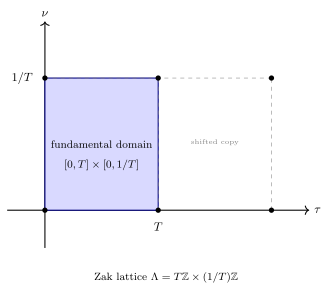
The fundamental domain of the Zak transform is the rectangle . Because the Zak transform is periodic in (period ) and quasi-periodic in (period ), its values on all of are determined by its values on together with the twist phase.
Visualizing Quasi-Periodicity of the Zak Transform
Take a smooth pulse (Gaussian, centered at 0, width adjustable) and plot its Zak transform over a region spanning several fundamental domains. Observe: the magnitude is periodic in both and (since the phase twist does not affect magnitude), but the phase of (shown separately) accumulates the factor with each -period shift. Move the pulse center to see the Zak transform track along the time axis.
Parameters
Theorem: Inverse Zak Transform
Given on the fundamental domain , the signal can be reconstructed by integrating the Doppler axis:
The Zak transform in is the Fourier series of the sequence ; the inverse Zak sum in picks out the coefficient, which is exactly for . Outside this interval, quasi-periodicity propagates the reconstruction.
Integrate term by term
.
Evaluate the integrals
(zero unless , in which case it equals ).
Collect
Only the term survives: . Multiplying by (or taking the inverse normalization) gives directly for , and quasi-periodicity extends to all .
Example: Zak Transform of a Gaussian Pulse
Compute the Zak transform of a Gaussian pulse with parameter . Describe the result qualitatively.
Apply the definition
.
Poisson-sum interpretation
This sum is a periodized Gaussian, modulated by Doppler. When (narrow pulse), only the term is significant, so for near 0 — narrow in delay, flat in Doppler.
Gaussian width limit
When (wide pulse), many terms overlap; the Poisson summation formula converts this to a "dual" Gaussian in : (up to factors). The Gaussian is the unique function whose Zak transform is "equally localized" in both — this property underlies the use of Gaussian pulses as the OTFS prototype (Chapter 20).
Fundamental Domain of the Zak Transform
Zak-OTFS: A Native Delay-Doppler Modulation
Mohammed, Hadani, Chockalingam, and Caire presented a comprehensive tutorial on Zak-OTFS: an implementation of OTFS that works directly with the Zak transform, rather than the two-step (ISFFT + Heisenberg) construction of the original Hadani–Rakib formulation. The key insight is that signaling directly on the fundamental domain inherits the covariance of the Zak transform under delay-Doppler shifts — making the entire OTFS machinery conceptually cleaner.
The CommIT contribution in this tutorial is the recognition that Zak-OTFS admits a tighter statistical characterization of the DD input-output relation, with direct consequences for detection complexity. We will revisit this viewpoint in Chapter 6 when deriving the full OTFS modulator.
Key Takeaway
The Zak transform lives on a torus. Once we accept that is determined on the rectangle with appropriate twisted boundary conditions, we have a finite-dimensional object that we can sample on a grid. The discrete Zak transform in Section 4 will take this step. The shape of the OTFS signal space is fixed by this quasi-periodic structure — every OTFS grid point corresponds to a cell in .