Continuous-Time DD Input-Output Relation
The Claim We Now Prove
At the end of Chapter 1 we stated — informally — that the delay-Doppler channel acts as a 2D convolution: This claim is the central structural result of OTFS — it is what makes OTFS "work." Every detector, every channel estimator, every ambiguity analysis relies on it.
The point is that we have, in Chapters 2 and 3, built precisely the tools this derivation needs: the Zak transform (which intertwines time-domain delay-Doppler shifts with translations on the DD plane) and the symplectic Fourier transform (which links DD and TF grids). The claim will now fall out directly from the Zak covariance.
Theorem: Continuous DD Input-Output Relation
Let be a transmitted signal passing through a time-varying multipath channel with spreading function , and let be the received signal plus AWGN. Denote their DD-domain representations (Zak transforms at period ) by and . Then where is the Zak transform of the AWGN process — itself a complex Gaussian random field on with per-cell variance matching the time-domain noise power.
For the discrete sum of Dirac paths, the relation simplifies to
Each physical path takes the transmit signal and produces a delay-Doppler-shifted and scaled copy at the receiver. In the time domain the shifts are multiplicative (phase rotations) and -dependent; in the DD domain, by the Zak covariance of Chapter 2, they become pure translations. The channel output is therefore a superposition of translated copies — the defining property of a 2D convolution.
This is the same symplectic-covariance argument we used in Chapter 3 to intertwine DD translations and TF modulations — the difference is that we now track the full channel action, not a single shift.
Time-domain channel action
The time-varying multipath channel maps input to output . Each path applies the delay-and-Doppler-shift operator (from TZak Transform of a Delay-and-Doppler-Shifted Signal): .
Apply the Zak transform
Apply to both sides. By linearity: .
Use Zak covariance
From Chapter 2, . The factor is a phase that depends on — it is the continuous-time artifact of the Zak twist. For the idealized bi-orthogonal pulse discussed in Chapter 2, this phase is absorbed into the redefinition (evaluated at the grid-point ); the equation then reads .
Recognize as 2D convolution
The sum is exactly the 2D convolution of with the discrete spreading function : . This gives the continuous-kernel form claimed in the theorem statement.
Pulse-shape corrections
For a non-ideal prototype pulse (typically rectangular with CP), additional off-grid phase factors appear and must be absorbed into effective complex gains . The structure — translated copies on the DD plane — is preserved. Pulse-shape corrections are treated rigorously in Chapter 20.
Key Takeaway
The DD channel acts by 2D convolution. This is the structural equivalent of "the LTI channel acts by 1D convolution with ." In the DD domain, the channel is a fixed, sparse 2D impulse response that does not depend on the running time . A detector designed against one location of the DD grid works for every other location — a uniform detector suffices.
Definition: 2D (Delay-Doppler) Convolution
2D (Delay-Doppler) Convolution
For functions on (or on the fundamental domain ), the delay-Doppler convolution is The operation is bilinear, commutative, associative, and has the 2D Dirac impulse as identity. For a channel whose is a sum of Diracs, the convolution reduces to a finite superposition of translated copies of .
The Convolution Is Doubly Circular on the Torus
The DD domain is the torus . Convolution on a torus is circular — shifts wrap around. The quasi-periodicity of the Zak transform (Chapter 2) manifests here as a phase twist picked up when a translated copy crosses the torus boundary.
For the discrete DD grid (Section 2 below) this twist is a cleanly defined index shift modulo (delay) and (Doppler), with associated phase factors. This is what the OTFS literature calls the "two-dimensional circular convolution on the DD grid."
DD Convolution of a Data Symbol With a Sparse Channel
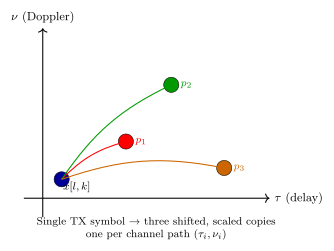
Place a single data symbol on the DD grid at . Define a three-path channel with taps at specified offsets. The 2D convolution produces three translated copies of the symbol at with amplitudes . Slide the symbol and watch the output track. The point is that the channel's structure — three spikes — is preserved; only its position changes with the input.
Parameters
Example: Input-Output for a Two-Path Channel
A transmitted DD signal has . The channel has . Compute the received DD signal and count the number of DD impulses in .
Apply the 2D convolution
. Each path of translates each impulse of : with .
Count impulses
Four pairs give four DD impulses in general position. If two pairs produce the same — the DD delay and Doppler sums coincide — the impulses collide and add coherently.
Comment
The support of has cardinality at most — the spreading function acts as an expander of sparse inputs. For OTFS, the transmit signal is supported on the whole DD grid (every cell carries a data symbol), so is also supported on the whole grid — but the per-cell value is a sum of at most contributions, which is the key structural fact.
DD Convolution: Three Paths Produce Three Translated Copies
Why This Matters: Why Detection Is Tractable
The 2D convolution structure of the DD channel is what makes OTFS detection feasible. The DD input-output matrix (Section 3) is sparse and structured — a block-circulant-with-circulant-blocks matrix — so message-passing, MMSE, and more sophisticated detectors can exploit the structure. In contrast, the TF-domain channel matrix under high Doppler is dense and non-structured, forcing either brute-force ML detection or heuristic approximations.