The DD Channel Matrix
From a Sum to a Matrix
The input-output relation of Section 2 can be written as , where is the DD channel matrix. This matrix form is what every linear detector (MMSE, ZF, matched filtering) takes as input, so we now write it out explicitly.
The point is that is not a generic complex matrix — it has two structural properties that detection algorithms exploit: sparsity (at most nonzero entries, not ) and block circulant structure (a consequence of the doubly-circular 2D convolution).
Definition: Vectorized DD Grid
Vectorized DD Grid
The DD grid matrix of size is vectorized column-by-column: Similarly and . The index mapping is for and .
Theorem: Structure of the DD Channel Matrix
With the column-major vectorization of the DD grid, the channel matrix is a sum of weighted shift-phase matrices: where is the Kronecker product, is the circular-shift (forward) permutation matrix, and is the diagonal modulation matrix encoding the Zak twist.
The matrix is:
- Sparse: exactly non-zero entries out of .
- Block circulant with circulant blocks (for integer-Doppler paths).
- Diagonalized by the 2D DFT: with diagonal — this is the ISFFT/SFFT structure of Chapter 3.
The Kronecker product decomposes into a "Doppler part" acting on the -dimensional Doppler axis, and a "delay part" acting on the -dimensional delay axis. Each axis is shifted circularly by the path index; the Doppler part also carries the Zak-twist phase because the delay shift crosses block boundaries of length in the vectorized representation.
Per-path action
From Theorem TDiscrete DD Input-Output Relation (Integer Doppler), path maps times the Zak-twist phase .
Vectorize
The -shift corresponds to multiplying by the Kronecker matrix . The -shift corresponds to multiplying by . Combined: .
Include the Zak twist
The phase depends only on whether the delay shift wraps, and across blocks. It combines into acting on the Doppler axis. Final: for Doppler, for delay.
Sum over paths
, confirming the claimed form.
Diagonalization
Each Kronecker shift is diagonalized by the 2D DFT (since each factor is diagonalized by its respective DFT). The sum is therefore also diagonalized — this diagonalization is the ISFFT of Chapter 3.
Sparsity Pattern of the DD Channel Matrix
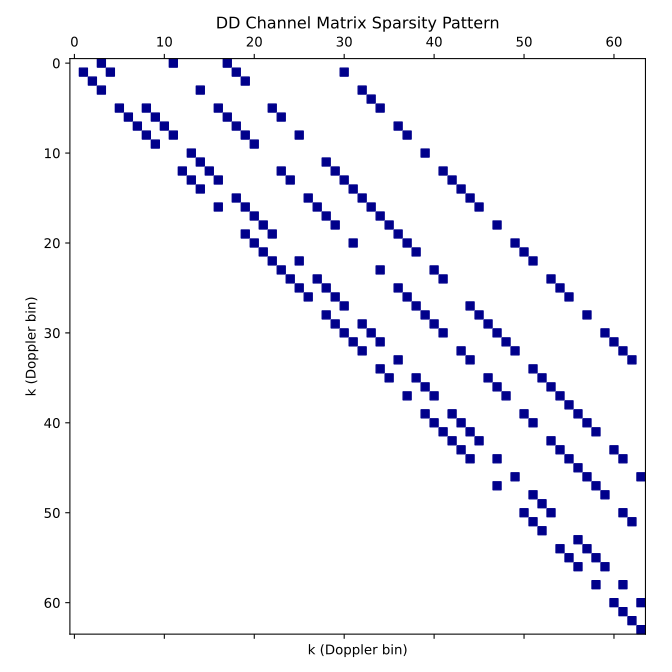
DD Channel Matrix Sparsity vs Channel Parameters
Visualize as a heatmap for a random -tap channel. Observe: (i) the matrix is sparse with diagonal bands, (ii) the bands correspond to path offsets, (iii) sparsity density equals . Vary and watch the density scale linearly.
Parameters
Example: Explicit Channel Matrix
For (so the DD grid has 8 cells), construct the DD channel matrix for a single path . Ignore the Zak twist (since and no boundary crossing for this simple example).
Per-axis matrices
is the circular shift matrix: . For Doppler, .
Kronecker product
. This is an block-diagonal matrix with and blocks.
Sparsity
has exactly 8 non-zeros (one per row) out of 64 entries — density , matching . As grow the density drops quickly.
How Detectors Exploit This Structure
The structured form is exactly what enables efficient OTFS detection (Chapter 8):
- Matched filter: can be computed as sparse back-projections, each costing — total .
- MMSE: is itself block-circulant, diagonalizable by the 2D DFT. The inverse can be computed in via the SFFT.
- Message passing: The factor graph has variable nodes and factor nodes, with each factor having at most incident variables. Belief-propagation iterations cost per sweep.
All three scale linearly (up to log factors) with the grid size — a direct consequence of the sparsity. A dense matrix would make OTFS impractical at typical 5G frame sizes (); the structure brings it down to realtime.
Key Takeaway
The DD channel matrix is sparse and structured — this is the enabler. Each of the physical paths contributes a Kronecker product of circular-shift and diagonal-phase matrices. The union is sparse with density , block-circulant with circulant blocks, and diagonalized by the 2D DFT. Every practical OTFS detector (matched filter, MMSE, message passing) exploits at least one of these three properties. Without them, detection on an grid would be computationally infeasible.
Computational Complexity: Dense vs Structured DD Matrix
| Operation | Dense matrix | Sparse DD structure |
|---|---|---|
| Matrix-vector product | ||
| Matched filter | ||
| Solve (direct) | via 2D FFT | |
| MMSE: | ||
| Storage | parameters |