OFDM Under Doppler: Inter-Carrier Interference
The ICI Mechanism
Under mobility, the channel changes during each OFDM symbol. This time variation shifts each received subcarrier's frequency slightly, so it no longer lands exactly on the DFT bin it was transmitted on. The result is energy leakage into neighboring subcarriers — inter-carrier interference (ICI).
This section derives ICI rigorously and shows that it is the inevitable consequence of using a signaling lattice that is matched to the TF grid rather than the DD grid. The same analysis will later (Section 4) show that OTFS does not have this problem, because its signaling lattice is matched to the DD grid.
Theorem: ICI Leakage Formula
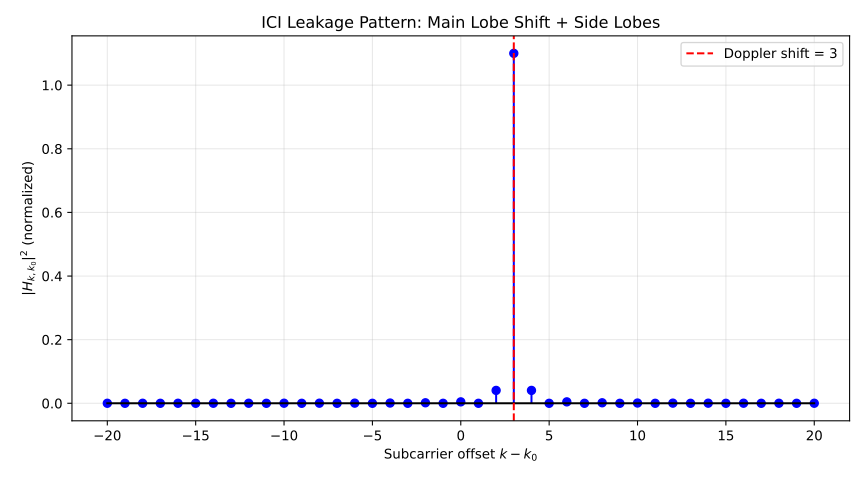
Consider an OFDM symbol passing through a single-Doppler path with normalized Doppler . The received subcarrier receives energy from the transmitted subcarrier via the leakage coefficient When (no Doppler), and for — orthogonality. When , the main lobe shifts, and neighboring subcarriers receive a non-trivial fraction.
The ICI-to-signal ratio is For small , .
Each subcarrier is a truncated complex exponential; its DFT is a sinc centered at the subcarrier frequency. A Doppler shift moves the sinc away from its bin, so its main-lobe contribution to the correct bin shrinks and side-lobe energy spills into adjacent bins. The scaling says ICI grows quadratically with Doppler — a small Doppler has small effect, but scaling with carrier frequency or velocity rapidly makes ICI the dominant impairment.
Transmit signal on subcarrier $m$
One OFDM symbol: for .
Doppler-shifted reception
Through a single-Doppler path with shift : .
DFT at subcarrier $m'$
.
Evaluate the sinc
. Reading off the magnitude of the sinc gives the leakage coefficient .
ICI-to-signal
Power conservation: . Signal fraction: . ICI fraction: for small .
ICI Leakage Pattern vs Normalized Doppler
For a single-Doppler-shift channel with normalized Doppler , plot the leakage coefficient as a function of . At , a single peak at . As grows, the peak shifts and spreads, spilling energy across neighboring subcarriers. Observe the quadratic growth of total ICI with .
Parameters
Theorem: SINR Ceiling Under ICI
For an OFDM system with QAM input signaling and normalized Doppler , the effective SINR on any subcarrier is upper-bounded by Even in the limit of zero thermal noise (), the SINR is bounded by — a hard ceiling that no transmit power can overcome.
At low SNR, noise dominates; at high SNR, ICI dominates. Unlike AWGN (which can be beaten by more transmit power), ICI scales with the signal itself — it is self-interference — so it cannot be overcome by pumping more power. The ceiling is a function of Doppler and subcarrier spacing only, independent of transmit power.
Received signal at subcarrier $m$
. Signal power: . ICI power: . Noise power: .
SINR formula
.
High-SNR limit
As , the noise term vanishes: . For small , and , giving .
Key Takeaway
Doppler imposes a hard SINR ceiling on OFDM. At normalized Doppler (typical for 120 km/h vehicular at 28 GHz with 5G NR numerology 2), the SINR ceiling is dB — fine for QPSK, tight for 16-QAM, infeasible for 64-QAM or higher. The ceiling does not depend on transmit power. The only way out is either (i) wider subcarriers (hurts spectral efficiency via CP overhead), (ii) explicit ICI cancellation (complex, imperfect), or (iii) a different waveform whose signaling lattice matches the DD geometry — OTFS.
Example: ICI in a High-Speed Train at mmWave
A high-speed train at km/h, GHz uses 5G NR numerology 2 ( kHz, s). Compute (a) , (b) normalized Doppler , (c) ICI-to-signal ratio , (d) SINR ceiling.
Doppler
Hz.
Normalized Doppler
.
ICI-to-signal
.
SINR ceiling
( dB). At this ceiling, even QPSK with reasonable error rate is tight — 64-QAM is out of reach. HST mmWave is where OFDM begins to structurally fail.
ICI Leakage Pattern: Main Lobe Shift Plus Side-Lobe Spread
ICI Mitigation Schemes and Their Limits
Many techniques attempt to mitigate ICI within the OFDM framework:
- Iterative ICI cancellation: receiver estimates neighboring subcarrier symbols, subtracts their leakage, re-decodes. Effective at moderate Doppler but accumulates error propagation.
- Pulse-shaping (windowed OFDM): replaces the rectangular pulse with a smoother window to reduce side-lobe leakage. Reduces by a factor of 2-4 but does not change the scaling.
- Variable subcarrier spacing (NB-IoT, NR numerologies): scales with Doppler. Has been deployed but hits the CP-overhead wall at extreme Doppler.
- Linear equalization of the TF matrix: treat the TF channel as an matrix and invert it. Complexity — impractical at typical frame sizes.
None of these fundamentally solve the problem: they treat ICI as a defect to be mitigated rather than recognizing it as a symptom of using the wrong signaling lattice. OTFS is the "fix at the waveform level": by signaling on the DD grid, ICI simply does not arise. The cell that used to receive leakage instead receives a shift of a neighboring data symbol — a clean convolutional structure.