ML Detection: The Benchmark
Why Start With ML
Maximum likelihood (ML) detection is the optimal detector in the sense that it minimizes the symbol error probability. It is also computationally infeasible for an OTFS frame of realistic size: the search space is , where is the QAM constellation size and is the number of data symbols. For 4-QAM on an frame, this is — astronomical.
So why study ML? Because it defines the performance benchmark against which all practical detectors are measured. It also motivates the structure of the suboptimal schemes: MMSE (Section 2) linearizes ML; message-passing (Section 3) approximates ML with a factor-graph decomposition; LCD (Section 4) exploits the sparse structure to reduce complexity.
Definition: ML Detection of the OTFS Frame
ML Detection of the OTFS Frame
Given the received DD vector , the channel matrix , and the QAM constellation , the maximum-likelihood detector is The objective minimizes the Euclidean distance to the received signal over all possible transmit DD frames. Under i.i.d. Gaussian noise, ML coincides with MAP detection.
Theorem: ML Complexity Is Exponential in the Frame Size
The ML problem has complexity in the worst case. For (QPSK) and , this is — infeasible on any computer.
The data vector has entries, each from a size- alphabet. Brute-force enumeration is therefore exponential. Sphere decoding can reduce average complexity (often called for moderate grids) but remains exponential in the worst case.
Search space
The constraint defines a set of size .
Objective evaluation
For each candidate , evaluating is using the sparse structure (not ).
Total complexity
Total: — exponential in . Even with sparse-multiply, ML is infeasible at realistic scales.
Sphere decoding
Sphere decoding prunes the search tree and has expected complexity in the high-SNR regime for small , but it is still exponential in the worst case and does not scale to .
Key Takeaway
ML is a benchmark, not a practical detector. The -dimensional joint-constellation search makes ML prohibitively expensive for any realistic OTFS frame. Practical detectors — MMSE, MP, LCD — are designed as computationally feasible approximations. The challenge of this chapter is how closely these approximations can track the ML benchmark.
Sparsity Is the Enabling Structure
The ML objective involves the channel matrix , which is sparse (Chapter 4). Each DD cell couples to at most transmit cells — the paths shifted to . This sparse coupling is what makes message-passing (Section 3) tractable: the factor graph degree is bounded by , which is small () even though the graph has nodes.
In contrast, OFDM under high Doppler has a dense TF channel matrix, with each subcarrier coupled to all others via ICI. Message-passing on a dense factor graph is intractable. The DD domain's sparsity is the structural reason OTFS detection is practical.
Example: ML Detection for
A 2×2 OTFS frame uses QPSK symbols (). The channel has 1 LOS path (perfect identity). Compute the ML search space size and the received signal structure.
Search space
possible transmit grids. Small.
Received signal
With LOS, . For each candidate : .
ML detection
The minimum-distance solution. For QPSK and per-cell AWGN, this is per-cell hard decision — each cell independently quantized. ML reduces to per-cell QPSK demapping (trivial).
With multipath
Add 3 more paths: ML must search 256 candidates, evaluating for each. Still feasible at this scale; at it blows up to .
ML Complexity as Grows
Plot against for QPSK, 16-QAM, 64-QAM. At , QPSK needs candidates; 64-QAM needs . Compare with practical computer limits (~) to see where ML becomes infeasible. The cutoff is around for QPSK, for 64-QAM.
Parameters
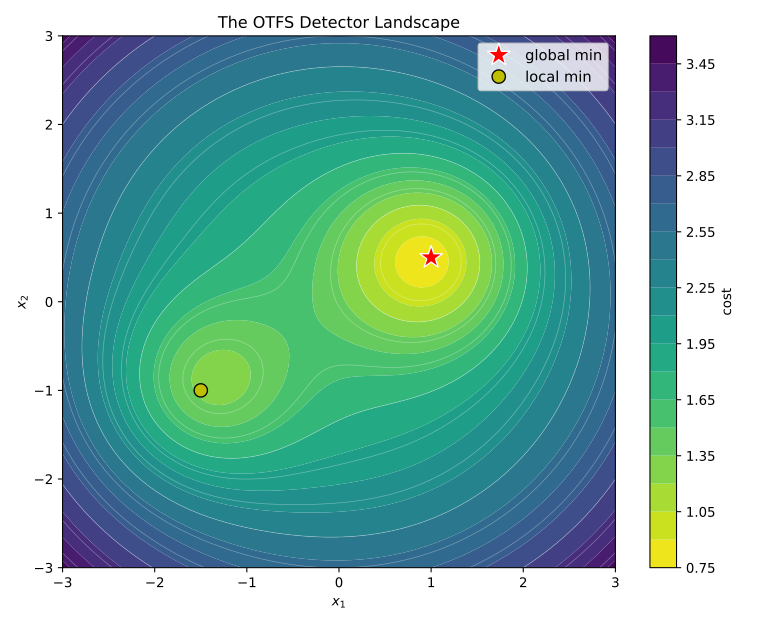
The OTFS Detector Landscape
Realtime Complexity Budget
For a 5G NR-aligned OTFS frame with and 100 frames/sec, the per-frame detection budget on commodity silicon is roughly floating-point operations. This translates to:
- MMSE: ops. Feasible.
- MP: ops. Feasible.
- ML: — completely infeasible.
The gap between MMSE and ML in BER is small (typically – dB) for moderate constellations. The gap closes to dB with message-passing. The remaining gap is bridged only by MAP-like lattice search, which is impractical.
Detection in OTFS is a complexity-limited, not a BER-limited, problem. Practical deployments use MMSE or MP; sphere decoding is reserved for small frames (e.g., pilot-only regions in superimposed designs).
- •
MMSE: via 2D FFT — ops per data symbol
- •
MP (Chapter 8.3): per frame
- •
Realtime target: ops per frame on GPU-accelerated hardware
Historical Note: Sphere Decoding: An Honest Detour
2000sSphere decoding, introduced in the late 1990s by Pohst and adapted to communications by Viterbo, Boutros, and others, gave the illusion of practical ML detection for MIMO systems in the 2000s. Average complexity was claimed to be polynomial for moderate matrix sizes. Subsequent work by Jaldén and Ottersten (2005) clarified that expected complexity is still exponential in the problem dimension, with the polynomial regime valid only at high SNR and small dimensions.
For OTFS, sphere decoding is possible but inefficient: the matrix is , large, and the path count does not directly translate to the lattice-search speed. The MP-OTFS detector (Section 3) achieves better BER-complexity trade-offs because it exploits the sparse factor-graph structure, not the lattice geometry. This is why OTFS detection literature has converged on MP rather than sphere decoding since Raviteja et al. (2018).
Why This Matters: Link to MIMO Detection
The OTFS detection problem is mathematically similar to MIMO detection: a linear equation with a discrete constellation constraint on . MIMO detection algorithms (V-BLAST, sphere decoding, MMSE) can all be adapted to OTFS. The key distinction is that OTFS's channel matrix has far more structure — sparse, block-circulant, diagonalizable by the 2D DFT. This structure makes MMSE efficient in OTFS () where it would be for generic MIMO.