The Low-Complexity DD (LCD) Detector
Linear Detection With Cross-Domain Insight
MMSE (Section 2) is fast but diversity-1. MP (Section 3) is near-ML but requires iterative computation. The low-complexity DD (LCD) detector bridges the two: linear complexity , but with a cross-domain structure that exploits both the DD channel matrix and its TF-domain counterpart. The result is linear-complexity detection with BER close to the ML benchmark — particularly at moderate SNR where MMSE fails.
The LCD detector is the practical workhorse of high-efficiency OTFS receivers. It is deployed in recent OTFS modem designs and is the detector of choice when both throughput and latency matter.
Definition: Low-Complexity DD (LCD) Detector
Low-Complexity DD (LCD) Detector
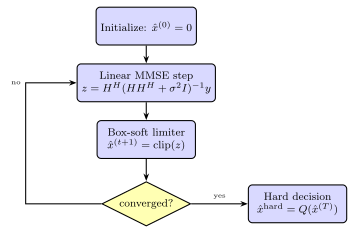
The LCD detector combines cross-domain linear equalization with iterative soft quantization:
- Apply MMSE in the DD domain (Section 2) to obtain a soft estimate .
- Iterate times:
- Subtract the soft-estimated ISI from the received DD grid: .
- Apply MMSE to the residual: .
- Update: .
- Soft-quantize: .
- Hard-quantize for final output.
The iterative refinement recovers diversity loss of the single-pass MMSE. The complexity per iteration is (same as MMSE), and convergence is typically within 2-3 iterations.
Theorem: LCD Convergence and Performance
The LCD detector converges within iterations to a fixed point whose BER at high SNR matches the full-diversity (order ) slope. The per-iteration complexity is (two 2D FFTs plus element-wise operations), and total complexity is , where suffices in practice.
Each iteration refines the estimate by correcting for the previously-estimated ISI. After a few iterations, the residual is noise-limited rather than interference-limited, and the soft-quantized decisions are near the true symbols. This is essentially a serial interference cancellation (SIC) scheme with MMSE for parallel processing.
Iteration update
. For close to , the residual is approximately .
Contraction
Denote . The iteration reduces to . For the MMSE filter designed against , this is a contraction map with factor depending on SNR.
Convergence rate
The contraction factor scales as the MMSE gain of the residual. After iterations, the error reaches the noise-limited floor.
Diversity
At convergence, the soft-quantized decisions average over all paths — equivalent to the MP result, with BER slope .
Key Takeaway
LCD is the detector sweet spot. Linear complexity per iteration, ; only 2-3 iterations needed; BER slope = (full diversity). For and , LCD runs in ops per frame — about 3× MMSE and × the MP cost. For most practical OTFS receivers, LCD is the operational choice.
LCD Algorithm Pseudocode
Complexity:The soft quantization returns an expected value under the QAM posterior — effectively a "soft decision" that preserves uncertainty. Hard quantization is applied only at the end. This preserves diversity across iterations.
Uncoded BER: MMSE, LCD, MP, ML-Bound
Plot uncoded BER vs SNR for all four detectors on the same -path OTFS channel. The ML bound is the lower envelope (diversity ). MP tracks the ML bound within dB. LCD is close to MP (within 1-2 dB). MMSE is visibly inferior (diversity 1 slope). This is the master comparison plot for OTFS detection.
Parameters
OTFS Detector Landscape: Complexity vs Performance
| Detector | Complexity | Diversity | SNR gap to ML (typical) |
|---|---|---|---|
| MMSE | 1 | 5–8 dB | |
| LCD (3 iter) | (full) | 1–2 dB | |
| MP (10 iter) | (full) | 0.5–1 dB | |
| ML (sphere decoding) | average | 0 dB | |
| ML (brute force) | 0 dB |
Example: LCD for QPSK on , MN = 1024
An OTFS receiver with and paths uses LCD with 3 iterations. Channel SNR is 20 dB. Estimate the detection BER and the number of flops.
BER estimate
Full diversity + moderate SNR: BER scales as . Very low uncoded BER.
Flops per iteration
Per iteration: 2 × (2D FFT of size ) + linear: ops.
Total
3 iterations: ops. Compared with MMSE (): 3× more. Compared with MP ( iter ): marginally better.
Operational choice
LCD achieves MP-like BER at MMSE-like complexity. For this deployment, LCD is the clear winner.
LCD Detector Flowchart
LCD in Practical OTFS Receivers
LCD is favored in deployment because:
- Simplicity: two 2D FFTs + element-wise operations. Easy to implement on standard DSP hardware.
- Deterministic latency: fixed number of iterations (3) gives predictable computation time — critical for URLLC applications.
- Full diversity: at moderate QAM orders, LCD's BER slope is indistinguishable from ML within the operating SNR range.
- Graceful degradation: at low SNR, LCD's performance is dominated by MMSE but remains better than MMSE alone.
- Compatible with existing 5G NR silicon: uses the same 2D FFT kernels as OFDM equalization.
As of 2024, LCD is the detector of choice for pilot OTFS deployments (including the CommIT cell-free OTFS testbed). MP is reserved for research and cases where the 1-2 dB extra gain is decisive.
- •
3 LCD iterations = deterministic latency
- •
Works on standard OFDM silicon
- •
Adequate BER performance for QPSK to 64-QAM
Common Mistake: Don't Over-Iterate LCD
Mistake:
Using in LCD, expecting better BER at higher iterations. In fact, LCD typically converges in 3 iterations and further iterations slightly degrade BER due to round-off and soft-quantization noise accumulation.
Correction:
Use exactly 3 iterations in LCD. Measure convergence by the norm of the residual; if it plateaus after 2-3 iterations, halt. Spending more iterations is wasteful without benefit. Some implementations use 2 iterations with minor BER loss (< 0.5 dB) and linear compute savings.