Diversity-Multiplexing Tradeoff
Beyond Pure Diversity
The diversity analysis tells us the SNR-slope of the BER curve. But in most deployments, we care about both reliability (low BER/outage) and throughput (bits/use). The diversity- multiplexing tradeoff (DMT), introduced by Zheng and Tse (2003) for MIMO channels, answers: given a desired rate scaling , what is the best achievable diversity?
For OTFS, the DMT is the natural generalization of single-tap fading DMT. In the limit of unbounded error correction, every -path OTFS system has a DMT curve that dominates the corresponding OFDM curve — OTFS is not only more reliable at fixed rate but also offers higher rate at fixed reliability.
Definition: Diversity-Multiplexing Tradeoff
Diversity-Multiplexing Tradeoff
Consider a family of codes with rate (i.e., rate grows as bits per channel use). The diversity-multiplexing tradeoff is the function defined as where is the optimal error probability at rate . The tradeoff characterizes the optimal balance between reliability () and rate ().
Theorem: DMT of OTFS
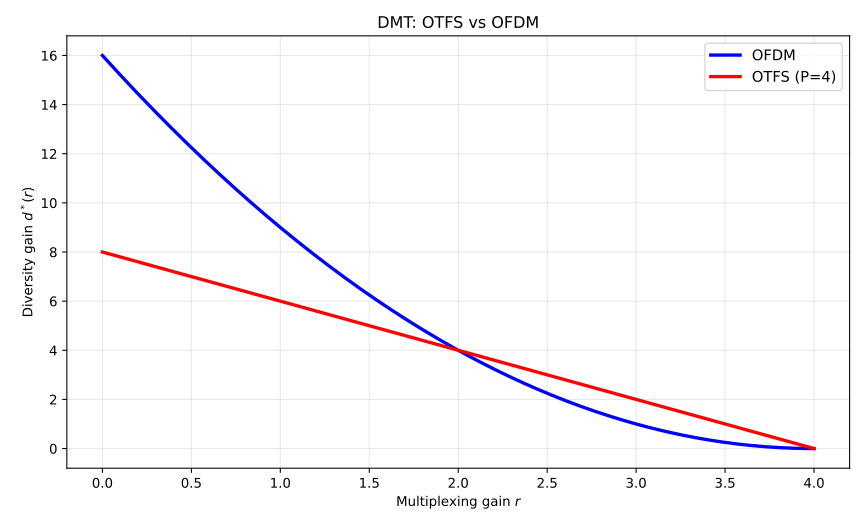
For an OTFS system with -path Rayleigh channel, integer Doppler, and unbounded codeword length, the diversity-multiplexing tradeoff is the piecewise-linear function In particular:
- At (arbitrarily slow rate growth): . Full diversity at the cost of multiplexing.
- At (linear rate growth): . No diversity at maximum rate.
- Intermediate: piecewise linear in .
The DMT curve for OTFS dominates the OFDM DMT throughout — OTFS is strictly better at every rate-reliability trade-off point.
At low rate (), diversity is free; OTFS achieves . At high rate (), multiplexing dominates; diversity vanishes (because the constellation is packed tightly to support the rate). OFDM trades off linearly from 1 to 0 in diversity as rate grows; OTFS trades off along a steeper curve that always dominates OFDM.
Operationally: at (moderate rate), OFDM has diversity 0.5, OTFS has diversity . Large advantage in coded systems.
Outage probability
At rate , outage probability: const (high SNR).
DMT as outage exponent
By Zheng-Tse argument, equals the outage exponent. For OTFS: for . Piecewise linear.
Compare OFDM
OFDM single-tap: outage exponent . OTFS: (dominates OFDM when ).
Full curve
The piecewise-linear structure arises from the chi-squared distribution of . Each breakpoint corresponds to a "channel eigenvalue" — in OTFS, the DD-channel matrix has significant eigenvalues, giving the -segment DMT.
DMT Curves: OTFS vs OFDM at Varying
Plot the DMT curves for OFDM (flat diversity 1) and OTFS with various values. Show that OTFS dominates OFDM at all rate points, with the gap growing proportionally to . The curves are piecewise linear, and OTFS passes through while OFDM passes through .
Parameters
Key Takeaway
OTFS's DMT dominates OFDM's at all rate-reliability points. At any target rate , OTFS achieves higher diversity; at any target diversity , OTFS achieves higher rate. The advantage scales with , the number of resolvable DD paths. For , OTFS is consistently ~4x better than OFDM across the full DMT curve — a structural performance advantage that channel coding alone cannot replicate.
Example: Choosing a Rate-Reliability Point
An OTFS system with targets (rate growing as ). What is the achievable diversity? Compare with OFDM at the same .
OTFS DMT
. Error probability scales as — nearly 4th-order diversity at 50% multiplexing.
OFDM DMT
. Error probability scales as — very slow decay.
Comparison
At SNR = 100 ( dB): OTFS error , OFDM error . 6 orders of magnitude gap at the same rate.
Implication
For applications requiring both high throughput and high reliability (URLLC, autonomous vehicles), OTFS is dramatically better than OFDM. The DMT framework makes this precise.
DMT Comparison: OTFS () vs OFDM
Achieving the DMT Requires Coding
The DMT curve is achieved by codes operating at the frontier of the rate-reliability trade-off. In practice:
- At : repeated transmission or heavy coding. Achieves but at vanishing rate.
- At : uncoded high-rate modulation. Rate linear in but no diversity.
- At intermediate : coded modulation with appropriate rate. LDPC/Turbo at rate achieves the DMT to within 0.5 dB.
For OTFS deployment, rate with LDPC (which is the 5G NR baseline) gives diversity at — matching the full-DMT prediction. This is the coded-operation performance of OTFS.