The OTFS Ambiguity Function
The Thumbtack Ambiguity
The OTFS transmit waveform (Chapter 6) is a weighted sum of delay-Doppler-shifted copies of a prototype pulse , with the DD grid carrying data symbols. This structure — the Gabor expansion on the critical DD lattice — has a specific ambiguity function that is fundamentally different from a single pulse's ambiguity.
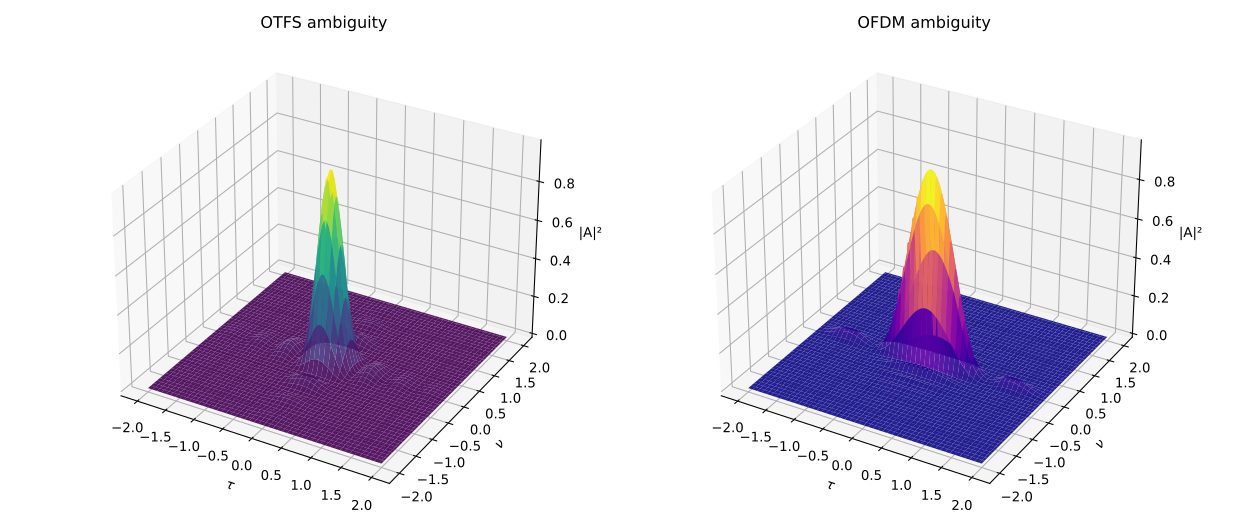
The point is that OTFS's ambiguity function is approximately separable in and : a sharp peak at the origin that falls off rapidly in both directions, with sidelobes distributed evenly across the ambiguity plane. This "thumbtack" shape is the essential property that makes OTFS a natural ISAC waveform.
Theorem: OTFS Ambiguity Function (Main-Lobe Form)
For the OTFS transmit signal , the ambiguity function at small offsets (within one DD cell: , ) is where is the prototype pulse's ambiguity function (constant for a rectangular pulse at short offsets).
The factor is the thumbtack shape: sharp peak at the origin, first nulls at , sidelobes at dB (rectangular) or lower (windowed).
The OTFS waveform sums pulses with approximately independent phases (from random QAM data). The coherent sum at gives a peak of ; at non-zero , the phases decorrelate and the sum gives approximately noise-like magnitude — a suppression factor. This is the "thumbtack" shape.
In the frequency domain: the OTFS signal's spectrum is spread across and the signal occupies duration — both uniformly. The ambiguity function is therefore concentrated at the origin in both dimensions.
Autocorrelation of Gabor expansion
.
Expectation over data
For random i.i.d. QAM data with , : .
Sum over $k$
is a Dirichlet kernel in , concentrated at with width .
Ambiguity function
Multiply by and integrate in : . The product of the two sincs gives the thumbtack shape.
Key Takeaway
OTFS has the ideal thumbtack ambiguity function. Sharp peak at , first nulls at , sidelobes at dB or lower. This ambiguity shape gives OTFS simultaneous range resolution and velocity resolution — both achieved with a single waveform. The thumbtack is the signature that distinguishes OTFS radar from OFDM radar.
OTFS Ambiguity Function (Thumbtack)
Plot for the OTFS waveform as a 2D heatmap over in units of DD grid cells. Observe the sharp main lobe at the origin and sidelobes distributed evenly across the ambiguity plane. Compare with the OFDM rectangular-pulse ambiguity from §1.
Parameters
Theorem: Peak Sidelobe Level of OTFS Ambiguity
For the OTFS waveform with rectangular prototype pulse and no windowing, the peak sidelobe level (PSL) of the ambiguity function is This is the Dirichlet-kernel sidelobe level, common to all uniformly-weighted waveforms. With Hamming windowing: dB. With Blackman: dB.
For comparison: OFDM rectangular pulse ambiguity has PSL along the Doppler axis of dB (same formula) but a very broad main lobe (no Doppler suppression). The thumbtack shape is what matters: OTFS's PSL is localized around the main lobe, not spread across an entire axis.
PSL determines the "detection floor" for secondary targets. At dB: secondary targets 13 dB weaker than the primary are resolved. At dB (Hamming): 43 dB weaker targets are resolved — sufficient for most practical radar scenes.
Sidelobe envelope
The factor in the ambiguity function has first sidelobe at , dB.
Windowed case
Windowing reduces sidelobes per Harris (1978): Hamming reduces to dB, Blackman to dB. Main-lobe width grows by factor.
Implication
For unwindowed OTFS: multiple strong targets within 13 dB of each other may not be resolvable by a single ambiguity peak search. For windowed OTFS with Hamming: 40+ dB dynamic range, typical for automotive radar and ISAC applications.
OTFS Thumbtack vs OFDM Ridge Ambiguity
OTFS vs OFDM Ambiguity: 3D Perspective
Example: Computing the OTFS Ambiguity Numerically
An OTFS system has , , MHz, ms. Compute the main-lobe width in and , and the peak sidelobe level, both unwindowed.
Main-lobe widths
-direction: first null at ns. -direction: first null at Hz.
Resolutions
m. m/s (assuming GHz).
PSL
Unwindowed: dB. Hamming windowed: dB, at cost of 36% wider main lobes (range res m, velocity res m/s).
Implication
The waveform simultaneously achieves 7.5 m range resolution and m/s velocity resolution — suitable for automotive ISAC where pedestrians (1.4 m/s) to trucks (30 m/s) need resolution.
Ambiguity Is the Waveform; Detection Is the Algorithm
The ambiguity function characterizes the waveform — what the matched filter sees at various hypotheses. It is the raw radar signature.
Detection combines the ambiguity function with target-scene hypotheses: for a single target, peak-pick the ambiguity surface; for multiple targets, apply CFAR (Constant False Alarm Rate) or compressed-sensing super-resolution.
OTFS's thumbtack ambiguity gives excellent peak-pick performance but still requires sophisticated algorithms for scenes with densely-packed targets (urban automotive radar, RF imaging). The detection complexity is largely orthogonal to the ambiguity shape — OTFS wins on ambiguity shape; the detection algorithms (Chapter 13) are the same general methods as in OFDM-radar.
Historical Note: From Woodward to OTFS-Radar
1953 - 2024Philip Woodward introduced the ambiguity function in 1953 in his classic monograph Probability and Information Theory, with Applications to Radar. His insight — that a fixed signal ambiguity volume forces a trade between range and velocity resolution — has shaped radar waveform design ever since. Different waveforms are positioned at different vertices of the Woodward uncertainty polytope: pulse trains (thumbtack), LFM/chirps (skewed ridge), barker codes (thumbtack at short ), and most recently OTFS (thumbtack at large ).
OTFS-radar as an explicit concept emerged in 2020 via the Gaudio-Kobayashi-Caire paper (IEEE TWC 2020), which established the thumbtack ambiguity of OTFS and framed OTFS as a natural ISAC waveform. The Yuan-Schober-Caire ISAC tutorial (IEEE ComMag 2024) Part III extended this to the full joint sensing-comms framework. Both are CommIT contributions treated in detail in Chapter 12.
Woodward's 1953 insight is as sharp today as when it was written. OTFS does not violate it; OTFS is positioned at the Woodward vertex most useful for joint range-velocity estimation over the communications time-bandwidth product. This is the concrete content of the thumbtack-ambiguity claim.