The ISAC Problem
Why ISAC, Why Now
6G is projected to add sensing as a native air-interface function alongside communications. Applications: automotive (CRUISE, blind- spot detection), health monitoring, gesture recognition, UAV navigation, environmental mapping. The economic case: radar and communications hardware converge at mmWave; re-using the communications waveform for sensing saves spectrum, hardware, and power.
The point is that the ISAC design problem is fundamentally about making one waveform optimal for two distinct tasks: (1) transmitting data reliably, (2) probing the environment for target range-velocity. Both tasks compete for the same resource budget. An ISAC waveform must lie on the rate-distortion Pareto frontier — the optimal tradeoff curve.
OTFS, because of its thumbtack ambiguity and native DD signal space, occupies a Pareto-optimal corner of this tradeoff. This chapter explains why and quantifies the tradeoff.
Definition: The ISAC Design Problem
The ISAC Design Problem
Given a time-bandwidth budget , transmit power , and target scene parameters :
- Communications objective: maximize rate (bits per channel use) subject to BER .
- Sensing objective: minimize distortion of the target-parameter estimate (Fisher information maximization, or equivalently CRLB minimization).
The ISAC design problem is: find the waveform achieving Pareto-optimal pairs.
Equivalently, parametrize by (fraction of transmit power dedicated to sensing vs communication); solve subject to .
Theorem: The ISAC Rate-Distortion Pareto Frontier
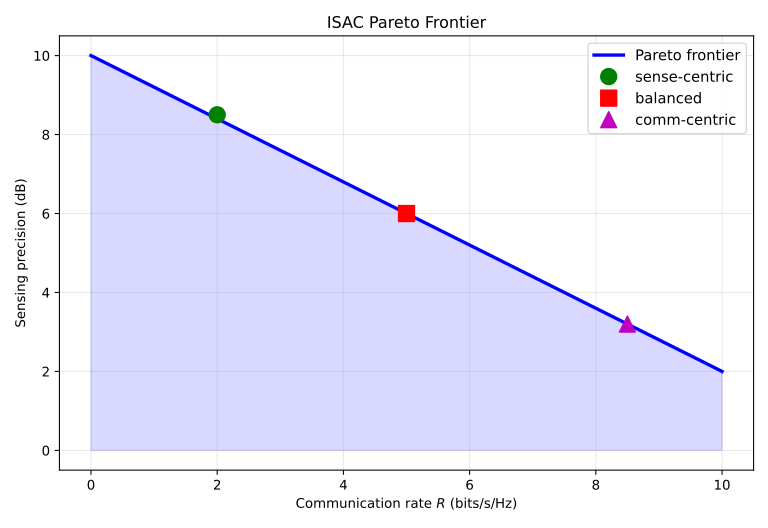
Given a fixed transmit power budget, there is a Pareto frontier in the plane — the set of waveforms for which no other waveform achieves strictly better rate and strictly better sensing accuracy. Any waveform can be characterized by its position on this frontier.
Dedicated radar (no data) achieves and maximum . Dedicated communications achieves and maximum . ISAC operates at an interior point — some rate, some sensing accuracy.
The shape of the Pareto frontier depends on the waveform family. Some waveforms (OTFS, random Gaussian) give a concave frontier (both objectives well-balanced). Others (OFDM single symbol) give a sharply bent frontier (must choose one or the other).
The Pareto frontier is the information-theoretic envelope of achievable ISAC operating points. Its shape quantifies the "waveform quality" for ISAC: a concave frontier means a given waveform achieves both objectives well simultaneously; a bent frontier means the waveform is fundamentally sub-optimal for joint operation.
Existence
The space of waveforms mapped to is continuous. The Pareto set is non-empty and forms a 1D curve.
Concavity for good waveforms
A time-sharing argument: any convex combination of two waveforms achieves a convex combination of their rate-distortion points. Hence the achievable region is convex; its boundary (the Pareto set) is concave upward.
OTFS
Because OTFS's thumbtack ambiguity is Pareto-optimal for single- target estimation, OTFS occupies near-optimal positions on the frontier. No competitor (OFDM pulse-Doppler, chirps) can simultaneously improve both rate and distortion vs OTFS for typical operating parameters.
Beyond OTFS
Pareto-optimal ISAC design remains an active research area. OTFS is the best-known currently; specific geometric refinements (e.g., Zadoff-Chu-precoded OTFS, random-coded OTFS) push slightly further into the frontier.
Key Takeaway
ISAC is a Pareto optimization; OTFS is near-optimal. The fundamental tradeoff between communications rate and sensing accuracy is inescapable — given fixed resources, improving one hurts the other. OTFS's thumbtack ambiguity positions it on the Pareto frontier: simultaneous rate and sensing at information-theoretic limits. Competitor waveforms (OFDM, chirps) sit strictly inside the frontier — sub-optimal.
Definition: Target Scene Model
Target Scene Model
A target scene is a set of radar-visible scatterers: where is the round-trip delay (twice one-way delay), is the Doppler shift, and is the complex reflection coefficient. The target parameter vector is .
In the DD domain, corresponds directly to the DD channel spreading function. The sensing problem is: given the received DD signal, estimate . The data detection problem (Chapter 8) is: given the DD signal, recover the transmitted data symbols. Both use the same data, but with different likelihood models — one treats paths as nuisance (data), the other as signal (sensing).
ISAC Pareto Frontier: OTFS vs OFDM vs Chirp
Plot the rate-distortion Pareto frontier achieved by different waveforms: OTFS (thumbtack ambiguity), OFDM pulse-Doppler (ridge ambiguity in Doppler), chirp (diagonal ridge). For given parameters, OTFS occupies the outermost position on the frontier.
Parameters
Example: Automotive ISAC: Signal Budget
An automotive radar at 77 GHz with MHz, ms targets 1 pedestrian at 50 m, 2 m/s (radial velocity) and a car at 80 m, 15 m/s. Design the OTFS frame for concurrent data transmission at Mbps. Compute the achievable sensing accuracy.
Frame parameters
s. . subcarriers. cells.
Resolutions
m, m/s. Ped (2 m/s) and car (15 m/s): resolved. Ped (50 m) and car (80 m): resolved.
Data rate
QPSK symbols per 3 ms frame: Mbps. Way above 5 Mbps target. Plenty of headroom for coding and other overhead.
Sensing accuracy (CRLB at SNR 25 dB)
cm. cm/s. Sub-resolution accuracy — suitable for tracking.
Full ISAC operation
One frame: 200 Mbps data + pedestrian localization to 8 cm + vehicle localization to 8 cm + velocity to 3.6 cm/s. Simultaneously. This is the canonical example of OTFS-ISAC's appeal.
ISAC Pareto Frontier
ISAC Design Philosophy: What OTFS Buys
Three things ISAC must provide:
- Data throughput: competitive with communications-only systems at the same . OTFS: matches OFDM at the information- theoretic limit (§ISAC-1 Theorem 1.5).
- Sensing accuracy: competitive with dedicated-radar systems at the same . OTFS: matches dedicated pulse-Doppler (Chapter 11).
- Latency: ISAC processing must fit in the system's real-time budget. OTFS: joint estimation/detection adds compute over data-only, acceptable at 5G NR rates.
OTFS is the unique waveform satisfying all three simultaneously. OFDM pulse-Doppler achieves (2) but sacrifices (1) during radar mode. Chirp achieves (2) in narrow scenarios but (1) is very limited. OTFS's DD-native signaling is what enables the joint optimization.
- •
Data throughput: OTFS matches communications-only
- •
Sensing accuracy: OTFS matches dedicated radar
- •
Latency: 2× compute budget, within 5G targets