The Passive-RIS Estimation Challenge
The Optimizer Needs to Know the Channel
Every optimization result in Chapters 5–15 — the coherent gain, the SDR solution, alternating-optimization convergence — is stated conditional on known channel state information (CSI). The controller chooses based on and ; if the channels are unknown, the only defensible choice is random phases, which gives scaling instead of — a factor of loss. The entire value proposition of RIS hinges on CSI.
But the RIS is passive. It cannot transmit pilots, it cannot correlate received waveforms, it cannot even know whether it is currently being illuminated. The controller must estimate and using only signals observed at the BS or the UE, with the RIS itself a passive multiplier. This chapter develops the three workhorse protocols (ON/OFF switching, DFT codebooks, compressed sensing) and derives their overhead-accuracy tradeoffs.
Definition: The Observable Cascaded Channel
The Observable Cascaded Channel
Consider an uplink pilot scheme where the UE transmits pilots () and the BS receives
where is the RIS configuration during pilot slot . Expanding the RIS term with the diagonal identity,
where is the cascaded channel matrix. The received signal becomes
The cascaded matrix is what the BS can estimate, not and separately. This is the central observation: the RIS introduces an inherent rank-1 ambiguity — scaling by and by leaves unchanged. Fortunately, the BS optimization only needs , so the ambiguity does not matter for beamforming.
Key Takeaway
The estimable object is — not and separately. The RIS optimization depends only on ; the fact that we cannot separate the two hops is harmless. has unknowns — the scale of the estimation problem.
Theorem: Minimum Pilot Length for Cascaded-Channel Estimation
Let collect pilot-slot observations. Assuming is either known or separately estimated, the cascaded channel can be uniquely recovered from by least squares if and only if the matrix of stacked RIS configurations has row rank . In particular, is necessary, and equality is achievable with an orthogonal configuration set.
Estimating with complex unknowns requires at least that many linearly independent measurements. If the BS has antennas and each pilot slot generates scalar observations (one per receive antenna), then we need at least pilot slots — one per RIS configuration.
Stack observations
Ignoring noise and the direct path, stack the -th pilot: . With unit-power pilots (), write , where .
Identifiability
Recovery of from requires to have a right-inverse, i.e., row rank . This forces .
Orthogonal design
If and is a unitary matrix with unit-modulus entries (e.g., the DFT matrix, which has precisely this structure), then the estimate is unbiased and the per-entry variance achieves the CRB.
The Central Tension
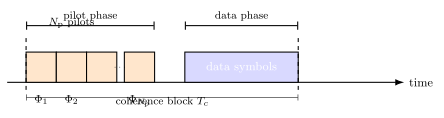
The lower bound is the source of the most important practical concern in RIS: channel-estimation overhead scales linearly with the number of RIS elements. But the coherent SNR gain scales as . So, per additional RIS element, we pay one pilot slot and gain of the coherent gain. The return on investment in element count is diminishing once we account for estimation.
Two escape routes are developed below:
- Structured sparsity (compressed sensing, Section 4.4): if the channel has only dominant paths, we need only pilots.
- Multi-user pilot reuse (Chapter 7): when multiple UEs share a BS-RIS link, the cost is amortized.
Common Mistake: Don't Try to Separate and
Mistake:
A newcomer sets up the problem with unknowns ('s entries plus 's entries) and concludes pilots suffice.
Correction:
The separation is impossible from the observable data alone: the product is identifiable, but multiplying by and dividing the -th row of by leaves all observations unchanged. Only is identifiable from passive-RIS pilots; the BS beamforming optimization needs only , so the ambiguity is not an obstacle. Do not waste pilot resources trying to recover a separation that doesn't exist.
Pilot Timeline for a Single Coherence Block
Pilot Overhead vs.
Show how the pilot fraction grows with RIS size for three strategies: naive element-by-element (), ON/OFF or DFT codebook (), and compressed sensing (). Change the sparsity to see the CS overhead curve shift.