The Joint Beamforming Problem
Two Beamformers, One Channel
The RIS introduces a new kind of beamforming to the wireless toolkit: the passive beamformer, expressed through the phase-shift matrix . It coexists with the classical active beamformer at the BS. Both aim to shape the same effective channel, but they do so differently — active beamforming spends transmit power to focus energy; passive beamforming reshapes the propagation environment at no RF-power cost. The joint design question: how do we choose both simultaneously?
A naive guess might be that the two decouple — optimize given the channel, then tune to make the channel look nicer. This is wrong: the effective channel depends on , so the optimal depends on too, and vice versa. The problem is irreducibly coupled.
Definition: The Joint Active-Passive Beamforming Problem
The Joint Active-Passive Beamforming Problem
Consider a -user MISO downlink: BS with antennas, single-antenna UEs, single -element RIS. The BS transmits , where is user 's beamformer and is the data symbol with . Stack the beamformers: .
User 's received signal is , with . The per-user SINR is
The joint sum-rate problem is
This is the central optimization of the book. Chapters 5–8 solve variants of it (single-user, multi-user, max-min fairness, discrete phases); Chapter 11 solves it under the array-fed architecture. Understanding its structure — bilinear objective, two constraint sets, one convex and one not — is the foundation for everything that follows.
Theorem: The Joint Problem Is Non-Convex
The feasible set is non-convex: any convex combination of two feasible violates the unit-modulus constraint (by Eex-ris-ch01-09). Moreover, for fixed , the objective is non-concave in due to the SINR denominator's dependence on inter-user interference.
As a consequence, no polynomial-time algorithm is known to produce the global optimum. All practical algorithms (alternating optimization, SDR, manifold methods) produce local optima and rely on multiple random initializations to find good solutions.
The unit-modulus constraint defines a circle in , which is non-convex. Its -dimensional product is a torus — also non-convex. Beyond the feasibility set, even the objective is non-concave in the joint variable. Non-convex problems can have multiple local optima and no efficient way to find the global one.
Non-convex feasibility set
Take and . Both are feasible (). Their midpoint is , which has . Non-convex.
Non-concave SINR ratio
For a 2-user example, the SINR denominator is a quadratic function of (through ). The log of a ratio of quadratics is not concave in general — can be verified by checking Hessians at specific points.
Sub-problems Can Be Convex
The joint problem is non-convex, but its coordinate sub-problems have better structure:
- Fix , optimize : the effective channel is known, so this reduces to a standard MU-MIMO precoding problem — convex when reformulated as WMMSE (weighted MMSE), solvable in closed form or semidefinite programming.
- Fix , optimize : the effective channel depends linearly on , so the objective is a quadratic in subject to unit-modulus — a quadratic with unit-modulus constraint, still non-convex but amenable to SDR, manifold methods, etc. (Chapter 6).
This alternating-convex structure is what the alternating optimization algorithm of Section 5.2 exploits. It is also the organizing principle of the whole optimization portion of the book.
Example: Single-User MISO-RIS: The Clean Case
Consider a single-user MISO-RIS system with . The SINR simplifies to (no interference term). Derive the optimal .
Separate the two optimizations
For fixed , the optimal BS beamformer is the MRT: , achieving .
Reduce to passive-only
The joint problem reduces to , subject to .
Quadratic in $\boldsymbol{\phi}$
Using the diagonal-product identity (Theorem 3.1): , where . The objective becomes — a quadratic in , optimized over the torus. For this single-user case, the element-wise optimization (Chapter 6) gives the closed-form solution — matched-filter on each element.
Key Takeaway
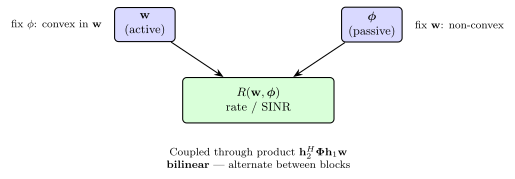
The joint problem has bilinear structure. For any fixed , the active subproblem reduces to standard MU-MIMO precoding (convex). For any fixed , the passive subproblem reduces to unit-modulus quadratic optimization (non-convex but tractable). This separation is the algorithmic DNA of alternating optimization and of nearly every RIS optimization algorithm in the literature.
The Bilinear Structure of Joint RIS Beamforming
Common Mistake: Don't Decouple Active and Passive Beamforming
Mistake:
"Set (all zeros), optimize for the direct channel. Then re-optimize for the resulting beamformer."
Correction:
The active and passive beamformers are coupled through the cascaded channel. Decoupling produces suboptimal solutions that can miss the coherent gain entirely. Specifically, the optimal depends on , and the optimal depends on . The alternating approach iterates between the two sub-problems, converging to a joint local optimum — the minimum-effort correct approach. A one-shot decoupled design typically loses – dB of coherent gain.
Why This Matters: The MU-MIMO Precoder Analogy
If you already understand MU-MIMO precoding (MIMO Ch. 6, Telecom Ch. 17), the RIS joint problem is a generalization: in MU-MIMO, we choose the precoder to shape the transmit signal for fixed channel. In RIS-MU-MIMO, we additionally choose to shape the channel itself. The WMMSE iteration (the standard MU-MIMO workhorse) becomes one step of an alternating scheme; the other step is the unit-modulus RIS subproblem. Think of RIS beamforming as "MU-MIMO precoding plus one extra variable" — the mental model scales.
See full treatment in Sum-Rate Maximization via WMMSE