The Unit-Modulus QCQP
A Single Problem, Three Algorithms
Chapter 5 reduced the joint optimization to two coordinated subproblems, one of which was the passive subproblem: maximize a (ratio of) quadratic forms in subject to . This is a unit-modulus QCQP, a canonical non-convex problem that appears across signal processing — constellation shaping, radar waveform design, phase retrieval, and RIS. The same three algorithms (SDR, manifold, element-wise) are used in all these applications; mastering them once pays off many times.
Definition: The Canonical Unit-Modulus QCQP
The Canonical Unit-Modulus QCQP
Consider the single-user MISO-RIS passive subproblem under fixed BS beamformer . Using the diagonal-product identity, the objective is
where . Augmenting and defining , the objective becomes
Setting , the canonical unit-modulus QCQP is
is Hermitian PSD. For the single-user case, it is rank 1; for multi-user / multi-stream cases, is higher rank but still PSD.
The QCQP in this form is known to be NP-hard in general (Zhang 2010). Polynomial-time exact solution is not possible; all three methods in this chapter are approximate — but in RIS-relevant regimes they are near-optimal.
Theorem: The Unit-Modulus QCQP Is NP-Hard
The problem with is NP-hard in general. In particular, the subcase where has 0/1 entries (Boolean quadratic programming) is equivalent to the MAX-CUT problem, which is NP-hard.
Reduction from MAX-CUT
MAX-CUT: given graph , find a subset maximizing . Encode as with iff . The objective is .
Map to unit-modulus QCQP
is a subset of . Setting the imaginary part to zero, the unit-modulus QCQP restricted to real phases matches the MAX-CUT encoding with suitable .
NP-hardness
Since MAX-CUT is NP-hard, the more general unit-modulus QCQP is at least as hard.
The Rank-1 Case Is Easy
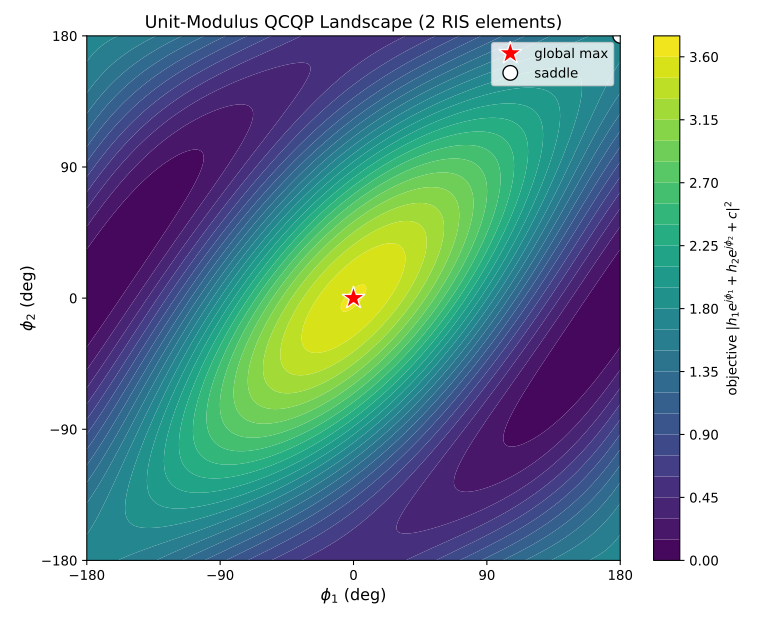
When is rank 1 (e.g., the single-user MISO case), the QCQP has a closed-form solution by matched filtering: . Achieves objective .
This is why single-user RIS beamforming has a clean closed form: the objective reduces to a rank-1 QCQP, which collapses to element-wise matching. The multi-user case is where rank goes above 1 and the three algorithms of this chapter become necessary.
Definition: Multi-User Generalization: Rank- Objective
Multi-User Generalization: Rank- Objective
For the -user MU-MIMO case, the sum-rate objective has the form (under a sum-of-squares surrogate to avoid the -ratio structure)
where are PSD matrices encoding the signal and interference contributions from each user, and can be up to . The unit-modulus QCQP is now indefinite: need not be PSD, which makes the feasible region's level sets non-convex and the problem harder.
Problem Difficulty: Rank of vs.
For fixed and different objective ranks (1, 2, 4, 8), plot the empirical gap of element-wise optimization to the SDR upper bound. Rank 1 (single user) has zero gap — the closed-form optimum; higher ranks have increasing gaps, showing that multi-stream/multi-user problems genuinely need better algorithms than element-wise.
Parameters
Example: Closed-Form Solution for Rank-1
Solve where for a given .
Substitute rank-1 structure
.
Triangle inequality
, with equality iff all have the same argument.
Match the phases
, giving objective .
Verification
Check: , so the sum is real and equal to . Squared: . ✓
The Three-Algorithm Menu
For rank- with , we have three choices:
- SDR (Section 6.2): Lift to an SDP, get a tight polynomial-time upper bound, extract a feasible solution via Gaussian randomization. Quality: best; cost: highest ().
- Manifold optimization (Section 6.3): View the constraint set as a Riemannian manifold; gradient descent in tangent space with retraction. Quality: second-best; cost: moderate ( per iteration, - iterations).
- Element-wise BCD (Section 6.4): Close-form update of one at a time. Quality: good but sometimes gap-to-SDR of -; cost: lowest ( per sweep).
Section 6.5 benchmarks all three and gives deployment guidance.
The Unit-Modulus QCQP Landscape