The Discrete-Phase RIS Problem
Every Real RIS Is Discrete
Chapter 2 covered the hardware story: a PIN-diode unit cell gives phase states for diodes, while a varactor with a 3-bit DAC gives 8 phase states. Continuous phases are a mathematical convenience, not a deployable reality. Section 8.1 formalizes the discrete-phase optimization problem, highlights its combinatorial structure, and contrasts it with the continuous case.
The golden thread: the RIS programs the channel. Discretizing the phase-shift alphabet constrains how finely the channel can be programmed, but does not fundamentally change what the RIS can do. Section 2.2 showed the loss is under coherent alignment — modest at , severe at . Here we translate the optimization framework from continuous to discrete .
Discrete Torus
The finite feasible set of the -bit RIS, consisting of distinct configurations. A finite subset of the continuous unit-modulus torus .
Related: Bit Depth, Discrete-Phase Unit-Modulus QCQP
Nearest-Level Projection
The operator that maps a continuous phase to its closest point on the discrete grid . Implements the "project-from-continuous" discrete optimization approach.
Related: Nearest-Level Projection, Discrete Bcd
Definition: Discrete-Phase Unit-Modulus QCQP
Discrete-Phase Unit-Modulus QCQP
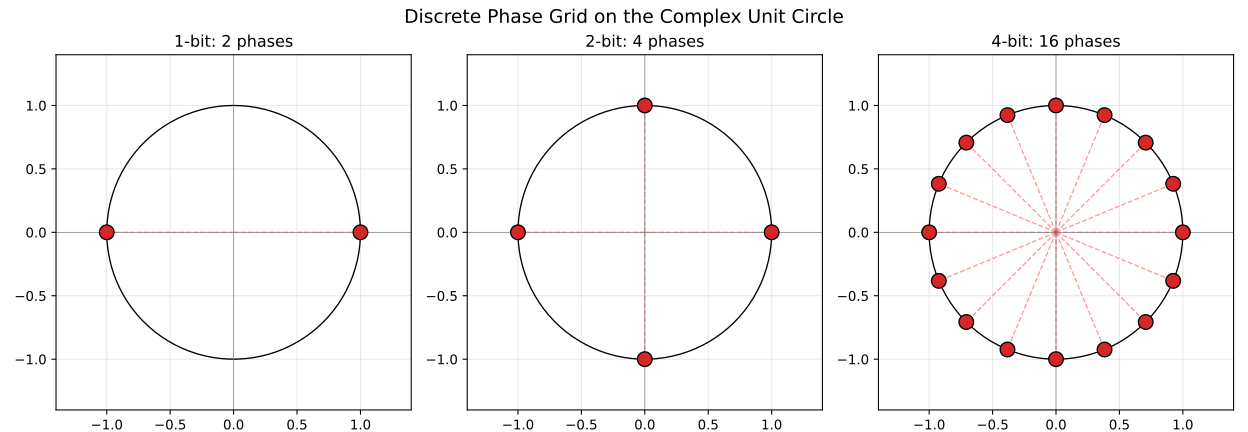
Let with be the -bit phase alphabet. The discrete feasible set is
The discrete-phase passive subproblem is
with PSD . The continuous-phase QCQP relaxes to ; the continuous problem is NP-hard, and the discrete version is strictly harder (at best the same, but typically combinatorially harder).
Theorem: Discrete-Phase QCQP Is NP-Hard
The discrete-phase unit-modulus QCQP with phase levels is NP-hard. Specifically:
- At (1-bit), the problem reduces to MAX-CUT, which is NP-hard (Karp 1972).
- For general , the problem can be reduced to 1-bit by discretization arguments.
The brute-force search space has configurations: at , that is . Exhaustive search is hopeless for any practical .
The continuous case is NP-hard (Ch. 6, Theorem 6.2); restricting to a discrete subset can only make the problem harder or equal — in this case, equal: both are NP-hard. The brute-force search space is , which is astronomically large even for modest .
Key Takeaway
Discrete-phase RIS is combinatorially hopeless — and pedagogically informative. No polynomial-time algorithm exists for the exact global optimum. Two practical routes: (1) continuous-then-project (Section 8.2), giving near-optimal solutions in polynomial time; (2) direct discrete optimization (Section 8.3), matching the continuous-project quality in most cases with similar cost. Both are approximate.
Two Routes to the Discrete Solution
Two algorithmic philosophies for the discrete-phase problem:
- Continuous-then-project: Solve the continuous-phase problem (Chapters 5–7), then project each onto the nearest discrete level. Simple, uses existing machinery, discretization loss of for coherent problems (Chapter 2, Theorem 2.4).
- Direct discrete optimization: Work natively in . Methods: discrete BCD (closed-form at each coordinate), branch-and-bound for small , tabu/simulated annealing heuristics, SDR + discrete randomization.
Section 8.2 develops the projection approach (simpler, usually sufficient), Section 8.3 the direct approach (slightly better for multi-user scenarios).
Example: Projection for a 2-bit RIS,
A continuous-phase solution is (radians). Project onto the 2-bit phase grid .
Grid boundaries
. Grid points at . Boundaries between grid cells: midpoints at .
Project each
- : nearest grid point is (distance ). Projected: .
- : between (dist ) and (dist ). Projected: .
- : between (dist ) and (dist ). Projected: .
Discretized $\boldsymbol{\theta}$
— a valid 2-bit configuration. The quantization error is , with max magnitude ✓.
Discrete Phase Grid on the Complex Unit Circle
Multi-User: Discretization Couples the Users
For single-user scenarios, the continuous-phase optimum projects cleanly: each element's optimal phase is independent of the others (), so rounding each is independently near-optimal.
For multi-user scenarios, the continuous-phase optimum has coupled coordinates — each depends on all others through the inter-user interference terms. Independent per-coordinate rounding can disrupt the coupling, giving a worse discrete solution than a more careful joint projection. Section 8.3's direct-discrete BCD is designed to handle this coupling.
Bit Budget vs. Element Count
A fixed hardware complexity budget (number of control pins) can be spent as either more elements at lower resolution, or fewer elements at higher resolution. The tradeoff:
- elements at -bit: control bits. Loss: per Theorem 2.4. Effective size: .
- at -bit: control bits. Loss: . Effective size: .
- at -bit: control bits. Loss: . Effective size: .
A fixed budget of control bits favors the higher-resolution option because coherent SNR is quadratic in : doubling at the cost of 1 fewer bit gives SNR, a favorable trade. So at hardware cost parity, more elements at lower resolution generally wins — but only if (below which the quantization loss erodes the scaling benefit).
- •
Control-bit budgets scale roughly with panel cost: - per bit/pin in volume.
- •
Phase resolution is standard for production RIS panels (losses dB).
- •
1-bit RIS is rare except in research prototypes (Arun and Balakrishnan 2020 RFocus).
Bit Budget: More Elements or More Bits?
For a fixed total control-bit budget , plot the effective coherent SNR as varies (with ). The curve shows the optimal tradeoff — typically - bits with the maximum allowed by the budget.
Parameters
Common Mistake: Don't Chase 1-Bit Because It's Simple
Mistake:
"1-bit RIS is cheapest; I'll build a huge panel and exploit the gain to beat all comers."
Correction:
1-bit costs — a coherent SNR penalty. To match 3-bit's performance, need . If control-bit budget is the constraint, - with moderate is typically the sweet spot. Go to 1-bit only if the pin/cost budget is very tight and you are happy with a penalty.