The STAR-RIS Concept
Breaking the Half-Space Barrier
Passive RIS reflects. Its physics is simple: an element sits in front of a ground plane, and incident waves can only go back to the half-space from which they came. This is a fundamental constraint: a user behind the RIS sees nothing. If the BS and UE are on opposite sides of an RIS panel, the classical architecture fails — the RIS shields rather than serves.
STAR-RIS (Simultaneously Transmitting and Reflecting RIS) removes this constraint by replacing the ground plane with a partially-transparent layer. Each element produces two waves: one reflected back to the incident half-space, and one transmitted through to the other side. The RIS now covers the full space — every direction a wave can reach. Multi-user deployments on both sides of the surface become natural.
The golden thread: the RIS still programs propagation, but now with two diagonals instead of one. Energy conservation ties them together: for passive hardware.
STAR-RIS
Simultaneously Transmitting and Reflecting Reconfigurable Intelligent Surface. Each element radiates waves in both half-spaces simultaneously (reflect + transmit), with coefficients satisfying . Enables full-space coverage from a single panel.
Related: Reflecting Ris, Energy Splitting (ES), Coupled Phases
Energy Splitting (ES)
A STAR-RIS protocol where each element continuously divides its incident energy between the reflection and transmission paths with per-element amplitudes satisfying . Best-performing protocol; requires continuous amplitude control hardware.
Related: STAR-RIS Joint Sum-Rate Problem (ES Protocol), Mode Switching
Definition: STAR-RIS System Model
STAR-RIS System Model
A STAR-RIS element has two outputs: a reflected wave (to the incident-side half-space) and a transmitted wave (to the opposite half-space). Each is characterized by a complex coefficient:
Stacking into diagonal matrices, and . For a user on the reflection side, the effective channel uses :
For a user on the transmission side:
The two half-spaces share the same (BS-to-RIS) but different / channels.
Note that passive RIS is the special case (no transmission) with . STAR-RIS reduces to passive RIS when all elements are set to "reflect-only" mode.
Theorem: Energy Conservation in Passive STAR-RIS
For any passive STAR-RIS element,
with equality for a perfectly lossless element. The phases can be independent only within certain hardware-specific relations — for instance, a common physical implementation (electric and magnetic currents) imposes
at each element. Whether the phases are fully independent or coupled defines the hardware model (symmetric, asymmetric, or fully coupled STAR-RIS).
A lossless passive element cannot create power. The incident wave splits into reflected + transmitted; the sum of their powers equals the incident power. Phases are free; amplitudes must respect conservation.
Passivity
A passive element has no power source. Total reflected power + transmitted power incident power.
Per-element coefficient bound
For a unit-power incident wave, reflected amplitude is and transmitted is . Squared-magnitude conservation gives .
Phase coupling from physics
In the electric-magnetic current model (Liu et al. 2021), the electric-current induced reflection and magnetic-current-induced transmission are naturally out of phase. Other implementations (purely dielectric, purely metallic) have different coupling.
Two Hardware Models: Coupled vs. Independent Phases
Two hardware implementations dominate the STAR-RIS literature:
- Coupled-phase model: . One phase controls both; easier to manufacture; slightly less flexible for optimization.
- Independent-phase model: are independent. Requires more complex hardware (both electric and magnetic control); fully flexible for optimization.
The coupled-phase model is physically realistic for most passive implementations; the independent-phase model is an idealization used in algorithmic studies. Some engineering realizations (active layers, meta-surfaces with separate E- and H-currents) approach the independent-phase ideal. We mainly work with the simpler independent-phase model below and flag where the coupled model would differ.
STAR-RIS: Full-Space Coverage Geometry
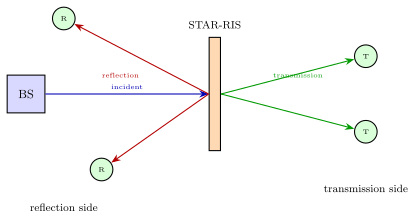
Key Takeaway
STAR-RIS extends passive RIS to full-space coverage. Each element has two independent (or coupled-) complex coefficients: for reflection and for transmission. Energy conservation constrains . The extra flexibility enables simultaneous multi-user coverage of both half-spaces, at the cost of more optimization variables and a more complex hardware design.
Example: Indoor-Outdoor Coverage from a Single Panel
A STAR-RIS panel is mounted on a building window. The BS is outside (serving outdoor pedestrian UEs via the reflection side), and indoor IoT devices are on the transmission side. How does STAR-RIS serve both user groups with one panel?
Reflection side
For outdoor UEs, the RIS appears as a conventional reflecting RIS: forms coherent beams toward each outdoor user. Received signal uses the coefficients.
Transmission side
For indoor UEs, the RIS acts as a window-transparent beamformer: shapes the transmitted beam. The BS signal passes through the RIS with controllable phase and amplitude, reaching indoor users who would otherwise have no outdoor-RIS path.
Simultaneous operation
Energy-splitting protocol (see Section 10.2): each element reflects a fraction of energy to outdoor UEs and transmits to indoor UEs. Optimal split per element depends on user priorities and channel strengths — solved jointly with .
Comparison to passive
With passive RIS: outdoor-only coverage. Indoor UEs would need a second RIS panel mounted inside. STAR-RIS saves one deployment point and halves the hardware cost for this common geometry.
Historical Note: STAR-RIS: From Academic Curiosity to Industry Standard
2021–presentThe idea of a transparent reconfigurable surface predates the RIS literature by decades — frequency-selective surfaces (FSS) of the 1990s could block some frequencies and pass others. The reconfigurable version, where transmission/reflection coefficients can be adjusted in real time, emerged around 2020 in Mu et al. (2022) and Xu et al. (2021), introducing the "STAR-RIS" name and the three-protocol framework.
Early prototypes used metamaterial metasurfaces with electric and magnetic resonators; commercial implementations have emerged in the 2024–2025 window. ETSI has begun drafting STAR-RIS standards as part of the broader RIS specification. What started as a theoretical curiosity has become the architectural default for any deployment where coverage through a barrier (window, wall with low attenuation) is required.
STAR-RIS Physical Realizations
Three hardware approaches to STAR-RIS:
- Chiral metasurface: orthogonal electric and magnetic layers enable independent control. Complex fabrication; research-grade at mmWave.
- Hybrid dielectric+metallic: dielectric transmission layer with metallic reflective patches. Coupled phases; easier to manufacture but less flexible.
- Amplifier-based (active STAR-RIS): each element has dual active amplifiers for r/t paths. Most flexible, most expensive, not covered here (see Ch. 9 for active RIS foundations).
Commercial implementations (ETSI 2024 draft) typically use option 2 with coupled- phases. Performance-focused research deployments use option 1.
- •
Typical reflection amplitude : - (rest transmitted or lost to material).
- •
Typical transmission amplitude : -.
- •
Combined loss (energy not reflected or transmitted): in good designs.
- •
Bandwidth: typically narrower than passive RIS (resonant structure more sensitive).
Common Mistake: Coupled vs. Independent Phases: Check Hardware
Mistake:
"Optimize and as two independent variables."
Correction:
Most passive STAR-RIS hardware imposes a coupling . Ignoring the coupling overestimates the achievable rate by - in typical scenarios. For independent-phase STAR-RIS (active or chiral-metasurface), the coupling can be dropped. Always verify the hardware model before running the optimization.