The Array-Fed RIS Architecture
Why mmWave Demands Array-Fed RIS
Conventional RIS deployments at mmWave face a hard trilemma: (1) the product path loss is brutal at - GHz, (2) active BS arrays need to be huge () to close the link budget, and (3) digital beamforming at large over GHz of bandwidth is prohibitive in power and cost. The conventional answer is hybrid analog-digital beamforming (MIMO Ch. 20–21) — but even that requires tight coordination between many RF chains.
The array-fed RIS takes a radically different approach: use a small active array (-) that is very close to a large passive RIS (-). The active array provides the baseband complexity (few RF chains, conventional digital precoding); the RIS provides the aperture gain (large physical area, passive). They combine to deliver massive-MIMO-like performance at - of the hardware cost. This is the CommIT Group's (Caire et al.) flagship architecture for 6G mmWave.
The golden thread: the RIS programs the propagation, but now its programmability is jointly designed with an active precoder that the RIS sees in the near field.
Array-Fed RIS
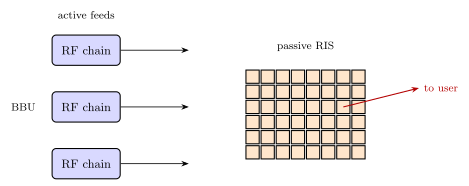
An architecture combining a small active antenna array with a large passive RIS panel placed in the array's near field. The active array provides digital baseband flexibility via few RF chains; the RIS provides aperture gain. The near-field BS-RIS channel is full-rank, enabling multi-user multiplexing through one passive surface.
Related: Near Field, Eigenmode Decomposition of
RIS Eigenmode
A singular-vector pair of the BS-RIS channel . The active array excites the -th eigenmode via ; the RIS then receives an excitation that can be focused toward user . Independent eigenmodes enable multi-user multiplexing in array-fed RIS.
Related: Array-Fed RIS Architecture, Svd
Definition: Array-Fed RIS Architecture
Array-Fed RIS Architecture
An array-fed RIS consists of:
- A small active array of antennas at the BS.
- A large passive RIS of elements.
- A short array-RIS distance such that the RIS is in the near-field of the array (i.e., , where is the active-array aperture).
The BS-to-RIS channel is a near-field channel, with rank governed by the near-field eigenmodes (not just the angular spread). Then is the (typically far-field) RIS-to-UE channel.
The system model is identical to Chapter 3's cascaded channel: , but the near-field structure of is the new engineering variable.
Theorem: Near-Field Eigenmode Rank of
For an array-fed configuration with active-array aperture , RIS aperture , array-RIS distance , and wavelength :
- Far-field regime (): where is the number of scattering paths (typically 1-3 in mmWave LoS).
- Near-field regime (): , where is the near-field "number of degrees of freedom."
In the array-fed RIS, we deliberately place the array in the near-field of the RIS: a few . The rank becomes approximately — full rank in .
In the far-field, a BS antenna "sees" the RIS as a single direction: has rank per LoS path. In the near-field, each active-array element has a slightly different path length and angle to each RIS element, giving a full-rank of rank under sufficient aperture geometry. Near-field gives us many eigenmodes; far-field gives us few.
Near-field spread function
Each active-array element sees each RIS element at slightly different range and angle. The per-element phase pattern across the RIS differs meaningfully across active-array elements (unlike far-field, where all active elements see a nearly identical plane wave).
Effective DoF
Standard near-field DoF theorem: the number of "resolvable beams" between two apertures of sizes and at distance is approximately . This is a generalization of the aperture-angle DoF to the near-field.
Choose $d_{\text{AR}}$ small
To maximize DoF, minimize . At few : , so full rank. This is the design sweet spot for array-fed RIS.
Array-Fed RIS Architecture Diagram
Array-Fed RIS vs. Conventional Alternatives
Three architectural alternatives at mmWave:
- Large fully-digital array (, ): best performance, prohibitive cost ( high-power ADCs at GHz).
- Hybrid analog-digital (, ): trades performance for cost. - dB below fully-digital.
- Array-fed RIS ( active + passive): trades both for hardware simplicity. Active array is conventional digital; RIS is near-field passive. Close to hybrid performance.
The array-fed RIS is the cost-effective third option. Its advantage grows as frequency increases (mmWave → sub-THz): active arrays become exponentially expensive, while passive RIS stays cheap per element.
Array-Fed RIS vs. Massive MIMO vs. Hybrid BF
Compare the sum-rate achievable by three architectures at matched cost: large fully-digital, hybrid analog-digital, and array-fed RIS. Vary the BS-UE distance; see how array-fed RIS dominates at mmWave/sub-THz where path loss is severe.
Parameters
Key Takeaway
Array-fed RIS: small active, large passive, near-field coupling. The active array provides digital-processing flexibility and multi-stream capability; the passive RIS provides aperture gain and physical coverage. They combine to approach massive-MIMO performance at - of the hardware cost — the key architectural argument for mmWave / sub-THz 6G.
Array-Fed RIS Deployment
Practical array-fed RIS deployment:
- Physical form: active array and passive RIS mounted on the same or adjacent structures, with few (e.g., - cm at 28 GHz, - cm at 140 GHz).
- Array-RIS alignment: the array must be near-field-centered on the RIS; off-axis alignment degrades the eigenmode structure.
- Integration: active array typically mounts on a rooftop; RIS panel on an adjacent wall or building facade; they are connected via a known-phase backhaul.
- Control latency: active array uses conventional BBU processing (ns latency). RIS controller uses a few-microsecond latency for phase reconfiguration.
- Calibration: the near-field BS-RIS link requires one-time high-accuracy calibration at deployment; subsequent drift is slow (months).
- •
Typical at 28 GHz: - cm.
- •
Total BS + RIS power: active array - W; RIS - W (passive).
- •
RIS panel size: - m² at mmWave, smaller at sub-THz.
- •
System cost: less than an equivalent fully-digital array.
Common Mistake: Don't Place the Array in the Far-Field of the RIS
Mistake:
"Put the array far from the RIS for convenience; the geometry doesn't matter too much."
Correction:
Array-fed RIS only works in the near-field configuration. If , the array-RIS channel becomes rank-1 (far-field), and the RIS sees the array as a single effective source — no eigenmode multiplexing. The architecture collapses to a conventional "weak BS + passive RIS" setup, losing all the multi-user multiplexing benefit. Always design as a rule of thumb, with a safety margin.