Multi-RIS System Model
One RIS Is Not Enough
Single-panel RIS solves a specific deployment problem: redirect a BS's signal around a blockage to reach one or a few users. For wide-area coverage — an entire street, a dense urban block, a multi-floor building — a single panel is not enough. Deployments in 6G will use multiple RIS panels, spatially distributed, cooperatively configured. This section formalizes the multi-RIS model and highlights how the optimization framework generalizes.
The golden thread continues to apply: each RIS panel programs its own slice of the propagation environment, and the joint optimization coordinates them. Panels can even cascade (signal bounces from panel 1 to panel 2 before reaching UE) — but this introduces new mathematical structure we treat in Section 12.2.
Multi-RIS
A deployment with RIS panels that jointly serve a set of users. Panels can be parallel (each bouncing BS signal independently to UEs, Section 12.1), cascaded (double-RIS, Section 12.2), or integrated with distributed APs (cell-free, Section 12.3).
Related: Double-RIS Cascaded Channel, Cell Free Ris
Definition: Multi-RIS Downlink System Model
Multi-RIS Downlink System Model
Consider a BS with antennas serving single-antenna users via RIS panels. Panel has elements and phase-shift matrix . Define:
- : BS-to-panel- channel.
- : panel--to-user- channel.
- : direct BS-to-user- channel.
Assuming parallel (no inter-panel cascading for now), the effective channel at user is
Each panel contributes one cascaded path; the contributions add coherently if the phases are aligned across panels.
Note the sum over . Multi-RIS superposes multiple cascaded paths — a form of spatial diversity. The effective channel has more gain potential than a single panel of the same total element count (because panels can be at different geometric positions, avoiding shadowing and accessing different scattering paths).
Theorem: Coherent Multi-RIS SNR Gain
Under coherent alignment across all panels with symmetric geometries (all panels at similar BS-to-UE distances), the coherent SNR scaling is
where are per-hop amplitudes and is the per-panel element count. Compared with a single panel of elements (if that were a valid deployment), multi-RIS gives the same coherent gain — but with geometric diversity (panels at different positions access different scattering paths). Under heterogeneous geometry, some panels serve better than others, giving even better aggregate performance via smart per-panel weighting.
Under coherent phase alignment across all panels, the cascaded signals add constructively. With panels of elements each, total elements combined. The coherent-sum SNR scales as — linear in squared, quadratic in .
Coherent sum
Each panel contributes . With coherent phases, these are all aligned: the sum amplitude is .
Squared
SNR .
Heterogeneity
If per-panel path losses differ, replace with panel-specific and sum contributions. Under optimal power allocation, worst panels contribute nothing; best panels dominate. Total gain bounded by the sum of per-panel gains.
Multi-RIS Urban Deployment
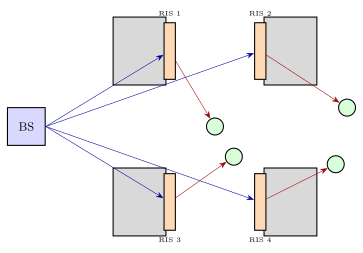
What Multi-Panel Actually Buys
Relative to a single large RIS panel of elements, multi- RIS offers:
- Geometric diversity: panels at different positions see different scattering environments. Robust to localized blockage.
- Coverage extension: panels on different facades reach different UE groups (angular diversity).
- Distributed deployment: easier to install multiple smaller panels than one huge panel.
- Scalability: can add panels incrementally as traffic grows.
Relative to a single RIS, multi-RIS offers:
- Graceful degradation: failure of one panel doesn't kill the link.
- Multi-user coverage: each panel can specialize in serving a subset of users.
- Aperture scaling: total elements instead of just .
The multi-panel architecture is the default for 6G deployments in dense environments.
Single RIS vs. Multi-RIS Coverage
Compare the coverage map (SNR heatmap) of a single RIS panel vs. distributed panels with the same total element count. Multi-RIS shows more uniform coverage and better blockage resilience.
Parameters
AO for Multi-RIS Joint Optimization
Complexity: where passive updates per iterationThe key addition over single-RIS AO: passive updates per iteration instead of 1. Each panel is updated holding the others fixed — a sequential BCD within the outer AO. Monotone convergence preserved.
Key Takeaway
Multi-RIS is the natural extension for wide-area coverage. The AO framework generalizes cleanly: passive-update subproblems per iteration, each solved by Chapter 6 algorithms. The real design question is not the algorithm — it's the deployment: where to put the panels, and how to allocate users to panels. Section 12.4 addresses this.
Common Mistake: Inter-Panel Coherence Requires Synchronized Control
Mistake:
"Multi-RIS just adds SNR contributions from each panel — deploy a few panels and expect coherent combining."
Correction:
Coherent combining across panels requires phase-aligned control: each panel must apply phases that are tuned to the same BS signal reference. Independent panels without synchronized control yield only incoherent summing (factor in power, not ). The controller must distribute a common time and phase reference to all panels. At mmWave, ns-level time synchronization is needed. Without it, multi-RIS degrades to SNR combining of independent paths — helpful but far from the coherent ideal.