ISAC Fundamentals and the RIS Role
One Waveform, Two Services
Integrated Sensing and Communications (ISAC) is the 6G architectural response to spectrum scarcity: instead of allocating separate bands to radar and wireless, design waveforms that simultaneously sense the environment and transmit data. Every ISAC waveform has a sensing face (ambiguity function, resolution, CRB) and a communication face (SINR, rate, coding). Optimizing both services jointly is the central ISAC problem.
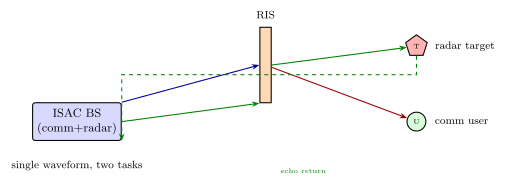
Adding RIS to ISAC is a natural extension. The RIS reshapes both the sensing path (radar-to-target-to-radar round-trip) and the communication path (BS-to-UE). Coherent RIS focusing simultaneously improves sensing SNR and communication SINR — sometimes in agreement, sometimes in conflict. The optimization finds the right balance.
The golden thread holds: the RIS programs the propagation environment for both radar and comm. In some deployment geometries, a single RIS panel serves both purposes; in others, the RIS is a dedicated sensing aid with communication-compatible phase control.
Definition: ISAC System Model with RIS
ISAC System Model with RIS
A RIS-aided ISAC system consists of:
- A BS with antennas transmitting a dual-purpose signal.
- single-antenna users receiving data.
- One radar target at position (with RCS ).
- A RIS panel of elements, shaping both paths.
The BS transmits where carries data. The signal is dual-function:
- Communication: each user receives through .
- Sensing: the transmitted signal illuminates the target (through the RIS), reflects back (through the RIS again), and the BS correlates to detect / estimate.
The RIS shapes the comm-path and the sensing-path . The optimization balances the two objectives.
Three RIS-ISAC deployment modes:
- RIS for both: one RIS reshapes both paths.
- RIS for comm, direct for sensing: classic beamforming for the radar, RIS only for coverage extension.
- RIS for sensing, direct for comm: radar relies on RIS to reach an otherwise invisible target.
Mode 1 is the most general and the focus of this chapter. Modes 2-3 simplify by effectively restricting to one purpose.
Theorem: Sensing SNR with RIS: Double Coherent Gain
Consider a BS-RIS-target-RIS-BS radar loop with coherent phase alignment at the RIS. The sensing SNR is
where are the BS-RIS and RIS-target amplitude path losses. The scaling (compared to for passive RIS comm) comes from coherent gain on the outgoing and return paths. The two-way path loss is compensated by this quartic gain.
For a target at distance from the RIS, with being the BS-RIS and RIS-target path amplitudes: .
Radar return traverses the BS-to-target-to-BS path twice through the RIS (once going out, once coming back). Coherent combining at both passes gives gain per pass — total! For : . A colossal number, offsetting the two-way path loss that plagues bi-static radar.
Outgoing path
BS transmits through to RIS, reflects toward target. Coherent at RIS output: amplitude (one N for each hop). Incident power at target: .
Target scattering
Target has RCS ; backscatters. Reflected signal from target: proportional to times incident amplitude.
Return path
Backscattered signal traverses (target-to-RIS) and (RIS-to-BS). RIS coherently focuses back to BS: another amplitude factor per hop. Received at BS: amplitude , power .
SNR
.
Key Takeaway
RIS gives sensing SNR gain via double coherent passes. Compared to communication (), sensing benefits more from RIS because the signal passes through the RIS twice (out and back). This quartic gain is the central appeal of RIS-ISAC: at , the RIS adds dB to the radar SNR.
RIS-Aided ISAC Deployment
Why RIS-ISAC Is Harder Than RIS-Comm
Adding sensing to RIS optimization introduces new complications:
- Two objectives, one : the RIS phases must serve both comm and sensing simultaneously. The phase profile for maximum radar SNR (focus on target) is generally different from the profile for maximum comm SINR (focus on users). The optimization finds a compromise.
- Different optimization metrics: comm uses SINR or rate; sensing uses CRB or beampattern MSE. They are not directly comparable; requires multi-objective optimization.
- Quasi-static target: sensing applications often assume a slow-moving target (seconds), while comm adapts faster (ms). Two-timescale operation.
- Interference coupling: the data signal creates sensing interference (self-jamming), and the sensing waveform leaks energy to non-user directions. Careful waveform + phase design.
RIS-ISAC: Comm SINR vs. Sensing SNR Tradeoff
Tradeoff between communication SINR (per-user) and sensing SNR (radar) as a function of the weight parameter that balances the two objectives. At : full communication focus. At : full sensing focus. The Pareto-optimal curve shows the achievable region.
Parameters
Common Mistake: Don't Conflate Sensing Gain with Comm Gain
Mistake:
"The RIS gives gain to the link — sensing gets the same."
Correction:
Communication sees the signal pass through the RIS once (BS→UE): coherent gain. Sensing sees the signal pass through twice (BS→target→BS, round-trip): gain. The two gains are fundamentally different. When comparing RIS-ISAC benefit, distinguish carefully: at , communication gain is dB while sensing gain is dB. RIS is disproportionately more valuable for sensing than for communication.
RIS-ISAC Target Scenarios
Where RIS-ISAC shines:
- Smart-city sensing: RIS panels on street facades simultaneously serve pedestrian UEs and sense vehicular traffic (automotive radar alternative).
- Automotive V2X: roadside RIS extends radar sensing around corners and blind spots, while serving vehicle comms.
- Indoor industrial: RIS panels track machinery / workers while maintaining factory-wide coverage.
- Terahertz imaging + comm: RIS is the only practical way to achieve useful sensing range at sub-THz (the path loss is otherwise too severe).
Where RIS-ISAC is a weaker fit:
- Radar-only applications with no comm users (just use a dedicated radar).
- Comm-only with no sensing value (use conventional RIS).
- Scenarios with extreme mobility (sensing coherence time too short).
- •
Typical RIS-ISAC deployment: - elements, mmWave 28-60 GHz.
- •
Sensing range: up to m at 28 GHz with .
- •
Communication + sensing simultaneously in the same beam: possible; requires careful waveform design.
- •
ETSI RIS 001 includes ISAC use cases (2024 draft).