RIS Localization Signal Model
Why Positioning Is a RIS Killer App
Conventional positioning uses trilateration from multiple base stations (GPS-style) or fingerprinting. Both struggle indoors and in dense urban: GPS signals don't penetrate, and fingerprint databases require expensive calibration. RIS-aided localization offers a third way: a known RIS panel acts as a reference point with precisely known geometry. UE signals bouncing off the RIS encode positional information in their phase patterns.
The golden thread: the RIS programs the propagation environment. For localization, it literally shapes the signal to reveal position information. Near-field RIS operation is especially powerful because wavefront curvature across the aperture directly encodes UE distance — a strong "range" measurement that conventional far-field positioning cannot exploit.
Definition: RIS-Aided Positioning Signal Model
RIS-Aided Positioning Signal Model
Consider a BS with antennas, a known RIS with elements at fixed position , and a UE at unknown position . The BS transmits a known pilot , reaching the UE via the cascaded path through the RIS.
The received signal at the UE is
where the effective channel explicitly depends on UE position :
The -dependence lives in both the direct channel and the RIS-to-UE channel ; in the near-field regime, this dependence includes quadratic phase terms that encode distance, not just angle.
Conventional far-field positioning: depends on only through AOA . Estimate AOA → get a bearing line; intersect with multiple bearings → triangulate.
Near-field RIS positioning: depends on through AOA and distance. A single near-field measurement gives direct position information; no triangulation needed. This is the central algorithmic advantage.
Theorem: Near-Field RIS: Direct Range + Angle Estimation
For a UE at position in the near-field of the RIS (), the per-element RIS-to-UE phase is
where is the position of RIS element . Expanding in the near-field (but not far-field) regime:
where is the RIS-UE distance and is a unit vector. The first two terms are the far-field linear phase (gives AOA). The third term is a quadratic in — this encodes distance .
The simultaneous presence of linear + quadratic terms means a single RIS panel in the near-field can estimate both position components. In the far-field, only AOA is observable — one bearing line only.
In the far-field, the RIS-to-UE channel is a plane wave from the RIS's perspective: per-element phases are linear in element index. Only angle is observable. In the near-field, per-element distances to the UE differ, producing a quadratic (not linear) phase pattern across the aperture. Both angle and distance are encoded.
Exact per-element phase
(free-space propagation). Each element's distance to the UE depends on its position.
Taylor expansion
Expand around the RIS center . First-order: linear in (gives AOA). Second-order: quadratic in (gives range).
Observability
Far-field: only first-order term dominates; single panel gives AOA only. Near-field: second-order term is significant; single panel gives range + AOA → full 3D position from one measurement.
Key Takeaway
Near-field RIS gives single-panel 3D positioning. The wavefront curvature across the RIS aperture encodes UE distance; phase variation across elements encodes angle. A single panel in the near-field observes both — no triangulation needed. This is a fundamentally different (and simpler) positioning architecture than GPS-style trilateration.
Example: Indoor Positioning with a RIS Panel
Indoor warehouse with a RIS panel on the ceiling. BS is external; UE is at unknown position inside the warehouse (walls blocking direct path). RIS: , GHz. Warehouse dimensions: m.
Near-field check
RIS aperture: m² at , spacing. m. m. Warehouse size m . UEs are near-field. ✓
Single-panel positioning
Near-field enables position estimation from one RIS alone. Per-element phase pattern encodes both angle (direction from panel) and distance (range from panel).
Expected accuracy
Angular CRB: (from aperture). Range CRB: depends on SNR and aperture; at dB SNR, few centimeters. Position CRB: combined angular + range gives cm-level accuracy in the warehouse. Compared with GPS ( m indoors, often unusable): orders-of-magnitude improvement.
Deployment
Single RIS panel on ceiling serves as reference point. UEs send pilots; BS processes them through the panel and estimates position via FIM methods (Section 14.2).
Near-Field RIS Positioning Geometry
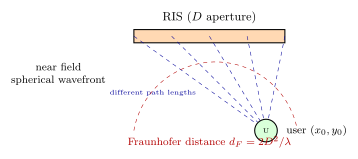
Near-Field vs. Far-Field Positioning: Phase Pattern
Visualize the RIS-side phase pattern for a UE at different distances from the panel. Near-field: curved (quadratic) phase pattern encoding distance. Far-field: linear phase (AOA only). The transition happens around the Fraunhofer distance.
Parameters
Handling NLoS via RIS
A remarkable feature of RIS localization: the UE and BS need not have a direct LoS. The RIS can act as a "virtual LoS" bouncing signals around blockages. For a UE at :
- Direct BS-UE channel is blocked (no direct LoS).
- BS-RIS and RIS-UE channels are LoS (geometry-engineered).
- BS-RIS-UE cascaded path reaches the UE with known RIS phase and position information.
This is the NLoS-robust feature of RIS positioning: as long as the RIS has LoS to both BS and UE, positioning works. Compare with GPS-denial in indoor/urban canyon scenarios, where every direct path is blocked.
Common Mistake: Don't Assume Far-Field in Localization
Mistake:
"RIS localization works like GPS — get bearings from each panel, triangulate."
Correction:
Near-field positioning is fundamentally different from far-field AOA-only positioning. A single near-field RIS panel gives a full 3D position fix via distance + angle; far-field panels require multiple measurements or triangulation.
Checking the regime:
- At 28 GHz with a 30-cm RIS aperture: m. Indoor UEs typically at m — near-field is the rule, not exception.
- At 100 GHz (sub-THz): grows; near-field range shrinks. Design the RIS aperture carefully.
Assuming far-field when in near-field discards the distance information; accuracy falls from cm-level to meter-level.