The array and array_ufunc Protocols
Making Custom Objects Play Nicely with NumPy
NumPy defines several protocols that let custom objects integrate seamlessly
with NumPy functions. When you call np.sin(my_object), NumPy doesn't need
to know about your class — it asks your object how to handle the operation
through well-defined dunder methods.
This is the foundation of libraries like CuPy, JAX, and Dask that provide NumPy-compatible interfaces without being NumPy.
Definition: The array Protocol
The array Protocol
The __array__ method tells NumPy how to convert your object to an ndarray.
NumPy calls this whenever it needs to operate on your object:
class PhysicalQuantity:
    """A value with units that converts to raw NumPy array."""

    def __init__(self, value: np.ndarray, unit: str = "V"):
        self._value = np.asarray(value)
        self.unit = unit

    def __array__(self, dtype=None, copy=None) -> np.ndarray:
        if dtype is not None:
            return self._value.astype(dtype)
        return self._value

    def __repr__(self) -> str:
        return f"PhysicalQuantity({self._value}, unit='{self.unit}')"
Now np.array(PhysicalQuantity([1, 2, 3])) works, and so does
np.mean(PhysicalQuantity([1, 2, 3])).
Definition: The array_ufunc Protocol
The array_ufunc Protocol
__array_ufunc__ intercepts NumPy universal function (ufunc) calls on custom
objects. It gives your class full control over how operations like np.add,
np.multiply, and np.sin are handled:
class PhysicalQuantity:
    # ... (previous code) ...

    def __array_ufunc__(self, ufunc, method, *inputs, **kwargs):
        """Intercept NumPy ufunc calls to preserve units."""
        # Convert all PhysicalQuantity inputs to raw arrays
        raw_inputs = []
        units = set()
        for inp in inputs:
            if isinstance(inp, PhysicalQuantity):
                raw_inputs.append(inp._value)
                units.add(inp.unit)
            else:
                raw_inputs.append(inp)

        # Apply the ufunc to raw arrays
        result = getattr(ufunc, method)(*raw_inputs, **kwargs)

        # Wrap result back in PhysicalQuantity
        if len(units) == 1:
            return PhysicalQuantity(result, unit=units.pop())
        return result  # mixed units: return raw
The signature is always (self, ufunc, method, *inputs, **kwargs) where
method is typically '__call__', 'reduce', 'accumulate', or 'outer'.
Definition: The array_function Protocol
The array_function Protocol
While __array_ufunc__ handles element-wise operations (ufuncs),
__array_function__ (NEP 18) intercepts all NumPy functions including
np.concatenate, np.linalg.norm, np.fft.fft, etc.:
import functools

HANDLED_FUNCTIONS = {}

def implements(np_function):
    """Register an implementation for a NumPy function."""
    def decorator(func):
        HANDLED_FUNCTIONS[np_function] = func
        return func
    return decorator

class PhysicalQuantity:
    def __array_function__(self, func, types, args, kwargs):
        if func not in HANDLED_FUNCTIONS:
            return NotImplemented
        return HANDLED_FUNCTIONS[func](*args, **kwargs)

@implements(np.concatenate)
def concatenate(arrays, axis=0):
    raw = [np.asarray(a) for a in arrays]
    units = {a.unit for a in arrays if isinstance(a, PhysicalQuantity)}
    result = np.concatenate(raw, axis=axis)
    if len(units) == 1:
        return PhysicalQuantity(result, unit=units.pop())
    return result
This is how libraries like pint and astropy.units provide transparent
NumPy integration.
Theorem: NumPy Ufunc Dispatch Priority
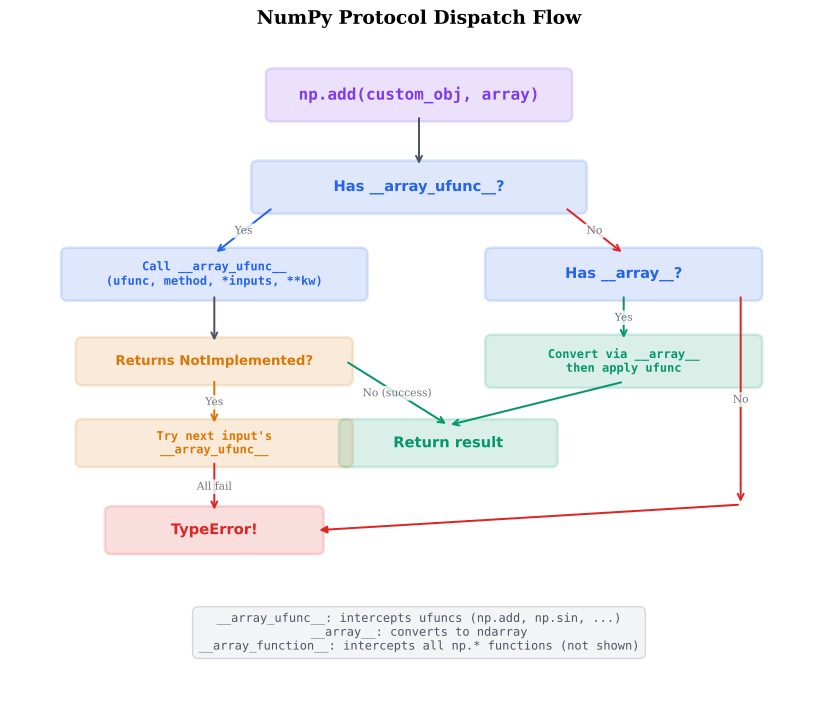
When a NumPy ufunc is called with mixed types (e.g., np.add(custom_obj, ndarray)),
NumPy checks __array_ufunc__ on each input in order. If an input returns
NotImplemented, NumPy tries the next input. The dispatch priority is:
- Subclasses of
ndarrayare checked before non-subclasses - Among non-subclasses, inputs are checked left to right
- If all inputs return
NotImplemented, NumPy raisesTypeError - Setting
__array_ufunc__ = Noneopts a class out entirely, forcingTypeErrorimmediately
This ensures that custom types can always override default NumPy behavior without monkey-patching.
Think of it like Python's __radd__ mechanism but generalized to all
ufuncs. The key design principle is that custom types always get a chance
to handle the operation before NumPy falls back to converting them to
arrays.
Example: Building a Unit-Aware Array Class
Create a PhysicalQuantity class that wraps a NumPy array with a unit
string. It should work transparently with NumPy ufuncs (addition, multiplication,
trigonometric functions) while preserving or computing the correct units.
Core class with __array__ and __array_ufunc__
import numpy as np

class PhysicalQuantity:
    def __init__(self, value, unit="dimensionless"):
        self._value = np.asarray(value, dtype=float)
        self.unit = unit

    def __array__(self, dtype=None, copy=None):
        return self._value if dtype is None else self._value.astype(dtype)

    def __repr__(self):
        return f"PQ({self._value}, '{self.unit}')"

    def __array_ufunc__(self, ufunc, method, *inputs, **kwargs):
        raw = [np.asarray(i) if isinstance(i, PhysicalQuantity) else i
               for i in inputs]
        units = [i.unit for i in inputs if isinstance(i, PhysicalQuantity)]

        result = getattr(ufunc, method)(*raw, **kwargs)

        # Determine output unit
        if ufunc in (np.add, np.subtract):
            if len(set(units)) > 1:
                raise ValueError(f"Cannot {ufunc.__name__} different units: {units}")
            return PhysicalQuantity(result, units[0])
        elif ufunc in (np.multiply,):
            new_unit = "*".join(units) if len(units) > 1 else units[0]
            return PhysicalQuantity(result, new_unit)
        elif ufunc in (np.sin, np.cos, np.exp, np.log):
            return PhysicalQuantity(result, "dimensionless")
        return result
Testing NumPy interop
voltage = PhysicalQuantity([1.0, 2.0, 3.0], "V")
current = PhysicalQuantity([0.1, 0.2, 0.3], "A")

# Addition (same units)
v_sum = np.add(voltage, PhysicalQuantity([0.5, 0.5, 0.5], "V"))
print(v_sum)  # PQ([1.5, 2.5, 3.5], 'V')

# Multiplication (different units)
power = np.multiply(voltage, current)
print(power)  # PQ([0.1, 0.4, 0.9], 'V*A')

# Mean (via ufunc reduce)
print(np.mean(voltage))  # Works via __array__ fallback

# Error on mismatched units
np.add(voltage, current)  # ValueError: Cannot add different units
NumPy Interop Benchmark
Compare the performance overhead of custom array classes using array_ufunc vs. plain NumPy arrays. See how the overhead scales with array size and operation complexity.
Parameters
NumPy Protocol Dispatch Flow
Common Mistake: Forgetting copy Semantics in array
Mistake:
class MyArray:
    def __array__(self, dtype=None, copy=None):
        return self._data  # Returns a reference, not a copy!

obj = MyArray(np.array([1, 2, 3]))
arr = np.array(obj)
arr[0] = 999  # Modifies obj._data too!
Correction:
class MyArray:
    def __array__(self, dtype=None, copy=None):
        if copy is False:
            # NumPy 2.0+: caller explicitly wants no copy
            return self._data.view()
        return self._data.copy()  # Safe: return a copy by default
NumPy 2.0 added the copy parameter to __array__. Handle it to support
both zero-copy views and safe copies.
The cuda_array_interface for GPU Interop
Just as __array__ enables NumPy interop, __cuda_array_interface__ enables
GPU array interop between CuPy, PyTorch, Numba CUDA, and other GPU libraries:
class GPUSignal:
    """Signal stored on GPU with CuPy interop."""

    def __init__(self, data_gpu):
        self._data = data_gpu  # CuPy array

    @property
    def __cuda_array_interface__(self):
        return self._data.__cuda_array_interface__
This protocol exposes the GPU memory pointer, shape, dtype, and strides, enabling zero-copy data exchange between GPU libraries.
Universal Function (ufunc)
A NumPy function that operates element-wise on arrays (e.g., np.add, np.sin, np.exp). Custom classes can intercept ufunc calls via __array_ufunc__.
Related: Array Protocol
Array Protocol
A set of dunder methods (__array__, __array_ufunc__, __array_function__) that let custom objects integrate with NumPy's dispatch system.
Related: Universal Function (ufunc)
Quick Check
What happens when you call np.add(custom_obj, np_array) and custom_obj.__array_ufunc__ returns NotImplemented?
NumPy raises TypeError immediately
NumPy falls back to calling array on custom_obj
NumPy checks np_array's array_ufunc next
The operation returns NotImplemented
NumPy checks each input's array_ufunc in order. If all return NotImplemented, it raises TypeError.
NumPy Interop Protocols
# Code from: ch03/python/numpy_interop.py
# Load from backend supplements endpointKey Takeaway
NumPy's __array__, __array_ufunc__, and __array_function__ protocols let
custom classes integrate seamlessly with the NumPy ecosystem. Implement
__array__ for basic conversion, __array_ufunc__ for element-wise operations,
and __array_function__ for full NumPy API coverage. The __cuda_array_interface__
extends this pattern to GPU interop.