Broadcasting
Broadcasting: NumPy's Killer Feature
Broadcasting is the mechanism that lets NumPy operate on arrays of different shapes without explicit loops or data replication. Adding a scalar to an array, adding a row vector to every row of a matrix, or computing pairwise distances between point clouds — all of these are broadcasting in action.
Mastering broadcasting is what separates "I use NumPy" from "I think in NumPy."
Definition: Broadcasting
Broadcasting
Broadcasting is NumPy's mechanism for performing element-wise operations on arrays with different shapes. Instead of replicating data, NumPy virtually stretches the smaller array to match the larger one.
a = np.array([[1, 2, 3],
              [4, 5, 6]])   # shape (2, 3)
b = np.array([10, 20, 30])  # shape (3,)

c = a + b    # b is broadcast to shape (2, 3)
# c = [[11, 22, 33],
#      [14, 25, 36]]
No data is copied: NumPy uses stride tricks internally (stride 0 along the broadcast axis).
Definition: Broadcasting Rules
Broadcasting Rules
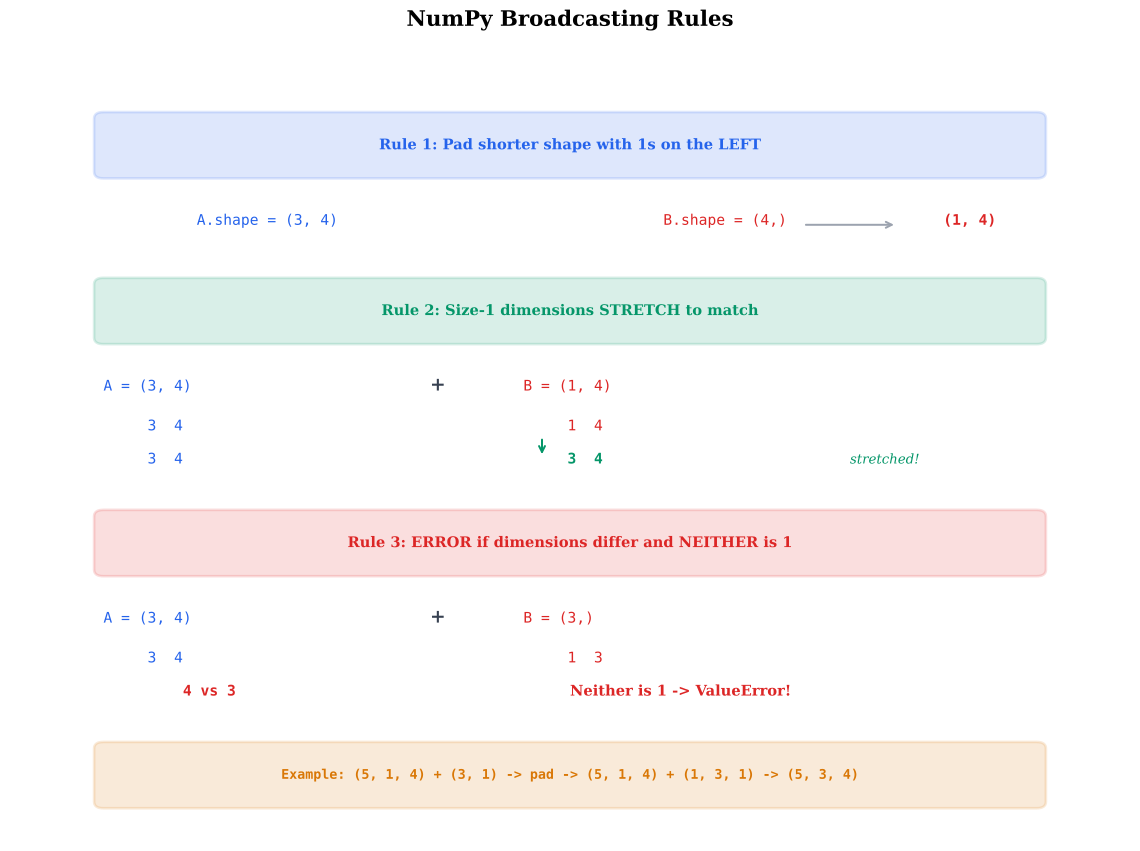
Two arrays are compatible for broadcasting if, for each trailing dimension (aligning shapes from the right):
- The dimensions are equal, OR
- One of them is 1 (or missing)
When a dimension is 1 or missing, it is stretched to match the other.
Examples:
| Shape A | Shape B | Result | Rule Applied |
|---|---|---|---|
(3, 4) |
(4,) |
(3, 4) |
B gets axis 0 of size 1, stretched to 3 |
(3, 1) |
(1, 4) |
(3, 4) |
A stretched along axis 1, B along axis 0 |
(5, 3, 4) |
(3, 1) |
(5, 3, 4) |
B gets axis 0, axis 2 stretched |
(3, 4) |
(3,) |
Error | Trailing dims 4 vs 3 — incompatible |
Definition: np.newaxis and Explicit Axis Insertion
np.newaxis and Explicit Axis Insertion
np.newaxis (alias for None) inserts a length-1 axis, enabling
broadcasting along that dimension:
a = np.array([1, 2, 3])      # shape (3,)
b = np.array([10, 20])       # shape (2,)

# Cannot add directly: shapes (3,) and (2,) are incompatible
# Solution: insert axes to create outer product structure
c = a[:, np.newaxis] + b[np.newaxis, :]
# a[:, np.newaxis] has shape (3, 1)
# b[np.newaxis, :] has shape (1, 2)
# result has shape (3, 2) — broadcasting as outer addition
Equivalent to np.expand_dims(a, axis=1).
Theorem: Broadcasting Compatibility Theorem
Arrays with shapes and are broadcast-compatible if and only if, after left-padding the shorter shape with 1s to equalize lengths, every pair of corresponding dimensions satisfies or .
The output shape is .
Broadcasting aligns dimensions from the right (like aligning decimal points). Missing dimensions on the left are treated as size 1. A size-1 dimension can be "stretched" to any size because repeating a single value is always valid.
Theorem: Broadcasting as Implicit Outer Products
For 1-D arrays and ,
the operation u[:, None] * v[None, :] computes the outer product
without forming
any intermediate copies.
Inserting axes creates shapes (m, 1) and (1, n). Broadcasting
stretches both to (m, n) and multiplies element-wise, which is
exactly the outer product definition:
.
Example: Adding Bias Vector to Batch of Samples
Given a batch of 100 samples with 5 features (shape (100, 5)) and
a bias vector of shape (5,), add the bias to each sample using
broadcasting. Then compute per-feature means.
Broadcasting addition
rng = np.random.default_rng(42)
X = rng.standard_normal((100, 5))    # shape (100, 5)
bias = np.array([1.0, -2.0, 0.5, 3.0, -1.5])  # shape (5,)

# Broadcasting: (100, 5) + (5,) -> (100, 5)
X_biased = X + bias

# Per-feature means (should be close to bias values)
print(X_biased.mean(axis=0))
# ~ [1.0, -2.0, 0.5, 3.0, -1.5]
Example: Pairwise Distances via Broadcasting
Compute the pairwise Euclidean distance matrix for points in 2-D
using broadcasting (no loops, no np.tile).
Broadcasting approach
points = rng.standard_normal((50, 2))  # 50 points in 2-D

# Expand dims for broadcasting:
# points[:, None, :] has shape (50, 1, 2)
# points[None, :, :] has shape (1, 50, 2)
diff = points[:, None, :] - points[None, :, :]   # (50, 50, 2)
dist = np.sqrt((diff ** 2).sum(axis=-1))          # (50, 50)

print(dist.shape)           # (50, 50)
print(dist[0, 0])           # 0.0 (distance to self)
assert np.allclose(dist, dist.T)  # symmetric
Example: Avoiding np.tile and np.repeat
Show why np.tile / np.repeat are almost never needed when
broadcasting is available.
Wasteful approach with np.tile
a = np.arange(5)              # shape (5,)
b = np.arange(3)              # shape (3,)

# BAD: explicitly replicate data
a_tiled = np.tile(a, (3, 1))  # shape (3, 5) — copies data
b_tiled = np.tile(b, (5, 1)).T  # shape (3, 5) — copies data
result_bad = a_tiled + b_tiled

# GOOD: broadcasting (no data copied)
result_good = a[np.newaxis, :] + b[:, np.newaxis]  # (3, 5)

assert np.array_equal(result_bad, result_good)
# result_good uses zero memory overhead beyond the output
Broadcasting Step-by-Step Visualizer
See how broadcasting works for different shape combinations. Watch dimensions align from the right, stretch, and produce the output shape.
Parameters
Broadcasting Animation
Animated visualization showing how NumPy broadcasts arrays step by step: padding shapes, stretching size-1 dimensions, and computing the result.
Parameters
Broadcasting Rules
Broadcasting vs np.tile / np.repeat
| Aspect | Broadcasting | np.tile / np.repeat |
|---|---|---|
| Memory | Zero extra allocation (stride tricks) | Copies entire array |
| Speed | Fast (no data movement) | Slower (allocation + copy) |
| Readability | Concise once you learn the rules | Explicit but verbose |
| When to use | Almost always | When you truly need a replicated array in memory |
| Example | a[:, None] + b[None, :] | np.tile(a, (n, 1)) + np.tile(b, (1, m)) |
Quick Check
What is the result shape of np.ones((3, 1)) + np.ones((1, 4))?
(3, 4)
(3, 1, 4)
Error: incompatible shapes
(1, 4)
(3, 4)Broadcasting: (3,1) and (1,4) -> stretch to (3,4).
Common Mistake: Trailing Dimension Mismatch
Mistake:
Trying to add arrays with incompatible trailing dimensions:
a = np.ones((3, 4))
b = np.ones((3,))
c = a + b   # ValueError: shapes (3,4) and (3,) not aligned
Trailing dims: 4 vs 3 — neither is 1, so broadcasting fails.
Correction:
Reshape b to make the dimension alignment explicit:
c = a + b[:, np.newaxis] # (3, 4) + (3, 1) -> (3, 4)
broadcasting
NumPy's mechanism for performing element-wise operations on arrays with different shapes by virtually stretching size-1 dimensions.
Related: np.newaxis and Explicit Axis Insertion, outer product
Broadcasting Patterns
# Code from: ch05/python/broadcasting_patterns.py
# Load from backend supplements endpointKey Takeaway
Broadcasting aligns dimensions from the right and stretches size-1
axes. It replaces np.tile / np.repeat with zero-copy virtual
expansion. The pattern a[:, None] + b[None, :] creates outer
operations — master this and you rarely need explicit loops.