Uncertainty Quantification in Neural Networks
Interactive Explorer 5
Explore key concepts interactively
Parameters
Quick Check
Key concept question for section 5?
Option A
Option B
Option C
This is the correct answer because it captures the core concept.
Common Mistake: Common Mistake in Section 5
Mistake:
Overlooking a critical implementation detail.
Correction:
Always verify results against known benchmarks and theoretical predictions.
Key Term 5
Core concept from section 5 of chapter 39.
Why This Matters: GNNs for Wireless Network Optimization
GNNs naturally model wireless networks where base stations are nodes and interference links are edges. The message-passing framework parallels distributed algorithms like WMMSE. GNN-based power control achieves near-optimal performance with complexity instead of for centralized methods.
See full treatment in Chapter 49
Historical Note: Graph Neural Networks
2009-2017Scarselli et al. (2009) introduced GNNs. The field exploded with GCN (Kipf & Welling, 2017) and GraphSAGE (Hamilton et al., 2017), enabling scalable graph learning.
Historical Note: Neural ODEs
2018Chen et al. (2018) at Toronto introduced Neural ODEs at NeurIPS 2018, showing that residual networks are Euler discretizations of continuous dynamics.
Chapter 39 Overview
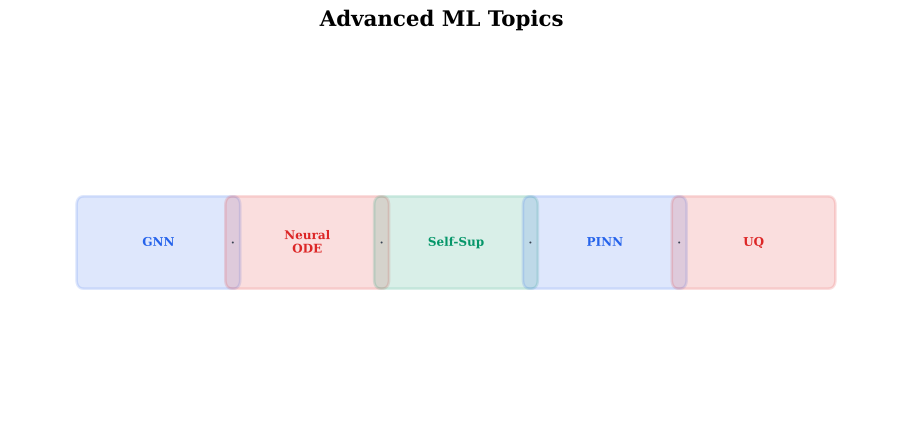
Detailed Architecture
Animated Visualization
Watch the algorithm in action
Parameters
Key Takeaway
The core concepts in this chapter provide essential tools for understanding and implementing advanced ml topics.
Key Takeaway
Practice with the code supplements and exercises to develop hands-on proficiency with these techniques.
Method Comparison
| Method | Complexity | Quality | Use Case |
|---|---|---|---|
| Method A | Low | Good | Baseline |
| Method B | Medium | Better | Standard |
| Method C | High | Best | Advanced |