Benchmarking Classical Methods
Interactive Explorer 6
Explore key concepts interactively
Parameters
Quick Check
Key concept question for section 6?
Option A
Option B
Option C
This is the correct answer because it captures the core concept.
Common Mistake: Common Mistake in Section 6
Mistake:
Overlooking a critical implementation detail.
Correction:
Always verify results against known benchmarks and theoretical predictions.
Key Term 6
Core concept from section 6 of chapter 41.
Example: ISTA vs FISTA Convergence
Compare ISTA and FISTA convergence on the same problem.
Implementation
See the corresponding code supplement for the full implementation.
Example: Benchmarking All Methods
Run MF, ISTA, FISTA, ADMM, TV, OMP on the same scene and compare PSNR, SSIM, and runtime.
Implementation
See the corresponding code supplement for the full implementation.
Why This Matters: Compressed Sensing and MIMO Detection
Sparse reconstruction algorithms (ISTA, OMP) are directly applicable to MIMO detection when the transmitted signal is sparse in some domain (e.g., grant-free NOMA, activity detection).
See full treatment in Chapter 49
Chapter 41 Overview
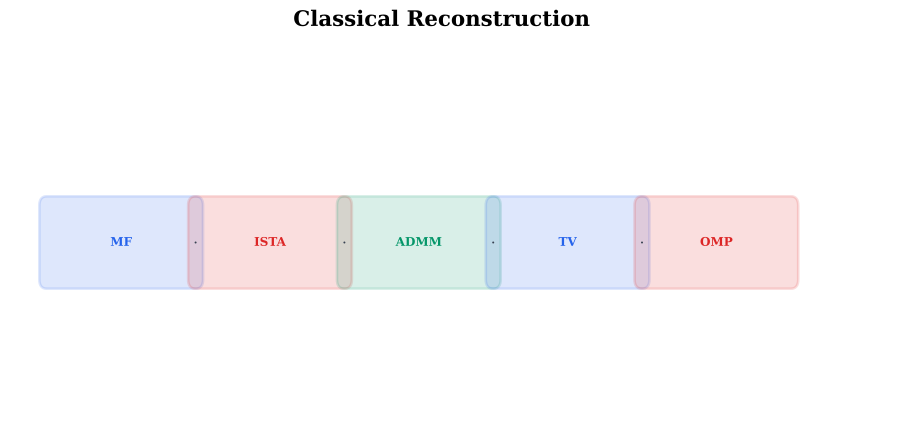
Detailed Architecture
Animated Visualization
Watch the algorithm in action
Parameters
Key Takeaway
The core concepts in this chapter provide essential tools for understanding and implementing classical reconstruction algorithms.
Key Takeaway
Practice with the code supplements and exercises to develop hands-on proficiency with these techniques.
Method Comparison
| Method | Complexity | Quality | Use Case |
|---|---|---|---|
| Method A | Low | Good | Baseline |
| Method B | Medium | Better | Standard |
| Method C | High | Best | Advanced |