Job Management and Cluster Computing
Interactive Explorer 4
Explore key concepts interactively
Parameters
Quick Check
Key concept question for section 4?
Option A
Option B
Option C
This is the correct answer because it captures the core concept.
Common Mistake: Common Mistake in Section 4
Mistake:
Overlooking a critical implementation detail.
Correction:
Always verify results against known benchmarks and theoretical predictions.
Key Term 4
Core concept from section 4 of chapter 46.
Example: SLURM Job Array for Parameter Sweep
Submit 100 experiments as a SLURM job array with different hyperparameters.
Implementation
See the corresponding code supplement for the full implementation.
Example: Bidirectional Code Sync
Set up rsync-based bidirectional sync between local and remote.
Implementation
See the corresponding code supplement for the full implementation.
Why This Matters: Remote GPUs for Wireless ML
Training deep learning models for wireless (channel estimation, detection, reconstruction) requires GPUs. Remote development workflows enable using shared GPU clusters efficiently.
See full treatment in Chapter 49
Chapter 46 Overview
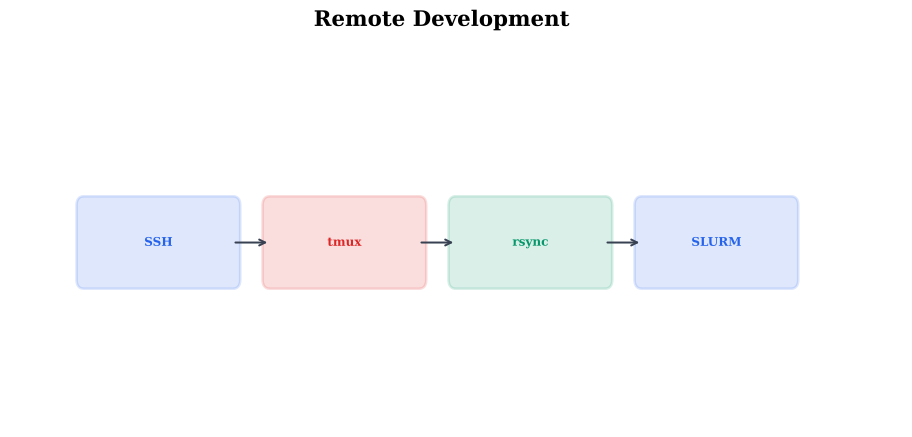
Detailed Architecture
Animated Visualization
Watch the algorithm in action
Parameters
Key Takeaway
The core concepts in this chapter provide essential tools for understanding and implementing remote development workflow.
Key Takeaway
Practice with the code supplements and exercises to develop hands-on proficiency with these techniques.
Method Comparison
| Method | Complexity | Quality | Use Case |
|---|---|---|---|
| Method A | Low | Good | Baseline |
| Method B | Medium | Better | Standard |
| Method C | High | Best | Advanced |