Convex Optimization Problems
Definition: Standard-Form Optimization Problem
Standard-Form Optimization Problem
A general optimization problem in standard form is
where is the optimisation variable, is the objective, are inequality constraints, and are equality constraints.
The optimal value is .
If the problem is a maximisation, we convert it by minimising .
Definition: Convex Optimization Problem
Convex Optimization Problem
An optimization problem is convex if:
- The objective is convex.
- Each inequality constraint function is convex.
- Each equality constraint is affine: .
Equivalently, the feasible set is convex and the objective is convex over it.
The fundamental property: every local minimum of a convex problem is a global minimum.
Theorem: Local Optima Are Global Optima
For a convex optimization problem, any locally optimal point is also globally optimal.
If there were a better point elsewhere, the line segment connecting it to the local minimum would contain a feasible point with even lower objective, contradicting local optimality.
Proof by contradiction
Suppose is locally optimal but not globally optimal: there exists feasible with . By convexity of the feasible set, is feasible for . By convexity of : . For small enough, is arbitrarily close to yet has strictly lower cost — contradicting local optimality.
Definition: Linear Program (LP)
Linear Program (LP)
A linear program has a linear objective and linear constraints:
LPs are convex and solvable in polynomial time (e.g., interior-point methods). The feasible set is a polyhedron, and the optimum is attained at a vertex (extreme point) when bounded.
Definition: Quadratic Program (QP)
Quadratic Program (QP)
A quadratic program has a quadratic objective and linear constraints:
The QP is convex if and only if .
Definition: Second-Order Cone Program (SOCP)
Second-Order Cone Program (SOCP)
A second-order cone program has the form:
SOCPs generalise LPs and QPs and are solvable in polynomial time.
Robust beamforming problems in MIMO systems are naturally SOCPs: the constraint is a second-order cone constraint.
Definition: Semidefinite Program (SDP)
Semidefinite Program (SDP)
A semidefinite program optimises a linear objective over the intersection of the PSD cone with affine constraints:
SDPs generalise LPs, QPs, and SOCPs. They are solvable in polynomial time via interior-point methods.
SDPs appear throughout wireless communications: relaxations of beamformer design, MIMO transceiver optimisation, and sensor localisation.
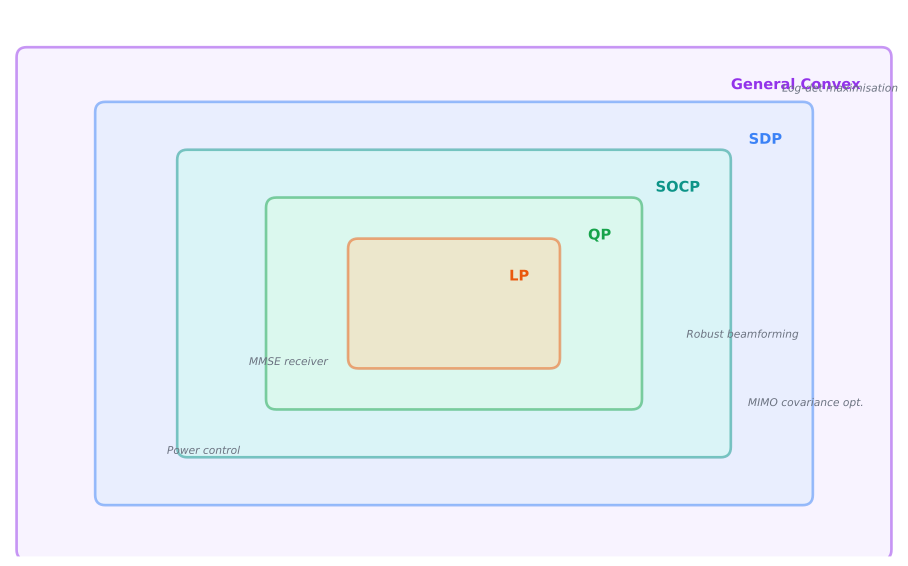
Hierarchy of Convex Programs
| Problem | Objective | Constraints | Example in Wireless |
|---|---|---|---|
| LP | Linear | Linear | Power control (high-SNR regime) |
| QP | Quadratic () | Linear | MMSE receiver design |
| SOCP | Linear | Second-order cone | Robust beamforming |
| SDP | Linear in | + affine | MIMO transmit covariance optimisation |
Definition: Lagrangian and Lagrangian Dual Function
Lagrangian and Lagrangian Dual Function
For the standard-form problem, the Lagrangian is
where are the dual variables (or Lagrange multipliers) for the inequality constraints and are the multipliers for equalities.
The Lagrangian dual function is
The dual function is always concave (as the pointwise infimum of affine functions of ), regardless of convexity of the original problem.
Theorem: Weak and Strong Duality
Weak duality: For any and any , .
The dual problem is , so always.
Strong duality () holds for convex problems that satisfy a constraint qualification, the most common being Slater's condition: there exists a strictly feasible point with for all .
Weak duality says the dual always provides a lower bound on the primal optimal value. Slater's condition ensures the bound is tight. In wireless problems, strong duality almost always holds because the constraints typically have non-empty interior.
Weak duality
Let be any feasible point. Then and . With : . Taking the infimum over : . Since this holds for every feasible : .
Maximising the bound
Taking the supremum over with gives .
Slater's condition guarantees that the duality gap for convex problems. The proof uses a separating hyperplane argument applied to the set and the point .
Lagrangian Dual Function for a Simple QP
Visualise the Lagrangian dual function for the quadratic program . The dual provides a lower bound on the optimal value, and the duality gap closes when strong duality holds.
Parameters
Example: Dual of a Linear Program
Find the dual of the LP: subject to .
Form the Lagrangian
.
Minimise over $\mathbf{x}$
The Lagrangian is linear in , so it is unbounded below unless the coefficient is zero:
State the dual
The dual problem is: subject to , .
Equivalently: subject to (with sign change ). The dual of an LP is another LP.
Why This Matters: SDPs in MIMO Beamforming
The optimal downlink beamforming problem (minimise total transmit power subject to per-user SINR constraints) can be formulated as an SOCP or, via rank-one relaxation , as an SDP. The SDP relaxation is tight (the optimal is always rank one), so the relaxation solves the original problem exactly. This remarkable result, due to Bengtsson and Ottersten (2001), is a cornerstone of modern beamforming theory.
See full treatment in MMSE-SIC Optimality
Hierarchy of Convex Programs
Numerical Precision of Interior-Point Solvers
Modern interior-point solvers (MOSEK, SeDuMi, SDPT3) solve SDPs and SOCPs to roughly 6–8 digits of accuracy in time. In practice, be aware of the following:
- Conditioning: Poorly scaled problems (coefficients spanning many orders of magnitude) cause numerical issues. Always normalise constraints so that coefficients are .
- Solver tolerances: Default feasibility/optimality tolerances are typically . For beamforming problems with per-antenna power constraints, tighter tolerances () may be needed to ensure the rank-one property of SDP solutions.
- Problem size limits: SDPs with matrix variable size become impractical for general-purpose solvers. First-order methods (ADMM, proximal) scale better but give lower accuracy.
- Standard tools: CVXPY (Python) and CVX (MATLAB) provide disciplined convex programming interfaces that automatically verify convexity and select appropriate solvers.
- •
SDP matrix variable size limited to ~500 for general-purpose interior-point solvers
- •
Problem conditioning: normalise coefficients to
- •
Default solver tolerance ; tighten for rank-constrained problems
Common Mistake: Not All QPs Are Convex
Mistake:
Assuming that any quadratic program is convex and efficiently solvable.
Correction:
A QP is convex only if . If has negative eigenvalues, the problem is non-convex and generally NP-hard. Always check the Hessian/Q matrix before claiming convexity.
Lagrangian
The function that incorporates constraints into the objective via dual variables.
Related: Dual Function, KKT Conditions
Duality Gap
The difference between the primal and dual optimal values. Under Slater's condition, the gap is zero (strong duality).
Related: Lagrangian and Lagrangian Dual Function, Slater Condition
Slater's Condition
A constraint qualification for convex problems: there exists a point that is strictly feasible, meaning for all inequality constraints. Guarantees strong duality ().
Related: Duality Gap, Weak and Strong Duality