Integer and Combinatorial Optimization Basics
When Convexity Breaks Down
Many wireless problems are inherently discrete: which users to schedule, which sub-carriers to assign, which modulation order to use. These problems are generally NP-hard — no polynomial-time algorithm is known. This section introduces the key ideas: complexity, relaxation, and approximation.
Definition: Integer Program (IP)
Integer Program (IP)
An integer program is an optimisation problem of the form
When some variables are integer and others continuous, it is a mixed-integer program (MIP). When all variables are binary (), it is a binary integer program (BIP).
Integer programming is NP-hard in general. However, special structures (total unimodularity, submodularity) can sometimes be exploited.
Definition: NP-Hardness (Informal)
NP-Hardness (Informal)
A problem is NP-hard if no polynomial-time algorithm is known to solve all instances. Specifically, every problem in the class NP can be reduced to it in polynomial time.
Key NP-hard problems in wireless:
- User scheduling in downlink MIMO (maximise sum rate by selecting users from )
- Sub-carrier assignment in OFDMA
- Antenna selection in massive MIMO
- Maximum-likelihood detection (ML decoding)
Definition: LP Relaxation
LP Relaxation
The LP relaxation of an integer program replaces with (and typically for binary programs):
The LP relaxation provides a lower bound on the integer optimal value: .
If the LP relaxation happens to return an integer solution, then that solution is optimal for the integer program too. This occurs when the constraint matrix is totally unimodular (all square sub-determinants are ).
LP Relaxation vs. Integer Points
Visualise the LP relaxation polytope (shaded region) and the feasible integer points (dots) for a 2D integer program. Observe that the LP optimum may not be integer, and the integrality gap varies with the constraint structure.
Parameters
Definition: SDP Relaxation
SDP Relaxation
For a binary quadratic program (e.g., subject to ), the SDP relaxation lifts the variable to a matrix :
The constraint is dropped (this is the relaxation). The SDP solution provides a bound, and a feasible binary vector is recovered via randomised rounding (Goemans–Williamson).
SDP relaxation with randomised rounding achieves a -approximation for MAX-CUT. In wireless, SDP relaxation is used for MIMO detection and multicast beamforming.
Definition: Greedy Algorithm
Greedy Algorithm
A greedy algorithm builds a solution incrementally by making the locally optimal choice at each step:
Start with . At each step, add the element that gives the largest marginal gain .
For general combinatorial problems, greedy may be arbitrarily bad. But for submodular objectives (diminishing returns), greedy achieves a approximation ratio.
Definition: Submodularity
Submodularity
A set function is submodular if for all and :
This is the diminishing returns property: adding to a smaller set helps at least as much as adding it to a larger set.
In wireless, the mutual information as a function of the selected antenna set is submodular. This makes greedy antenna selection near-optimal.
Theorem: Greedy Approximation for Monotone Submodular Maximisation
Let be a non-negative, monotone, submodular set function. The greedy algorithm that selects elements to maximise subject to achieves
where is the optimal -element set.
Diminishing returns guarantees that the greedy choice at each step captures at least a fraction of the remaining gap. After steps, the fraction of the optimum missed is at most .
Per-step progress
Let be the greedy set after steps and be the optimum. By submodularity and greedy choice: .
Induction
Let . Then , so . Hence .
Example: Greedy Antenna Selection
A base station has antennas but can only use RF chains. The channel matrix is . The capacity with antenna subset is where selects columns indexed by . Apply greedy selection.
Verify submodularity
is a monotone, submodular function of (a consequence of the concavity of and the structure of rank-one updates).
Greedy iteration
Start with . At each step, try each remaining antenna and compute the capacity increase . Select the antenna giving the largest increase. Repeat 4 times to get the 4-antenna subset.
Guarantee
By the greedy bound, . In practice, the ratio is typically much closer to 1.
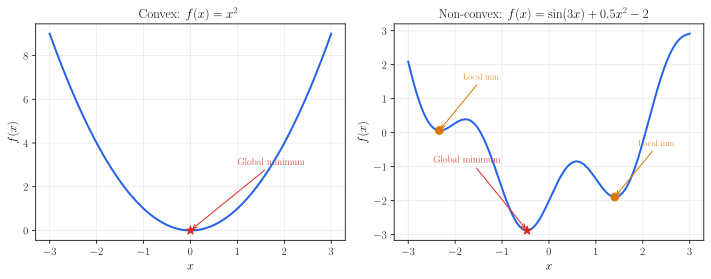
Convex vs. Non-Convex Optimization Landscape
Why This Matters: Combinatorial Problems in Wireless Scheduling
In every OFDMA or MU-MIMO time slot, the base station must select which users to serve and which resources to assign — a combinatorial problem. Practical schedulers (proportional fair, max-weight) use greedy heuristics. Understanding the approximation guarantees from submodularity tells us how close these heuristics are to optimal.
See full treatment in Cooperative Diversity
Historical Note: Relaxation in Optimisation
1947–2005The idea of relaxing integer constraints goes back to Dantzig's simplex method (1947) for linear programs. Goemans and Williamson's 1995 SDP relaxation for MAX-CUT was a breakthrough in approximation algorithms. In wireless, Luo, Ma, and colleagues popularised SDP relaxation for beamforming and detection in the mid-2000s.
Common Mistake: Naive Rounding Can Be Arbitrarily Bad
Mistake:
Solving the LP relaxation and rounding each to the nearest integer, assuming the result is near-optimal.
Correction:
Simple rounding provides no approximation guarantee in general. The integrality gap (ratio of LP to IP optimal values) can be arbitrarily large for poorly structured problems. Use randomised rounding, dependent rounding, or problem-specific techniques.
Quick Check
Which of the following wireless problems is generally NP-hard?
Water-filling power allocation
Maximum-likelihood MIMO detection
MMSE receiver computation
SVD computation
Correct. ML detection ( over a discrete alphabet) is NP-hard in the worst case. Sphere decoding and SDP relaxation are common approaches.
Quick Check
The greedy algorithm achieves a -approximation for maximising a monotone submodular function under a cardinality constraint. What is approximately?
0.500
0.632
0.750
0.878
Correct. .
NP-Hard
A problem for which no polynomial-time algorithm is known. Every problem in the class NP can be reduced to an NP-hard problem in polynomial time.
Related: Integer Program (IP), LP Relaxation
LP Relaxation
Replacing integer constraints with continuous relaxations () to obtain a tractable lower bound on the integer program's optimal value.
Related: Integer Program (IP), Integrality Gap
Submodular Function
A set function with the diminishing-returns property: adding an element to a smaller set gives at least as much marginal gain as adding it to a larger set.
Related: Greedy Algorithm, Antenna Selection