Continuous-Time Signals and LTI Systems
Signals Are the Language of Communications
Every wireless system transmits, receives, and processes signals. A signal is simply a function of time (or space, or frequency) that carries information. This chapter develops the mathematical tools for analysing signals and the systems that process them — the foundation on which every subsequent chapter builds.
Definition: Signal Classification
Signal Classification
A continuous-time (CT) signal is a function .
-
Energy signal: . Finite total energy, zero average power. Example: a single pulse.
-
Power signal: . Infinite energy but finite average power. Example: a sinusoid.
-
Deterministic: completely specified by a mathematical formula.
-
Random (stochastic): described by probability distributions (treated in Section 4.6 and Chapter 2).
Definition: Dirac Delta Function
Dirac Delta Function
The Dirac delta is the distribution satisfying
for every continuous test function . Key properties:
- Sifting:
- Scaling:
- Fourier pair:
Strictly, is not a function but a distribution (generalised function). We use it freely as engineers do, with the understanding that all integrals involving are shorthand for distributional pairings.
Definition: Linear Time-Invariant (LTI) System
Linear Time-Invariant (LTI) System
A system mapping input to output is:
- Linear:
- Time-invariant: if , then
An LTI system is completely characterised by its impulse response .
Definition: Convolution
Convolution
The output of an LTI system with impulse response and input is the convolution:
Properties:
- Commutative:
- Associative:
- Identity:
Convolution in time corresponds to multiplication in frequency: . This is the single most important property for frequency-domain analysis.
Convolution Animation
Watch the "flip and slide" interpretation of convolution. The impulse response is flipped and slid across the input , and the output is the area under the product.
Parameters
Definition: Stability and Causality
Stability and Causality
An LTI system is:
-
BIBO stable (bounded-input bounded-output) iff (i.e., ).
-
Causal iff for (the output depends only on present and past inputs).
All physical communication systems are causal. Stability ensures that finite-power inputs produce finite-power outputs.
Example: RC Low-Pass Filter
An RC circuit has impulse response where is the unit step. Verify it is causal and BIBO stable. Find the output when the input is (unit step).
Causality
for (due to ).
BIBO stability
.
Step response
for .
This is the classic exponential rise to the steady-state value of 1.
Theorem: Transfer Function
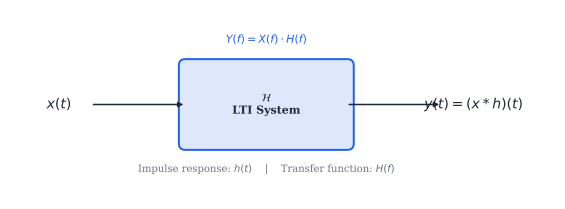
For an LTI system with impulse response , the transfer function (frequency response) is
and the input-output relation in the frequency domain is
This is the convolution theorem: convolution in time becomes multiplication in frequency.
Complex exponentials are eigenfunctions of LTI systems: the system scales each frequency component by without mixing frequencies.
Eigenfunction property
.
LTI System Block Diagram
Common Mistake: The Wireless Channel Is NOT Exactly LTI
Mistake:
Treating the wireless channel as a time-invariant system in all analyses.
Correction:
The wireless channel is a linear time-variant (LTV) system (Section 4.5). The LTI model is a useful approximation when the channel changes slowly compared to the symbol duration (quasi-static or block-fading model), but fast fading requires the full LTV framework.
Quick Check
What is ?
Correct. Convolution with a shifted delta simply delays the signal: .
Impulse Response
The output of an LTI system when the input is a Dirac delta: . Completely characterises the system.
Related: Transfer Function, Convolution, Linear Time-Invariant (LTI) System
Convolution
. The output of an LTI system with impulse response and input .
Related: Impulse Response, Transfer Function
BIBO Stability
An LTI system is BIBO (bounded-input bounded-output) stable iff .
Related: Impulse Response, Stability and Causality