Sampling Theorem and Discrete-Time Signals
Historical Note: Nyquist, Shannon, and the Sampling Theorem
Harry Nyquist (1928) and Claude Shannon (1949) independently established that a band-limited signal can be perfectly reconstructed from its samples — provided the sampling rate exceeds twice the bandwidth. This theorem is the bridge between continuous-time theory and digital implementation, underpinning every A/D converter, DSP chip, and software-defined radio in existence.
Definition: Ideal Sampling
Ideal Sampling
Ideal sampling of a continuous-time signal at rate produces the discrete-time sequence
Equivalently, the sampled signal can be written as
Taking the Fourier transform of :
The spectrum of the sampled signal is a periodised version of , repeated every Hz.
Theorem: Nyquist–Shannon Sampling Theorem
Let be band-limited with bandwidth , i.e., for . Then can be perfectly reconstructed from its samples if and only if
The minimum rate is the Nyquist rate. Reconstruction is achieved by ideal low-pass filtering:
If , the periodised copies of do not overlap, so the original spectrum can be isolated with a low-pass filter. If , copies overlap (aliasing) and information is irreversibly lost.
Spectrum of sampled signal
From the Poisson summation formula, . If for and , the replicas for do not overlap with in .
Reconstruction
Multiply by the ideal LPF to isolate : . In the time domain this becomes convolution with , yielding the interpolation formula.
Definition: Aliasing
Aliasing
When a signal is sampled at rate (below the Nyquist rate), the periodic spectral copies overlap. This spectral folding is called aliasing: high-frequency components masquerade as lower frequencies and cannot be separated.
The maximum unambiguous frequency is the folding frequency . Any frequency component aliases to (folded into the first Nyquist zone).
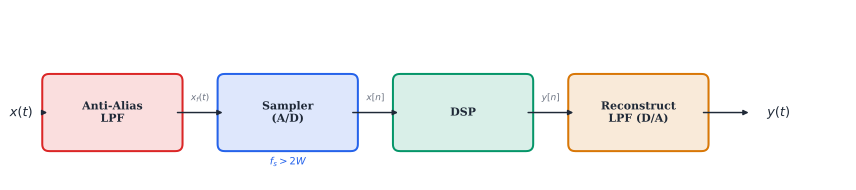
To prevent aliasing in practice, an anti-aliasing filter (analog low-pass) is applied before sampling to remove energy above .
Sampling Theorem: From Alias-Free to Aliasing
Sampling and Aliasing Demo
Adjust the sampling rate and observe how the spectrum changes. When , spectral copies overlap (aliasing) and the reconstructed signal differs from the original.
Parameters
Common Mistake: Real Signals Are Never Truly Band-Limited
Mistake:
Assuming that choosing eliminates aliasing for any real-world signal.
Correction:
Mathematically band-limited signals have infinite time duration (a consequence of the uncertainty principle). Real signals are time-limited and therefore have infinite bandwidth — they are never truly band-limited. In practice, an anti-aliasing filter attenuates out-of-band energy to an acceptable level (e.g., below the noise floor), and the residual aliasing is tolerable.
Definition: Discrete-Time Fourier Transform (DTFT)
Discrete-Time Fourier Transform (DTFT)
For a discrete-time signal , the DTFT is
where is the normalised angular frequency (radians/sample). The DTFT is periodic with period .
The inverse DTFT is
Definition: Discrete Fourier Transform (DFT)
Discrete Fourier Transform (DFT)
For a finite-length sequence , , the -point DFT is
with inverse
The DFT samples the DTFT at equally spaced points: .
The Fast Fourier Transform (FFT) computes the DFT in operations instead of , making real-time spectral analysis practical.
Example: DFT Frequency Resolution
A signal is sampled at Hz and we compute an -point DFT. What is the frequency resolution? If the signal contains two tones at 100 Hz and 104 Hz, can the DFT resolve them?
Frequency resolution
The frequency spacing between DFT bins is
Resolving the two tones
The tone separation is Hz Hz. So yes, the tones fall in different DFT bins and can be resolved.
If we had used ( Hz), the tones would fall in the same bin and could not be distinguished.
Common Mistake: Spectral Leakage in the DFT
Mistake:
Expecting the DFT to produce sharp spectral lines for all frequencies, regardless of the signal length.
Correction:
The DFT assumes the -point signal is one period of an -periodic sequence. If the signal frequency is not an exact multiple of , the energy "leaks" into adjacent bins. Windowing (Hann, Hamming, Blackman) reduces leakage at the cost of wider main lobes (reduced resolution). This is the DFT analogue of the time–frequency uncertainty principle.
Definition: Z-Transform
Z-Transform
The Z-transform of a discrete-time signal is
where . The DTFT is the Z-transform evaluated on the unit circle: .
Key properties (analogous to CTFT):
- Delay:
- Convolution:
- ROC: The Z-transform converges in a region of the -plane (region of convergence). Causal sequences have ROC outside a circle; stable systems have ROC including the unit circle.
Example: Z-Transform of a Causal Exponential
Find the Z-transform of , where . Determine the ROC and verify BIBO stability.
Z-transform
|z| > |a||z| > |a|$.
Stability check
Since , the ROC includes the unit circle . Therefore the system is BIBO stable.
The DTFT exists: .
Quick Check
A signal has bandwidth kHz. What is the minimum sampling rate to avoid aliasing?
4 kHz
8 kHz
16 kHz
2 kHz
Correct. The Nyquist rate is kHz. Any sampling rate kHz avoids aliasing.
Quick Check
An -point DFT is computed with sampling rate . What frequency does bin correspond to?
Correct. DFT bin corresponds to frequency for .
Sampling and Reconstruction Pipeline
ADC Resolution and Quantisation Noise
In practice, the analog-to-digital converter (ADC) has finite resolution: a -bit ADC maps each sample to one of levels. This quantisation introduces additive noise with approximate SNR:
At 5G NR mmWave frequencies, wideband signals (e.g., 400 MHz at 28 GHz) require ADCs operating at MSa/s. High-resolution ADCs (12+ bits) at these rates consume prohibitive power (1 W per ADC at 10-bit, 1 GSa/s). This motivates research into low-resolution ADCs (1–4 bits) and mixed-ADC architectures, where the quantisation noise is no longer negligible and must be modelled explicitly.
- •
Power consumption scales exponentially with ADC bit width at GHz sampling rates
- •
5G NR FR2 (mmWave) uses up to 400 MHz bandwidth, requiring MHz
- •
Typical SQNR for 10-bit ADC: approximately 62 dB
FFT Computation in Real-Time Systems
The FFT reduces the DFT from to operations. For an OFDM system with subcarriers (5G NR, 30 kHz SCS), one FFT requires approximately complex multiply-accumulate (MAC) operations. At 14 OFDM symbols per slot and 2000 slots/second (30 kHz SCS), the receiver must compute roughly MACs/s for the FFT alone — well within modern FPGA and ASIC capability, but a significant fraction of the baseband processing budget.
The choice of FFT size balances spectral efficiency (more subcarriers smaller guard band overhead) against latency and peak-to-average power ratio (PAPR).
- •
5G NR FFT sizes: 128, 256, 512, 1024, 2048, 4096 (3GPP TS 38.211)
- •
Real-time FFT at 4096 points requires dedicated hardware (FPGA/ASIC), not software
- •
Larger FFT reduces subcarrier spacing, increasing sensitivity to Doppler
Nyquist Rate
The minimum sampling rate for alias-free reconstruction of a band-limited signal: .
Related: Aliasing, Sampling Theorem
Aliasing
Spectral overlap caused by sampling below the Nyquist rate. High-frequency components fold into lower frequencies and cannot be recovered.
Related: Nyquist Rate, Anti Aliasing Filter
Discrete Fourier Transform (DFT)
. The frequency-domain representation of a finite-length sequence. Efficiently computed by the FFT.
Related: Discrete-Time Fourier Transform (DTFT), 2D-FFT Range-Doppler Processing for OFDM Radar, Z-Transform
Z-Transform
. The discrete-time analogue of the Laplace transform. The DTFT is its restriction to .
Related: Discrete-Time Fourier Transform (DTFT), Transfer Function