Antenna Parameters
Why Antennas Matter for Communications
Every wireless link begins and ends at an antenna. Chapters 5 and 6 treated the channel between two idealised points; now we must account for the spatial filtering that antennas perform. An antenna is not merely a transducer — it is a spatial filter that selectively transmits and receives energy in preferred directions. Understanding its parameters is essential for link budget analysis, array design, and MIMO spatial multiplexing.
Definition: Radiation Pattern
Radiation Pattern
The radiation pattern of an antenna is the normalised spatial distribution of radiated (or received) power as a function of direction in spherical coordinates:
where is the radiation intensity (power per unit solid angle, in W/sr). The pattern is typically plotted in polar or Cartesian form on a dB scale:
Key features of the pattern include:
- Main lobe: the direction of maximum radiation
- Side lobes: secondary maxima away from the main beam
- Nulls: directions of zero radiation
- Back lobe: radiation in the hemisphere opposite the main lobe
Definition: Isotropic Radiator
Isotropic Radiator
An isotropic radiator is a hypothetical antenna that radiates equally in all directions:
where is the total radiated power. No physical antenna is truly isotropic, but it serves as the reference for defining directivity and gain (hence units of dBi — decibels relative to isotropic).
Definition: Directivity
Directivity
The directivity of an antenna is the ratio of its maximum radiation intensity to that of an isotropic radiator with the same total radiated power:
Directivity is dimensionless (or expressed in dBi). A higher directivity means the antenna concentrates energy more tightly into a narrower beam.
Definition: Antenna Gain
Antenna Gain
The antenna gain accounts for both the directional focusing (directivity) and ohmic/mismatch losses:
where is the radiation efficiency:
In practice, is the quantity used in link budgets. For well-designed antennas , so . Gain is expressed in dBi (relative to isotropic).
Definition: Effective Aperture Area
Effective Aperture Area
The effective aperture (or effective area) of an antenna characterises its ability to capture power from an incident electromagnetic wave:
where is the incident power flux density (W/m) and is the received power. For any antenna, is related to gain by the fundamental relation (Theorem 7.1.1).
Theorem: Gain-Area Relation
For any antenna, the gain and effective aperture are related by
Equivalently: .
A larger effective area captures more power, corresponding to higher gain. At shorter wavelengths (higher frequency), the same physical area corresponds to more wavelengths across the aperture, hence higher gain. This relation is the bridge between the antenna world (gain) and the propagation world (effective area in the Friis equation).
Reciprocity argument
Consider an antenna transmitting power with gain in its peak direction. At distance , the power flux density is
.
A receiving antenna with effective area captures
.
Friis equation match
The Friis transmission equation (Chapter 5) gives
.
Comparing: .
This holds for any antenna by reciprocity, establishing the universal gain-area relation.
Definition: Half-Power Beamwidth
Half-Power Beamwidth
The half-power beamwidth (HPBW) is the angular width of the main lobe between the dB points:
For a uniformly illuminated aperture of length :
Narrower beamwidth implies higher directivity. The approximate relation is , where and are the HPBW in the E-plane and H-plane (in radians).
Definition: Antenna Polarization
Antenna Polarization
The polarization of an antenna describes the orientation of the electric field vector of the radiated wave. Common polarization states:
- Linear (vertical or horizontal): oscillates along a fixed direction
- Circular (RHCP or LHCP): rotates at the carrier frequency, tracing a circle
- Elliptical: general case; traces an ellipse
Polarization mismatch between transmit and receive antennas causes a power loss quantified by the polarization loss factor:
where and are the polarization unit vectors. Cross-polarized antennas have ( dB loss).
Example: Half-Wave Dipole Directivity
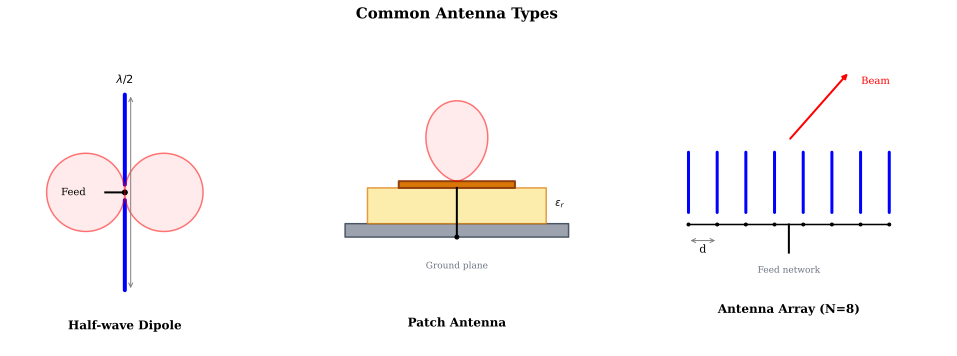
The radiation pattern of a half-wave dipole (length , oriented along the -axis) is
(a) Verify that the maximum occurs at (broadside).
(b) Compute the directivity by evaluating the beam solid angle.
Maximum direction
At : .
For or : the numerator is , so . The maximum radiation is in the broadside direction (perpendicular to the dipole axis), as expected from symmetry.
Beam solid angle
This integral evaluates to sr.
dBi.
The half-wave dipole has a gain of 2.15 dBi, which is the standard reference for dipole antennas.
Common Antenna Types
Historical Note: From Hertz to Marconi
Heinrich Hertz (1887) first demonstrated electromagnetic wave radiation using a spark-gap dipole antenna and a resonant loop receiver, confirming Maxwell's theory. Guglielmo Marconi (1901) achieved the first transatlantic wireless transmission using arrays of wire antennas elevated on kites, demonstrating that practical long-range communication required antennas with directivity. The systematic theory of antenna radiation patterns, gain, and effective area was developed throughout the 20th century, culminating in Balanis's comprehensive treatment (1982, now in its 4th edition).
Common Mistake: Confusing Gain with Directivity
Mistake:
Using "gain" and "directivity" interchangeably, or ignoring radiation efficiency when computing link budgets.
Correction:
Directivity is a purely geometric quantity describing how well the antenna focuses radiation. Gain additionally accounts for ohmic losses, impedance mismatch, and polarization losses. In link budgets, always use gain , not directivity . For high-efficiency antennas () the difference is small ( dB), but for electrically small antennas or poorly matched feeds, can be well below 0.5.
Why This Matters: Antenna Parameters in Link Budgets
The Friis equation (Chapter 5) ties together antenna gain and channel propagation:
Every 3 dB of antenna gain is equivalent to doubling the transmit power. In 5G NR, base stations use antenna arrays with 64-256 elements to achieve 20-25 dBi gain, compensating for the high path loss at mmWave frequencies. This is the fundamental motivation for the array theory developed in Sections 7.2-7.3.
Quick Check
An antenna has directivity dBi and radiation efficiency . What is its gain?
10 dBi
9.03 dBi
8.0 dBi
12.0 dBi
Correct. . In dB: dBi.
Antenna Efficiency in 5G NR Deployments
In 5G NR base station antenna panels, radiation efficiency depends strongly on the element type and array packaging:
- Patch antennas (sub-6 GHz FR1): -. Well-established technology with low cost and good efficiency.
- Stacked-patch mmWave (FR2, 24-52 GHz): -. Feed losses and packaging increase ohmic dissipation.
- Waveguide slot arrays (FR2): , but heavier and more expensive.
At mmWave frequencies, feed network losses (0.5-1.5 dB per mm of microstrip) become significant. A 64-element mmWave panel with 2 cm average feed length loses - dB in the feed alone. This is why antenna gain specifications for mmWave products often fall 3-5 dB below the theoretical directivity .
- •
Feed network losses scale with frequency: ~0.5 dB/cm at 28 GHz
- •
Total array efficiency includes element efficiency, feed loss, and scan loss
- •
Scan loss adds ~3 dB at 60° from broadside (cos factor)
Key Takeaway
The gain-area relation is the single most important equation in antenna engineering: it connects the antenna world (gain in dBi) to the propagation world (effective area in the Friis equation). Every 3 dB of antenna gain is equivalent to doubling the transmit power — making high-gain arrays essential at mmWave frequencies where path loss is severe.
Directivity
The ratio of an antenna's peak radiation intensity to the radiation intensity of an isotropic radiator with the same total radiated power: .
Related: Antenna Gain, Radiation Pattern, Half-Power Beamwidth
Antenna Gain
: directivity scaled by radiation efficiency. The practical quantity used in link budgets, expressed in dBi.
Related: Directivity, Effective Aperture Area, Antenna Parameters in Link Budgets
Effective Aperture
: the equivalent collecting area of a receive antenna. Relates antenna gain to captured power through .
Related: Antenna Gain, Friis Equation, Confusing Element Spacing with Array Aperture
Half-Power Beamwidth (HPBW)
The angular separation between the dB points on either side of the main lobe peak. Inversely proportional to the aperture size in wavelengths.
Related: Directivity, Radiation Pattern, Array Factor