ISI and the Need for Equalization
Why Equalization?
When a digital signal passes through a frequency-selective channel, the channel impulse response spans multiple symbol periods. Each received sample becomes a superposition of the desired symbol and neighbouring symbols --- a phenomenon called intersymbol interference (ISI). The eye diagram provides a powerful visual diagnostic: ISI narrows the "eye opening," reducing the margin for correct detection. Equalization is the art of undoing this distortion at the receiver.
Definition: Intersymbol Interference (ISI)
Intersymbol Interference (ISI)
Consider a sequence of transmitted symbols passed through a discrete-time channel with impulse response , where is the channel memory. The received signal (before noise) is
where is additive noise. The ISI term represents the intersymbol interference: energy from symbols that contaminates the detection of .
ISI is the discrete-time manifestation of frequency selectivity. A flat (frequency-nonselective) channel has and produces no ISI.
Definition: Eye Diagram
Eye Diagram
The eye diagram is formed by superimposing successive segments of the received baseband waveform, each one symbol period long, on the same time axis. Key features include:
- Eye opening (): the vertical distance between the upper and lower traces at the optimal sampling instant. A larger opening indicates less ISI and greater noise margin.
- Optimal sampling time: the time within each period where the eye is widest.
- Timing sensitivity: the slope of the traces at the zero crossings indicates sensitivity to timing jitter.
In the absence of ISI and noise, the eye is fully open. As ISI increases, the eye closes, and eventually reliable detection becomes impossible.
Definition: Matched-Filter Bound
Matched-Filter Bound
The matched-filter bound (MFB) is the BER achieved by a matched filter receiver on an ISI-free channel with the same total received energy. For BPSK with channel :
The MFB serves as a lower bound on achievable BER for any equalizer operating on the same channel: no receiver can do better than collecting all multipath energy coherently with no ISI.
Theorem: Nyquist ISI-Free Criterion (Discrete-Time)
A discrete-time channel with transfer function can support ISI-free transmission at symbol rate if and only if there exists a receive filter such that the cascade satisfies
Equivalently, the folded spectrum must satisfy
for all .
The Nyquist criterion demands that the overall impulse response (channel equalizer) has zero crossings at every integer multiple of except . This is the condition for a single "clean" sample per symbol period.
Necessity
If , then . The folded spectrum identity follows directly from the Poisson summation formula applied to the sampled response.
Sufficiency
If the folded spectrum equals a constant, then by inverse DFT, for all and . Hence no ISI at the sampling instants.
Eye Diagram with ISI
Visualise how a multipath channel closes the eye diagram. Adjust the channel tap (second tap) and noise level to see the effect on the eye opening and detection margin.
Parameters
Example: ISI from a Two-Tap Channel
A BPSK signal () is transmitted over a two-tap channel . The noise is AWGN with variance .
(a) Write the received signal model.
(b) How many distinct noise-free received levels exist?
(c) Compute the minimum eye opening and compare to the ISI-free case.
Received signal model
The received sample at time is
Noise-free levels
The noise-free output is . Since , we get four possible values:
| (noise-free) | ||
|---|---|---|
There are 4 distinct levels.
Minimum eye opening
The eye opening is determined by the minimum distance between levels corresponding to different current symbols. For , the received values are ; for , they are .
The minimum distance between the two groups is .
Without ISI (), the distance would be . Thus ISI has halved the eye opening, reducing the noise margin by 6 dB.
ISI Closing the Eye Diagram
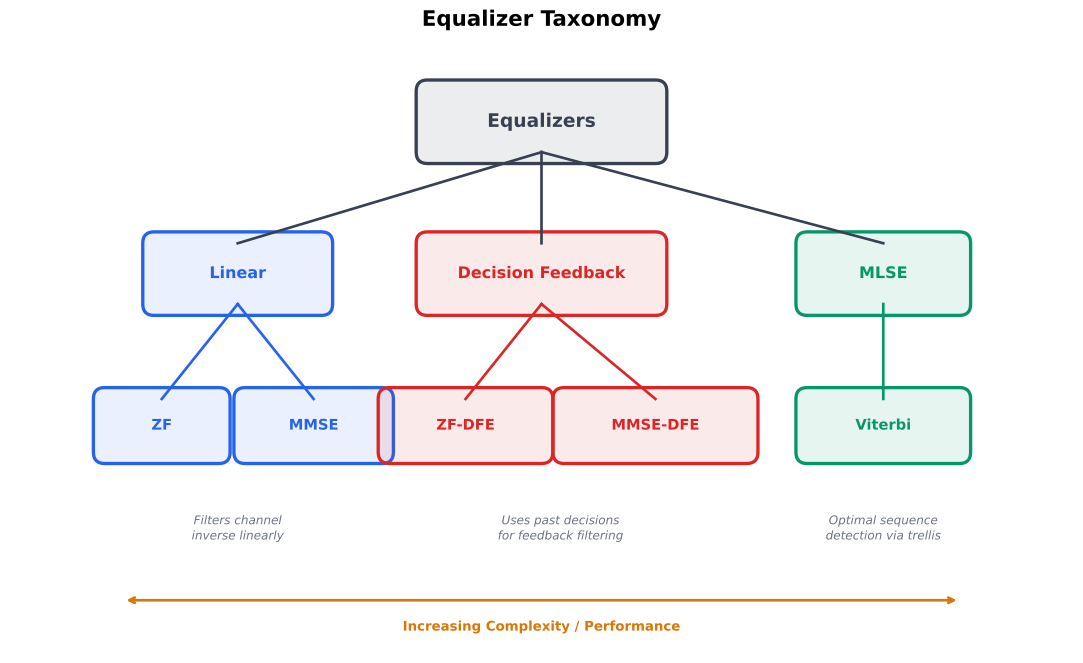
Taxonomy of Equalizer Architectures
Quick Check
A discrete-time channel has impulse response . What is the channel memory ?
(no ISI)
Correct. The channel has taps, so . Each received sample depends on the current symbol and the two previous symbols.
Common Mistake: Confusing ISI with Noise
Mistake:
Treating ISI as additional noise and simply increasing the noise variance in the matched-filter BER formula. For example, writing .
Correction:
ISI is deterministic given the transmitted sequence, not random like AWGN. The ISI pattern depends on the specific symbol sequence, creating distinct received levels (as seen in the eye diagram). A proper treatment requires either equalization or sequence detection. The "noise-plus-ISI" approximation is only valid as a rough bound and significantly underestimates BER at high SNR where ISI dominates.
Historical Note: The Origins of Equalization
1960sThe term "equalization" dates back to early telephony, where analog circuits were used to "equalize" (flatten) the frequency response of long telephone lines. Robert Lucky at Bell Labs pioneered automatic adaptive equalization in 1965, demonstrating that a transversal filter could automatically adjust its taps to compensate for channel distortion using a training sequence. Lucky's zero-forcing equalizer was soon followed by the minimum-mean-square-error (MMSE) formulation by Widrow (1967) and the decision-feedback equalizer by Austin (1967). These innovations enabled voiceband modems to operate at data rates that would be impossible without equalization.
Intersymbol Interference (ISI)
Distortion caused by a dispersive channel in which the impulse response spans multiple symbol periods, causing previously transmitted symbols to interfere with the current symbol.
Related: Equalization, Eye Diagram
Eye Diagram
A display formed by overlaying successive symbol-period segments of the received waveform. The vertical opening indicates noise margin, and the horizontal opening indicates timing margin.
Related: Intersymbol Interference (ISI)
Equalization
The process of compensating for the distortion introduced by a dispersive (frequency-selective) channel, typically implemented as a digital filter at the receiver.
Related: Intersymbol Interference (ISI), Zero-Forcing Equalizer, MMSE Equalizer