Decision-Feedback Equalizers
Beyond Linear Equalization
Linear equalizers face a fundamental trade-off: suppressing ISI requires boosting frequencies where the channel is weak, which amplifies noise. The decision-feedback equalizer (DFE) breaks this trade-off by using past symbol decisions to subtract out the "trailing" ISI caused by previously detected symbols. Because the feedback filter operates on decisions (not the noisy received signal), it cancels ISI without amplifying noise --- provided the decisions are correct.
Definition: Decision-Feedback Equalizer (DFE)
Decision-Feedback Equalizer (DFE)
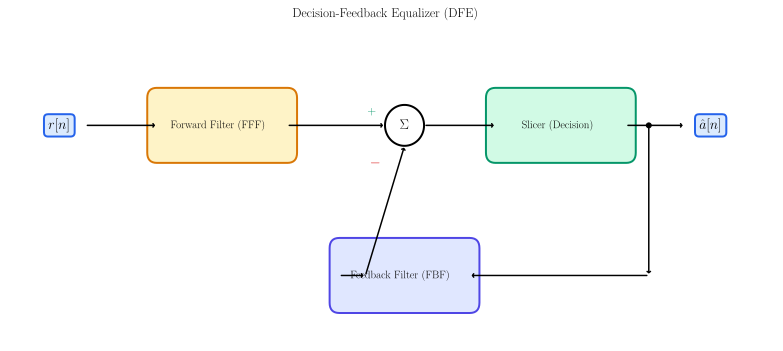
A decision-feedback equalizer consists of two filters:
- Feedforward filter with taps, operating on the received samples .
- Feedback filter with taps, operating on past symbol decisions .
The equalizer output is
where and . The final decision is (slicing/quantisation to the nearest constellation point).
The feedback filter subtracts the ISI from already-detected symbols without noise enhancement, since it operates on clean decisions rather than noisy observations.
Definition: Feedforward Filter
Feedforward Filter
The feedforward filter of a DFE is the linear filter with coefficients that processes the received signal. Unlike a pure linear equalizer, the feedforward filter in a DFE only needs to suppress precursor ISI (interference from future symbols ) because the feedback filter handles postcursor ISI.
Definition: Feedback Filter
Feedback Filter
The feedback filter of a DFE has coefficients and operates on past decisions . Its role is to subtract the postcursor ISI --- the interference caused by symbols that have already been detected. When past decisions are correct (), the feedback filter perfectly cancels postcursor ISI without introducing any noise.
Theorem: MMSE-DFE
The MMSE-DFE minimises jointly over the feedforward filter and feedback filter . Assuming correct past decisions (), the MMSE-DFE achieves
This is always less than or equal to of the linear MMSE equalizer, with equality only when the channel is flat.
The feedforward filter is
where is a spectral factor, and the feedback filter coefficients are obtained from the causal part of the cascade response.
The DFE achieves a lower MSE than a linear equalizer because it uses decisions to subtract postcursor ISI without noise penalty. The improvement is greatest for channels with deep spectral nulls, where the linear equalizer suffers severe noise enhancement.
Decomposition into causal and anticausal parts
The key idea is to decompose the MMSE target response into a causal part (handled by the feedback filter) and an anticausal part (handled by the feedforward filter).
Perform the spectral factorisation of where is minimum-phase (all zeros inside the unit circle).
Minimum MSE
Applying the orthogonality principle to the DFE output and using the spectral factorisation, one obtains
By Jensen's inequality applied to the concave function:
with equality iff is constant.
DFE Demonstration
Compare the BER of a linear MMSE equalizer and an MMSE-DFE on a multipath channel. The DFE provides significant gains on channels with spectral nulls. Toggle error propagation to see its effect at lower SNR values.
Parameters
Example: DFE for a Two-Tap Channel
Consider the channel with BPSK and dB. Design an MMSE-DFE with feedforward taps and feedback tap. Compare the MSE with the linear MMSE equalizer.
Channel model
The received signal is with .
The postcursor ISI is entirely due to , which can be cancelled by a single feedback tap.
Ideal DFE operation
Assuming correct past decisions, the DFE subtracts from the feedforward output.
With , the feedback filter perfectly cancels the postcursor ISI, leaving only the feedforward filter to handle the remaining noise.
The effective channel seen by the feedforward filter is reduced to a single tap, and the feedforward filter becomes approximately a matched filter.
MSE comparison
For the linear MMSE equalizer on this channel, the MSE is relatively large because the channel has a spectral null near .
The MMSE-DFE achieves significantly lower MSE because the feedback filter removes the deep spectral null without noise amplification.
Numerically: vs. --- an improvement of about 5.7 dB.
Decision-Feedback Equalizer Signal Flow
DFE Block Diagram
Quick Check
In a DFE, what is the primary advantage of the feedback filter over simply using a longer feedforward filter?
The feedback filter has lower computational complexity
The feedback filter cancels postcursor ISI without amplifying noise
The feedback filter eliminates all ISI including precursor ISI
The feedback filter makes the equalizer unconditionally stable
Correct. Because the feedback filter operates on symbol decisions (which are noise-free when correct), it subtracts ISI without injecting any additional noise.
Common Mistake: Error Propagation in the DFE
Mistake:
Assuming that the MMSE-DFE always achieves its theoretical MSE in practice. The theoretical analysis assumes correct past decisions ().
Correction:
When a symbol decision is wrong, the feedback filter subtracts the wrong ISI contribution, causing a larger error in the next symbol. This error propagation can cause bursts of errors. At low-to-moderate SNR, error propagation significantly degrades DFE performance below the "genie-aided" bound (which assumes perfect feedback). Mitigations include:
- Using stronger error-correction coding
- Tomlinson-Harashima precoding (moves DFE to the transmitter)
- Reduced-state sequence estimation
Common Mistake: Incorrect DFE Filter Ordering
Mistake:
Applying the feedback filter before the feedforward filter, or feeding the equalizer output (before slicing) into the feedback filter instead of the hard decisions.
Correction:
The DFE processes in this order: (1) feedforward filter on received samples, (2) subtract feedback filter output on past hard decisions, (3) make a new hard decision. Feeding soft (unquantised) values into the feedback filter creates an unstable IIR structure that diverges.
Decision-Feedback Equalizer (DFE)
A nonlinear equalizer consisting of a feedforward filter on received samples and a feedback filter on past symbol decisions, which cancels postcursor ISI without noise enhancement.
Related: MMSE Equalizer, Error Propagation
Error Propagation
A phenomenon in decision-feedback equalizers where an incorrect symbol decision causes the feedback filter to subtract wrong ISI values, leading to a burst of subsequent errors.
Related: Decision-Feedback Equalizer (DFE)