Generalisations: SC-FDMA, FBMC, OTFS
Beyond Conventional OFDM
While OFDM is the dominant multicarrier waveform in current wireless standards, it has well-known limitations: high PAPR, sensitivity to CFO and Doppler, and spectral leakage due to the rectangular windowing of each subcarrier. Several generalisations address these issues for specific use cases. SC-FDMA reduces PAPR for uplink transmission, FBMC provides better spectral containment, and OTFS targets high-Doppler scenarios.
Definition: SC-FDMA (Single-Carrier FDMA)
SC-FDMA (Single-Carrier FDMA)
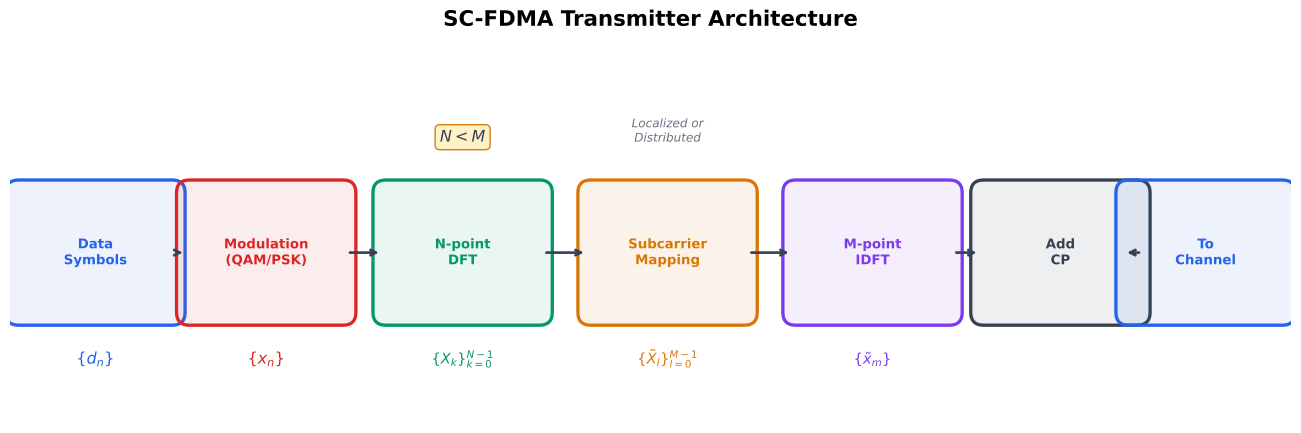
SC-FDMA, also called DFT-spread OFDM (DFT-s-OFDM), adds a DFT precoding stage before the standard OFDM IDFT. The transmitter architecture is:
- Map data symbols to a block.
- Apply an -point DFT: .
- Map the DFT outputs to of the OFDM subcarriers (localised or distributed mapping).
- Apply the -point IDFT to generate time-domain samples.
- Add cyclic prefix and transmit.
Because the transmitted signal passes through a DFT before the IDFT, the time-domain waveform resembles a single-carrier signal with much lower PAPR than conventional OFDM. SC-FDMA is used for the uplink in LTE and remains an option in 5G NR.
SC-FDMA preserves the single-tap equalisation advantage of OFDM (the receiver still uses DFT + per-subcarrier equalisation) while achieving 2--4 dB lower PAPR at the transmitter.
Definition: Filter Bank Multicarrier (FBMC)
Filter Bank Multicarrier (FBMC)
FBMC replaces the rectangular pulse shape of each OFDM subcarrier with a well-localised prototype filter that has much better frequency confinement. The most common variant is FBMC/OQAM (offset QAM), which transmits real-valued symbols staggered by half a symbol period to maintain orthogonality:
where and provides a phase offset pattern. Key advantages:
- No cyclic prefix needed — the filter provides sufficient time-domain containment.
- Better spectral containment — dramatically lower out-of-band emissions compared to OFDM.
- Higher spectral efficiency — no CP overhead.
However, FBMC's real-orthogonality (instead of complex) complicates MIMO and channel estimation.
FBMC was a candidate for 5G NR but lost to CP-OFDM due to implementation complexity and difficulty with MIMO integration.
Definition: OTFS (Orthogonal Time Frequency Space)
OTFS (Orthogonal Time Frequency Space)
OTFS modulates data symbols in the delay-Doppler domain rather than the time-frequency domain used by OFDM. Each data symbol (at delay index and Doppler index ) is spread across all time-frequency resources via a 2D transform:
Key properties:
- Each data symbol experiences the full channel diversity in both time and frequency.
- The channel in the delay-Doppler domain is sparse and quasi-static (changes slowly compared to time-frequency).
- Naturally suited for high-mobility scenarios (vehicular, high-speed rail, LEO satellite).
OTFS can be viewed as a 2D precoding applied on top of OFDM, making it compatible with existing OFDM infrastructure.
SC-FDMA vs. OFDM Signal Comparison
Compare the time-domain waveforms and PAPR of SC-FDMA and conventional OFDM for the same data symbols. Observe how the DFT precoding in SC-FDMA produces a more single-carrier-like signal with lower peak power.
Parameters
OFDM Frame Structure Animation
Animated view of an OFDM time-frequency grid showing the frame structure with data subcarriers, pilot positions, guard bands, and DC subcarrier. Watch as successive OFDM symbols are built and transmitted, illustrating the relationship between time-domain and frequency-domain representations.
Parameters
OFDM Waveform Generalisations Comparison
| Property | CP-OFDM | SC-FDMA | FBMC | OTFS |
|---|---|---|---|---|
| PAPR | High ( dB) | Low (single-carrier-like) | High | Depends on precoding |
| CP required | Yes | Yes | No | Yes (OFDM-based) |
| Spectral containment | Poor (sinc sidelobes) | Poor (same as OFDM) | Excellent | Same as OFDM |
| MIMO compatibility | Excellent | Good | Difficult (real orthogonality) | Good |
| Doppler resilience | Moderate | Moderate | Poor | Excellent |
| Channel estimation | Standard pilots | Standard pilots | Complex (preamble-based) | Delay-Doppler domain |
| Standard usage | LTE DL, 5G NR DL/UL | LTE UL, 5G NR UL option | Not standardised | Under study for 6G |
| Equaliser complexity | — single tap | — single tap + IDFT | per subcarrier | — 2D equalisation |
Why This Matters: Waveform Selection in 5G NR
After extensive evaluation by 3GPP, CP-OFDM was selected as the waveform for both downlink and uplink in 5G NR, with DFT-s-OFDM (SC-FDMA) as an optional uplink waveform for coverage-limited scenarios where low PAPR is critical (e.g., cell-edge users transmitting at maximum power).
The key reasons for CP-OFDM dominance:
- MIMO-friendly: Straightforward extension to massive MIMO
- Flexible numerology: Multiple subcarrier spacings (15, 30, 60, 120, 240 kHz)
- Mature ecosystem: Extensive LTE compatibility
- Simple channel estimation: Standard pilot-based methods
FBMC and other waveforms were considered but rejected due to MIMO integration challenges and implementation complexity.
See full treatment in Chapter 17
Why This Matters: OTFS and Future 6G Waveforms
OTFS is a leading candidate waveform for 6G communications, particularly for scenarios involving extreme mobility (V2X at 500 km/h, LEO satellite at 7.8 km/s, UAV communications). In these scenarios, the channel varies rapidly within a single OFDM symbol, causing severe ICI. OTFS addresses this by operating in the delay-Doppler domain where the channel is sparse and quasi-static.
Research directions include efficient OTFS detection algorithms, integration with massive MIMO, and hybrid OFDM-OTFS schemes that switch between waveforms based on channel conditions.
Quick Check
Why does SC-FDMA (DFT-spread OFDM) have lower PAPR than conventional OFDM?
SC-FDMA uses a shorter cyclic prefix, reducing peak power
The DFT precoding spreads each data symbol across all allocated subcarriers, making the time-domain signal resemble a single-carrier waveform
SC-FDMA uses fewer subcarriers, automatically reducing PAPR
SC-FDMA applies clipping before transmission
The DFT precoding before the IDFT effectively cancels the spreading effect of the IDFT for the allocated subcarriers. The result is a time-domain signal that looks like a single-carrier signal with a cyclic prefix, inheriting the low PAPR of single-carrier modulation.
OTFS as ISAC Waveform
Yuan, Schober, and Caire demonstrated that OTFS is a natural waveform for integrated sensing and communications (ISAC), since radar targets are characterised by their delay (range) and Doppler (velocity) — exactly the two dimensions in which OTFS places its data symbols. The delay-Doppler channel representation provides a sparse, quasi-static sensing matrix, enabling joint communication and radar parameter estimation with minimal overhead. The work shows that OTFS-ISAC achieves superior sensing resolution compared to OFDM-ISAC at equivalent spectral efficiency.
Delay-Doppler Domain Waveform Design
Gaudio, Kobayashi, and Caire analysed the fundamental trade-offs in delay-Doppler domain waveform design for dual-function radar-communication systems. They showed that the ambiguity function of OTFS symbols provides excellent range and velocity resolution when the guard symbols are properly designed, and derived the Cramér-Rao bounds for delay and Doppler estimation in the OTFS framework.
Deep Dive into OTFS
The OTFS material in this section provides a high-level overview. The OTFS book in this library covers the full theory: the Zak transform, delay-Doppler channel representation, input-output relations on the DD grid, efficient detection algorithms (message passing, variational inference), and the connection to time-frequency spreading codes. Readers interested in 6G waveform design should consult that book after completing this chapter.
SC-FDMA (DFT-Spread OFDM) Transmitter Architecture
SC-FDMA
Single-Carrier Frequency Division Multiple Access — a variant of OFDM that applies DFT precoding before the IDFT, producing a single-carrier-like signal with lower PAPR. Used for uplink in LTE and optionally in 5G NR.
Related: DFT-spread OFDM, Orthogonal Frequency Division Multiplexing (OFDM), CCDF of PAPR
FBMC
Filter Bank Multicarrier — a multicarrier scheme using well-localised prototype filters per subcarrier for improved spectral containment, at the cost of increased complexity and real-only orthogonality.
Related: Orthogonal Frequency Division Multiplexing (OFDM), OQAM, spectral containment
OTFS
Orthogonal Time Frequency Space — a modulation scheme that multiplexes data in the delay-Doppler domain, providing full time-frequency diversity and robust performance in high-mobility channels.
Related: Orthogonal Frequency Division Multiplexing (OFDM), Delay-Doppler, high mobility