The MIMO Channel Matrix
From SISO to MIMO: The Spatial Dimension
A single-input single-output (SISO) channel is characterised by a single complex gain . By deploying transmit and receive antennas, we open a spatial dimension that can carry multiple independent data streams simultaneously. The channel is no longer a scalar but a matrix , and the rich linear algebra of this matrix governs every aspect of MIMO performance: capacity, diversity, beamforming, and spatial multiplexing.
This section establishes the fundamental input-output model and the key matrix properties that determine what a MIMO channel can do.
Historical Note: The MIMO Revolution: Foschini and Telatar
1990sThe capacity potential of MIMO channels was independently discovered by Gerard Foschini at Bell Labs (1996) and Emre Telatar at AT&T (1995, published 1999). Foschini's BLAST architecture showed that capacity scales linearly with --- a revolutionary result that implied wireless spectral efficiency could be increased by simply adding antennas, without additional bandwidth or power.
Telatar's elegant information-theoretic analysis derived the exact capacity formula using random matrix theory. Together, these papers launched the modern era of MIMO communications and led directly to the multi-antenna technologies in Wi-Fi (802.11n/ac/ax), 4G LTE, and 5G NR.
Definition: MIMO Channel Matrix
MIMO Channel Matrix
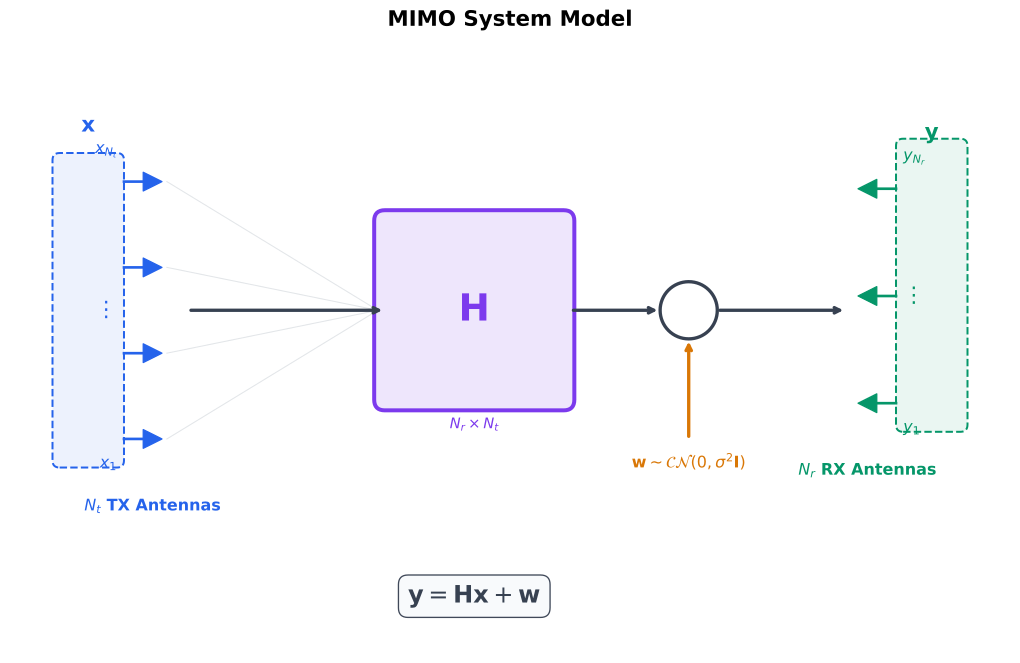
Consider a narrowband MIMO system with transmit antennas and receive antennas. The MIMO channel matrix has entry
where is the complex channel gain from transmit antenna to receive antenna . The baseband input-output relationship is
where is the transmitted signal vector subject to a power constraint , the received vector is , and the noise is circularly symmetric complex Gaussian.
This is the flat-fading (narrowband) model. For frequency-selective MIMO channels, each OFDM subcarrier has its own , and the same framework applies per subcarrier.
Definition: Channel Rank
Channel Rank
The rank of the MIMO channel is
The rank determines the maximum number of independent spatial streams (parallel data pipes) that the channel can support. Since is , we always have
A channel with is called full-rank. Rich scattering environments (many multipath components, no dominant LOS) tend to produce full-rank channels.
Definition: Condition Number
Condition Number
The condition number of the channel matrix is
where and are the largest and smallest nonzero singular values of .
- : all singular values equal (perfectly conditioned). The channel supports equally strong parallel streams. An i.i.d. Rayleigh channel has close to 1 on average for large arrays.
- : ill-conditioned. Some spatial streams carry much less signal than others. LOS channels and highly correlated channels tend to have large .
A large condition number does not mean the channel is "bad" --- it means it favours beamforming over spatial multiplexing. The optimal strategy depends on both the channel and the SNR regime.
MIMO System Model
Definition: Spatial Multiplexing
Spatial Multiplexing
Spatial multiplexing is the transmission of multiple independent data streams over the same time-frequency resource using multiple antennas. If the channel has rank , up to streams can be multiplexed, each seeing an effective SNR determined by the corresponding singular value of .
The total rate achieved by spatial multiplexing is
where is the power allocated to stream .
Theorem: Channel Rank Determines Spatial Degrees of Freedom
For a MIMO channel with SVD , the number of independent spatial sub-channels (degrees of freedom) equals . Each sub-channel has gain (the -th singular value), and the sub-channels are mutually non-interfering.
Specifically, the transformation and decomposes the MIMO channel into parallel scalar channels:
The SVD finds the "natural coordinate system" of the channel. Transmitting along right singular vectors and receiving along left singular vectors creates non-interfering pipes through the channel, each with gain . This is the MIMO analogue of diagonalising a symmetric matrix.
Apply SVD
Write where and are unitary, and is diagonal with entries .
Transform input and output
Define and . Substituting into :
Since is unitary, (unitary transformations preserve the i.i.d. Gaussian distribution).
Read off parallel channels
Because is diagonal, the -th component decouples:
There are exactly nonzero singular values, hence independent scalar sub-channels.
MIMO Capacity vs. SNR
Explore how MIMO capacity scales with SNR for different antenna configurations. Compare (SISO), , , and systems with i.i.d. Rayleigh fading. The capacity is averaged over many channel realisations (ergodic capacity).
Parameters
Number of transmit antennas
Number of receive antennas
Maximum SNR on the x-axis
Example: MIMO Channel Analysis
Consider a MIMO channel with
(a) Find the singular values and condition number.
(b) Decompose into parallel channels and compute the capacity at dB with equal power allocation.
Compute singular values
We need the eigenvalues of :
The eigenvalues are and , so the singular values are and .
Condition number
$
The channel is moderately well-conditioned --- both streams carry useful signal, though one is weaker.
Capacity with equal power allocation
At dB ( linear), equal power gives . With :
For comparison, a SISO channel at the same total SNR gives bits/s/Hz. The MIMO system provides a capacity increase.
Quick Check
A MIMO channel (, ) has channel matrix . What is the maximum number of independent spatial streams this channel can support?
2
4
6
8
The rank is at most , so at most 2 independent streams can be supported.
Common Mistake: More Antennas Does Not Always Mean More Streams
Mistake:
Assuming that adding more transmit antennas always increases the number of spatial streams. For example, expecting a system to support 8 streams.
Correction:
The number of spatial streams is limited by . A system can support at most 2 streams (limited by the 2 receive antennas). The extra transmit antennas provide beamforming gain (array gain), not additional multiplexing. To increase multiplexing, you must add antennas on both sides of the link.
Key Takeaway
The SVD is the master key to MIMO: it decomposes any channel into non-interfering parallel sub-channels, each with gain . Every MIMO result in this chapter — capacity, degrees of freedom, diversity — ultimately traces back to this decomposition.
Channel Estimation Overhead in Practical MIMO
The theoretical MIMO capacity assumes perfect CSI at the receiver (CSIR). In practice, estimating the channel matrix requires transmitting orthogonal pilot sequences of length at least symbols. This creates a tension:
- Pilot overhead: for a coherence block of symbols, symbols are spent on pilots, leaving for data. The effective rate is reduced by a factor .
- Estimation noise: with limited pilot energy, the estimated has error , causing residual interference that limits capacity.
- Scaling problem: for massive MIMO (--), the pilot overhead becomes prohibitive in FDD (where downlink and uplink channels differ). This motivates TDD operation (channel reciprocity) and compressed CSI feedback.
At 5G NR frequencies with OFDM symbols per slot and antenna ports, the system uses only 4--8 orthogonal pilot symbols via CSI-RS beamforming, exploiting angular-domain sparsity to reduce overhead.
- •
Minimum pilot length: symbols per coherence block
- •
FDD feedback overhead grows with ; TDD uses reciprocity
- •
5G NR CSI-RS uses beamformed pilots (4-8 ports) even with 32-64 physical antennas
MIMO (Multiple-Input Multiple-Output)
A communication system with transmit antennas and receive antennas, exploiting the spatial dimension for multiplexing, diversity, or beamforming gains.
Related: Channel matrix, Spatial multiplexing
Channel matrix
The matrix whose entry is the complex gain from transmit antenna to receive antenna .
Related: MIMO (Multiple-Input Multiple-Output), Channel rank
Channel rank
The number of nonzero singular values of , equal to the number of independent spatial sub-channels available for communication.
Related: Channel matrix, Spatial multiplexing
Condition number
The ratio measuring how evenly the channel distributes signal energy across spatial sub-channels. is ideal for multiplexing; favours beamforming.
Related: Channel matrix
Spatial multiplexing
Transmitting multiple independent data streams over the same time-frequency resource by exploiting the spatial dimensions provided by multiple antennas.
Related: MIMO (Multiple-Input Multiple-Output), Channel rank