MIMO Capacity: Deterministic Channels
Capacity as the Ultimate Limit
Having established the MIMO input-output model and the SVD decomposition into parallel channels, we can now answer the fundamental question: what is the maximum achievable rate?
For a known (deterministic) channel , the capacity is achieved by choosing the optimal input covariance matrix subject to a power constraint. The solution combines the SVD decomposition from Section 15.1 with the water-filling principle from Chapter 11, yielding one of the most elegant results in information theory.
Definition: MIMO Capacity (Deterministic Channel)
MIMO Capacity (Deterministic Channel)
For a deterministic MIMO channel with and power constraint , the MIMO capacity is
where means is positive semidefinite (valid covariance matrix).
This is the mutual information maximised over Gaussian inputs. Gaussian inputs are optimal because the noise is Gaussian (maximum entropy property).
Definition: Parallel Channel Decomposition
Parallel Channel Decomposition
Using the SVD and the transformation from Theorem 15.1.1, the MIMO channel decomposes into parallel scalar channels:
Each sub-channel has gain (the -th eigenvalue of ). The MIMO capacity problem reduces to optimally allocating total power across these parallel Gaussian channels, which is solved by water-filling.
Theorem: MIMO Capacity via SVD and Water-Filling
The capacity of the deterministic MIMO channel with and power constraint is
where the optimal power allocation is given by water-filling:
and is chosen so that . Here .
The optimal input covariance matrix is .
Water-filling allocates more power to stronger sub-channels (large ) and less to weaker ones, even shutting off the weakest sub-channels entirely. At high SNR, the water level is high relative to all , so power is approximately equal across sub-channels. At low SNR, it is better to concentrate power on the strongest sub-channel (beamforming).
Reduce to parallel channels
Apply the SVD decomposition from Theorem 15.1.1. The MIMO mutual information under Gaussian inputs with covariance is
In the SVD basis, the optimal is diagonal (the off-diagonal elements cannot increase mutual information because the sub-channels are decoupled), so .
Decompose the determinant
With diagonal :
This is a sum of independent terms, each depending on one power variable .
Apply water-filling (KKT conditions)
Maximise subject to and . The Lagrangian is
Setting :
Solving for with the non-negativity constraint:
Redefining as the "water level" gives the standard water-filling form. The water level is found by the constraint .
SVD Decomposition into Parallel Sub-Channels
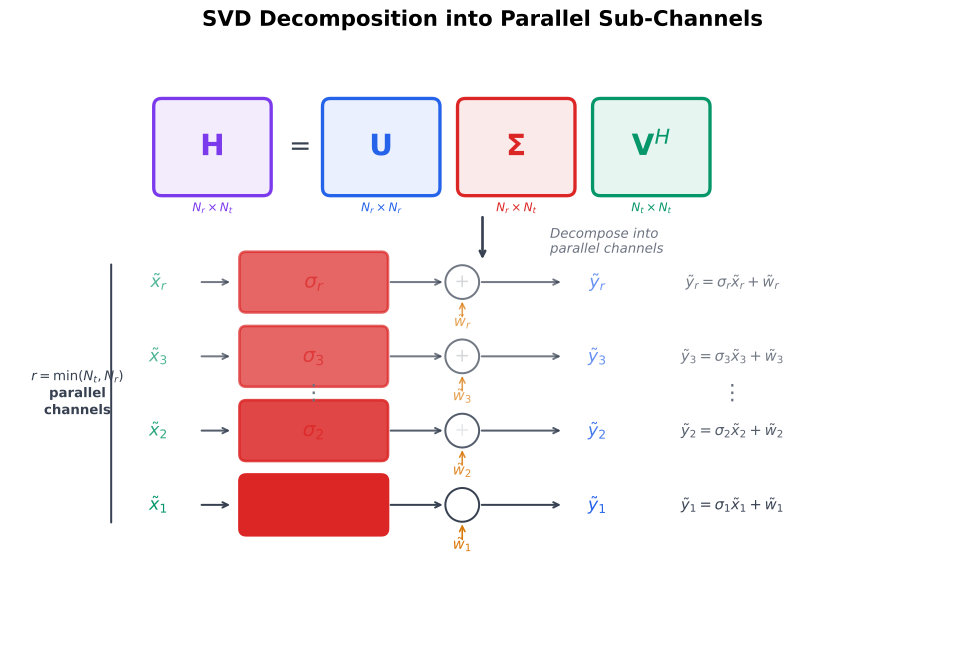
SVD Decomposition of a MIMO Channel
SVD Parallel Channels and Water-Filling
Visualise the SVD decomposition of a MIMO channel into parallel sub-channels and the water-filling power allocation. Adjust the channel singular values and total SNR to see how power is distributed.
Parameters
Type of channel realisation to generate
Example: Water-Filling Power Allocation
A MIMO channel has singular values , , . The noise variance is and total power is .
(a) Find the water-filling power allocation.
(b) Compute the capacity.
(c) Compare with equal power allocation.
Set up the water-filling equations
The channel gains are , , . The "inverse gains" (water-filling floors) are
Find the water level
First try all 3 channels active. The water level must satisfy :
Check: . So channel 3 is shut off.
Try 2 channels active:
, , . All non-negative, so this is the solution.
Compute capacity
$
Compare with equal power
Equal power: .
Water-filling gains bits/s/Hz ( improvement) by redirecting power from the weak third sub-channel to the stronger first and second.
Common Mistake: Equal Power Allocation Is Near-Optimal at High SNR
Mistake:
Spending significant effort on water-filling at high SNR, or conversely, using equal power allocation at low SNR where it is highly suboptimal.
Correction:
At high SNR, the water level is much larger than all , so for all active sub-channels. Equal power allocation loses very little.
At low SNR, water-filling concentrates all power on the strongest sub-channel (beamforming), which can provide several dB of gain over equal allocation. The transition occurs around (ratio of strongest to weakest eigenvalue).
Quick Check
A MIMO channel has singular values and . What is the capacity at SNR dB with optimal power allocation?
bits/s/Hz
bits/s/Hz
bits/s/Hz
bits/s/Hz because one singular value is zero
The channel has rank 1 (), so all power goes to the single active sub-channel. .
Water-filling
The optimal power allocation strategy for parallel Gaussian channels that allocates more power to stronger sub-channels and less (or none) to weaker ones: .
Related: MIMO capacity, Spatial multiplexing
MIMO capacity
The maximum mutual information achievable over a MIMO channel, optimised over the input covariance matrix: .
Related: Water-filling, Channel rank