Scheduling Algorithms
Balancing Throughput and Fairness
The max-rate scheduler of Section 20.1 maximises sum throughput but is inherently unfair: users far from the base station — those who need the most help — are starved of resources. At the opposite extreme, round-robin scheduling ignores channel quality entirely and divides time equally, sacrificing the multiuser diversity gain. Real-world cellular networks require a middle ground that captures most of the multiuser diversity gain while ensuring every user receives acceptable service. The proportional fair (PF) scheduler, deployed in every 3G, 4G, and 5G system, achieves precisely this balance.
Definition: Scheduling Policies
Scheduling Policies
Consider users with instantaneous rates in slot . Three canonical scheduling policies are:
Max-Rate (MR) Scheduler:
Maximises instantaneous sum throughput.
Round-Robin (RR) Scheduler:
Each user is served in turn regardless of channel conditions.
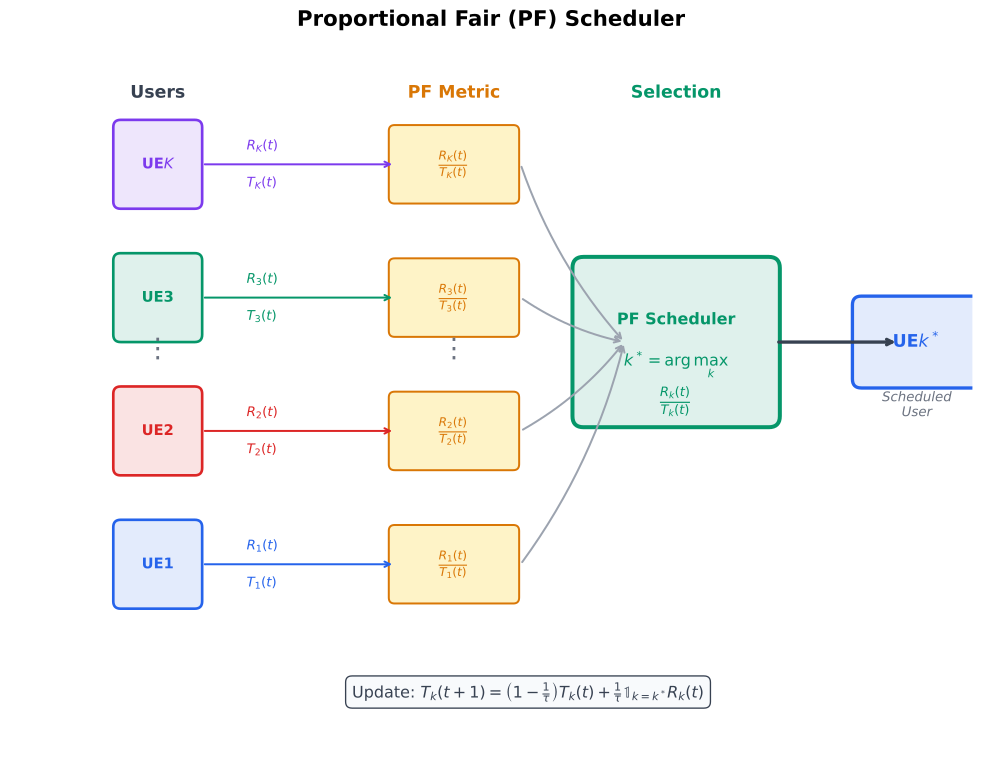
Proportional Fair (PF) Scheduler:
where is an exponentially weighted moving average (EWMA) of user 's past throughput:
with averaging window (typically -- slots).
The PF metric serves a user when its current rate is high relative to its own average. A cell-edge user with a low absolute rate can still win the competition when it experiences a relative channel peak.
Definition: The Alpha-Fair Utility Family
The Alpha-Fair Utility Family
The -fair utility function, for parameter , is defined as:
A scheduler that maximises over the long-term average throughputs produces:
- : max-rate scheduling (maximise sum throughput).
- : proportional fairness (maximise sum of log throughputs).
- : minimum potential delay fairness (harmonic mean).
- : max-min fairness (maximise the minimum rate).
Increasing trades aggregate throughput for greater equality among users.
The -fair family provides a single-parameter knob that operators can tune to match their service-level agreements. In LTE and 5G NR, the scheduler is typically PF () with adjustments for QoS-differentiated traffic classes.
Proportional Fair Scheduling Algorithm
Complexity: per slot (one comparison per user). The PF scheduler adds negligible overhead beyond the CQI acquisition cost.The EWMA window controls the memory of the scheduler. Small reacts quickly to changing conditions but is more variable; large provides more stable fairness at the expense of slower adaptation.
Theorem: PF as Gradient Ascent on Sum Log-Utility
The PF scheduling rule converges, in the limit of large , to the solution of:
where is the ergodic rate region (the set of achievable long-term average throughput vectors). At each step, the PF rule selects the user that provides the steepest ascent direction for the objective .
The gradient of with respect to is . Allocating one slot to user increases by approximately . The marginal gain is , which is exactly the PF metric. Hence PF performs stochastic gradient ascent on the log-utility.
Stochastic approximation framework
The EWMA update can be written as a stochastic approximation:
With step size , this is a Robbins--Monro iteration tracking the mean-field ODE:
Optimality at the fixed point
At the fixed point , the scheduling rule satisfies the KKT conditions of:
This is because acts as the dual variable (shadow price) for user 's throughput, and the scheduling rule greedily maximises the Lagrangian in each slot. By the results of Kushner and Whiting (2004), the stochastic iterates converge almost surely to this fixed point.
Proportional Fair Scheduling Dynamics
Simulate PF scheduling for users over time slots. The plot shows each user's moving-average throughput converging over time, the fraction of slots allocated to each user, and the resulting sum log-throughput. Compare the PF outcome to max-rate and round-robin by observing how PF balances between the extremes. Increasing the SNR widens the dynamic range of channel gains across users.
Parameters
Scheduling Decisions Over Time
Watch how the PF scheduler allocates time slots to users in real time. Each frame shows the instantaneous channel gains, the PF metric , and which user is selected. Notice how even users with poor average channels periodically win the scheduling competition when they experience relative channel peaks.
Parameters
Throughput--Fairness Frontier
Explore the Pareto frontier between aggregate throughput and fairness as the parameter sweeps from 0 (max-rate) through 1 (proportional fair) to large values (max-min fair). The plot shows the achievable throughput vector for each , along with the sum throughput and Jain's fairness index. Increasing or SNR changes the shape of the frontier.
Parameters
Example: PF Scheduling Step-by-Step
Three users have the following channel conditions in slot :
| User | (bits/s/Hz) | (bits/s/Hz) |
|---|---|---|
| 1 | 5.0 | 4.0 |
| 2 | 2.5 | 1.0 |
| 3 | 3.0 | 3.5 |
The EWMA window is .
(a) Compute the PF metric for each user and determine who is scheduled. (b) Update for all three users. (c) What would a max-rate scheduler choose instead?
PF metric computation
(a) PF metric :
User 2 has the highest PF metric and is scheduled, even though user 1 has the highest absolute rate.
EWMA update
(b) With :
User 2's average throughput increases slightly; the others decay toward zero (they would receive service in future slots).
Max-rate comparison
(c) A max-rate scheduler would choose user 1 (). Over many slots, this would starve user 2 (who always has poor absolute rates), concentrating throughput on user 1. PF avoids this starvation.
Quick Check
In proportional fair scheduling, why is user scheduled when is maximised rather than when is maximised?
To reduce computational complexity
To ensure each user is served when its channel is near its own peak, providing both diversity gain and fairness
To guarantee equal time-slot allocation to all users
To maximise the minimum user throughput
Dividing by normalises each user's rate by its own long-term average. A cell-edge user with low absolute rate but a relative channel peak wins the competition, ensuring fairness while still exploiting multiuser diversity.
Common Mistake: PF Requires Sufficient Fading Variability
Mistake:
Assuming that PF always provides a large multiuser diversity gain, regardless of channel conditions.
Correction:
PF gains come from the relative channel fluctuations of each user. If all users have nearly deterministic channels (e.g., strong LoS with little fading), the PF metric is nearly constant for each user, and PF degenerates to round-robin. The multiuser diversity gain is proportional to the dynamic range of each user's fading, which is maximal under Rayleigh fading and minimal under Rician fading with large . In practice, 5G mmWave channels with narrow beams may exhibit less fading variability, reducing PF gains.
Why This Matters: Scheduling in LTE and 5G NR
Both LTE and 5G NR implement channel-aware scheduling at the MAC layer, operating on a 1 ms TTI (LTE) or configurable slot duration (5G NR, down to 0.125 ms at 120 kHz SCS):
- LTE: The eNodeB scheduler receives CQI reports every 1--10 ms and makes per-TTI, per-RB scheduling decisions. Most vendors implement PF or weighted PF with QoS-aware priority adjustments. The scheduler also handles HARQ retransmissions and semi-persistent scheduling for VoIP.
- 5G NR: The gNB scheduler operates at sub-slot granularity with support for grant-free transmissions (configured grant) and dynamic scheduling via DCI. Enhanced QoS frameworks (5QI) allow differentiated scheduling for URLLC, eMBB, and mMTC traffic. The proportional fair metric is augmented with delay-aware terms for latency-critical traffic.
- Cross-layer design: Both systems tightly couple the scheduler with link adaptation (AMC), HARQ, and buffer status reports (BSR), forming a cross-layer control loop that adapts to channel, traffic, and QoS conditions jointly.
PF Scheduler Convergence
Proportional Fair Scheduler Architecture
Common Mistake: Round-Robin Is Not Throughput-Fair
Mistake:
Believing that round-robin scheduling provides fair throughput because it gives equal time to all users.
Correction:
Round-robin allocates equal time but not equal throughput. A cell-edge user receiving 0.5 bits/s/Hz for 1 ms gets 0.5 kbits; a cell-centre user receiving 5.0 bits/s/Hz for 1 ms gets 5.0 kbits. The 10:1 throughput disparity persists despite equal time allocation.
For throughput-fair allocation, the scheduler must give more time to cell-edge users (compensating for their lower rates), which is what max-min fair scheduling () achieves — at the cost of significant sum-throughput loss. Proportional fairness () is the practical compromise deployed in real systems.
Proportional Fair Scheduling
A scheduling policy that selects user in each time slot, maximising the sum of log-throughputs . PF balances multiuser diversity gain against fairness by normalising each user's instantaneous rate by its own average.
Related: Multiuser Diversity, Opportunistic Scheduling, Alpha-Fair Utility
Alpha-Fair Utility
A parametric family of utility functions (with ) that interpolates between sum-rate maximisation (), proportional fairness (), and max-min fairness (). The parameter controls the trade-off between aggregate throughput and fairness.
Related: Proportional Fair Scheduling