Beamforming Architectures
The Architecture Design Space
In Chapters 7 and 18, we derived the capacity-achieving precoding for MIMO and massive MIMO under the assumption that each antenna has a dedicated RF chain (mixer, filter, ADC/DAC). This fully digital architecture is optimal but expensive: at mmWave frequencies, each RF chain costs several watts and several dollars. A 256-antenna array with 256 RF chains would consume tens of watts in RF chains alone. Hybrid beamforming reduces cost and power by using RF chains, combined with a network of analog phase shifters. The central question is: how much performance is lost by this architectural constraint, and how should the analog and digital precoders be jointly designed? This section provides the analytical tools to answer these questions.
Hybrid Beamforming Architecture
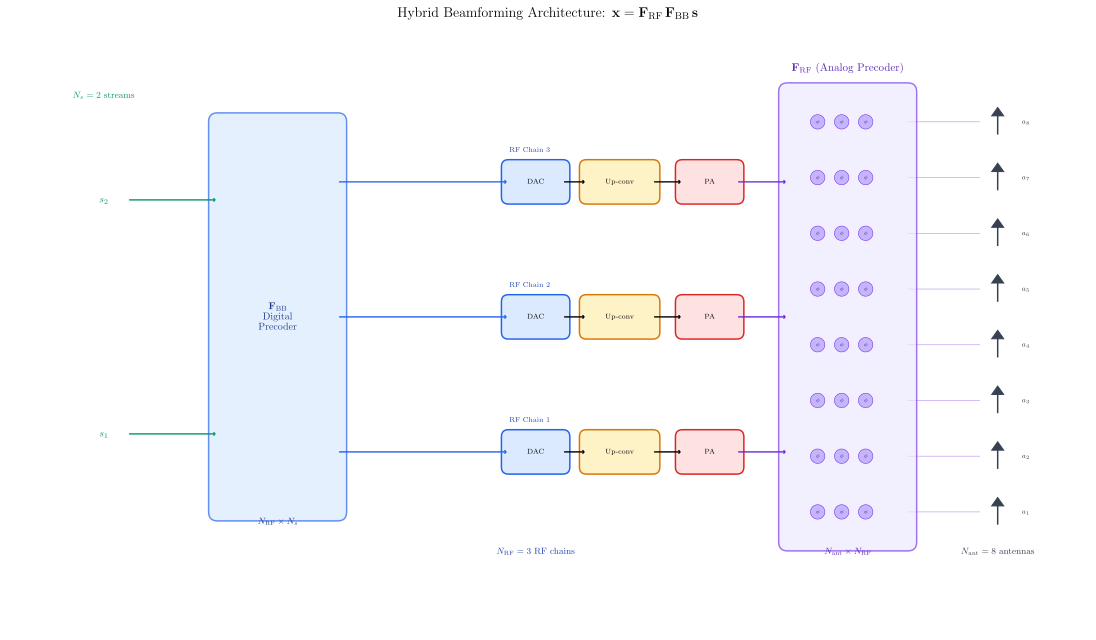
Definition: Analog, Digital, and Hybrid Beamforming
Analog, Digital, and Hybrid Beamforming
Consider a transmitter with antennas and RF chains serving data streams.
Fully digital beamforming (): The precoder is applied entirely in the digital baseband:
Analog beamforming (): A single data stream is phase-shifted by analog phase shifters. The precoder is constrained to have constant-modulus entries: .
Hybrid beamforming (): The precoder is factored as:
where is the analog precoder (constant-modulus entries, implemented with phase shifters) and is the digital precoder.
The constant-modulus constraint on arises because analog phase shifters can only adjust phase, not amplitude. This makes the hybrid beamforming design problem non-convex, unlike the unconstrained digital case.
Definition: OMP-Based Sparse Precoding for Hybrid Beamforming
OMP-Based Sparse Precoding for Hybrid Beamforming
The Orthogonal Matching Pursuit (OMP) algorithm for hybrid beamforming exploits the observation that mmWave channels are sparse in the angular domain. Given a dictionary of steering vectors , the analog precoder is constructed by greedily selecting the dictionary atoms that best approximate the unconstrained optimal precoder .
After selecting , the digital precoder is:
This is the least-squares projection of the optimal precoder onto the column space of .
The OMP approach works well when the channel has a small number of dominant paths (sparse angular support), which is characteristic of mmWave channels. For rich-scattering sub-6 GHz channels, the performance gap between hybrid and digital beamforming is larger because more RF chains are needed to capture the spatial richness.
OMP Algorithm for Hybrid Beamforming
Complexity: per iteration, iterations. With typical values (, , , ), this is a few thousand multiplications — negligible compared to channel estimation overhead.The OMP algorithm was proposed by El Ayach, Rajagopal, Abu-Surra, Pi, and Heath (2014) and has become the standard baseline for hybrid beamforming design. Extensions include simultaneous OMP (SOMP) for wideband channels and alternating minimisation methods for non-sparse channels.
Theorem: Spectral Efficiency Gap of Hybrid Beamforming
For a narrowband MIMO channel with scattering paths (clustered channel model), hybrid beamforming with RF chains and OMP-based design achieves spectral efficiency:
where are the path gains. In particular:
- When (sparse channel with fewer paths than RF chains), the gap vanishes: .
- The condition is sufficient to serve users with near-optimal performance in sparse channels.
Each RF chain can "point" its phase-shifter beam toward one dominant scattering cluster. If the channel has clusters and we have RF chains, we can capture all the channel's spatial energy. The rule accounts for the need to control both desired signal and inter-user interference.
Channel decomposition
The clustered channel model gives:
The optimal digital precoder uses the top- right singular vectors of , which lie in the span of .
OMP approximation error
OMP selects atoms from the dictionary to approximate the -dimensional signal subspace. The residual approximation error after iterations is:
When , this residual is zero (all paths are captured).
Rate gap bound
The rate loss from the projection error can be bounded using the matrix perturbation inequality for log-det:
which vanishes when or when (dominant path).
Hybrid Beamforming — Analog Beam Steering
Hybrid Beamforming Performance
Compare the spectral efficiency of hybrid beamforming (OMP-based) against fully digital and analog-only beamforming as a function of SNR. Adjust the number of antennas , RF chains , and users to explore the design space. Observe how increasing closes the gap to digital beamforming, and how the minimum useful scales with .
Parameters
Beamforming Architecture Comparison
Compare analog, hybrid, and fully digital beamforming architectures across key metrics: spectral efficiency, power consumption, and energy efficiency (bits/Joule). Adjust the antenna count and RF chain count to explore the trade-off. The power model accounts for RF chain power (250 mW each), phase shifter power (30 mW each), and baseband processing power.
Parameters
Example: Hybrid Beamforming Design for a 5G mmWave Base Station
A 5G mmWave base station has antennas and serves users. The mmWave channel has dominant clusters per user.
(a) What is the minimum number of RF chains for near-optimal hybrid beamforming performance? (b) Compute the RF chain reduction factor and power savings if each RF chain consumes 250 mW and each phase shifter 30 mW. (c) If OMP with a 128-entry DFT dictionary is used, how many complex multiplications are needed per channel update?
Minimum RF chains
(a) The rule is sufficient. Since per user and paths may overlap, the total angular support is at most . With , hybrid beamforming closely approaches the fully digital performance.
Power savings
(b) Digital: 64 RF chains 250 mW = 16.0 W. Hybrid: 8 RF chains 250 mW + 64 phase shifters 8 subarrays 30 mW 2.0 + 15.4 = 17.4 W.
Alternatively, with sub-connected architecture (each RF chain drives antennas): 8 RF chains 250 mW + 64 phase shifters 30 mW = 2.0 + 1.92 = 3.92 W.
Sub-connected hybrid saves 75% of RF power vs. fully digital.
OMP complexity
(c) Per OMP iteration: inner products of 64-dimensional vectors with 128 dictionary atoms for streams: multiplications.
Total for iterations: multiplications. This is negligible compared to channel estimation.
Quick Check
In a hybrid beamforming system with antennas and RF chains, what determines the maximum number of spatial streams (users) that can be simultaneously served?
The number of antennas
The number of RF chains
The number of scattering clusters in the channel
The dictionary size used in the OMP algorithm
Each RF chain provides one degree of freedom in the digital domain. With RF chains, at most 8 independent baseband signals can be generated. In practice, users can be served with good performance (the factor of 2 provides inter-user interference suppression capability).
Beamforming Architecture Comparison
| Property | Fully Digital | Hybrid (Fully Connected) | Analog Only |
|---|---|---|---|
| RF chains | 1 | ||
| Spatial streams | 1 | ||
| Phase shifters | 0 | ||
| Per-antenna control | Full (amplitude + phase) | Phase only (analog) + full (digital) | Phase only |
| Spectral efficiency | Optimal | Near-optimal for sparse channels | Single-stream only |
| Power consumption | Highest | Moderate | Lowest |
| Cost | Highest | Moderate | Lowest |
| Typical use case | Sub-6 GHz massive MIMO | mmWave 5G NR | Beam scanning, radar |
Why This Matters: Hybrid Beamforming in the MIMO Book
The MIMO book (Chapters 10--11) develops hybrid beamforming in much greater depth: alternating minimisation algorithms, sub-connected vs. fully connected architectures, wideband (frequency-selective) extensions, and hardware-aware codebook design. The RIS book (Chapter 5) extends the hybrid concept to reconfigurable intelligent surfaces, where the "analog precoder" is a passive metasurface rather than an active phase-shifter network.
See full treatment in Power Control for Massive MIMO
Key Takeaway
Hybrid beamforming with RF chains and OMP-based design closely approaches fully digital performance on sparse mmWave channels. The key insight is that mmWave channel sparsity — a curse for diversity — is a blessing for hybrid beamforming, because few RF chains suffice to capture the channel's angular support.
Hybrid Beamforming
A beamforming architecture that factors the precoder as , where is an analog precoder (phase shifters, constant-modulus) and is a digital precoder. Uses RF chains to reduce cost and power while approaching digital beamforming performance.
Related: OMP-Based Precoding, RF Chain
OMP-Based Precoding
A greedy algorithm that designs the analog precoder for hybrid beamforming by iteratively selecting steering vectors from a dictionary to best approximate the optimal unconstrained precoder. Exploits the angular sparsity of mmWave channels.
Related: Hybrid Beamforming, RF Chain
RF Chain
The analog signal processing chain between the antenna and the digital baseband, including mixer, filter, LNA (receive) or PA (transmit), and ADC/DAC. Each RF chain typically consumes 200--500 mW and represents the dominant cost in large antenna arrays, motivating hybrid architectures.
Related: Hybrid Beamforming, OMP-Based Precoding