802.11 Physical Layer
Two Decades of Wi-Fi: From 54 Mbps to 46 Gbps
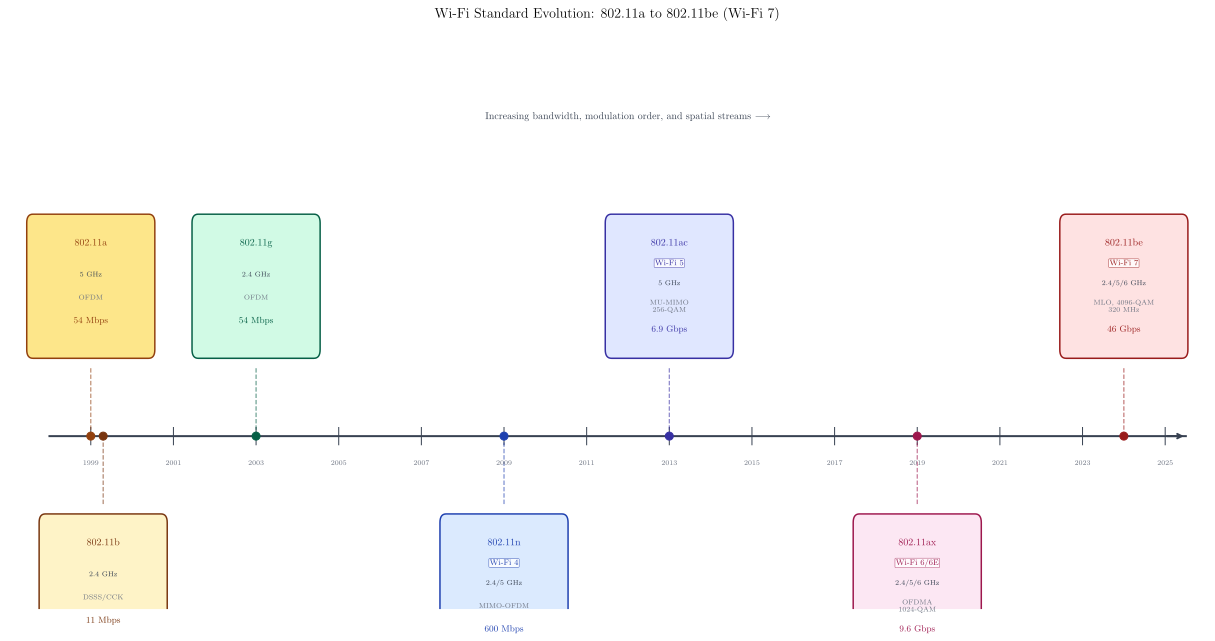
The IEEE 802.11 family has evolved from a single-stream 54 Mbps system (802.11a, 1999) to a multi-link, 16-stream behemoth targeting 46 Gbps (802.11be, 2024). Throughout this evolution, the core modulation has remained OFDM — what has changed is the FFT size, channel bandwidth, number of spatial streams, modulation order, and coding rate. Understanding the OFDM parameter choices across generations reveals a consistent design philosophy: maximise spectral efficiency while adapting to the unlicensed band constraints (20 MHz channelisation in 2.4 GHz, wider channels in 5 and 6 GHz). This section traces the PHY evolution from 802.11a through 802.11be.
Wi-Fi Standards Evolution Timeline
Wi-Fi Channel Bonding
Historical Note: From WaveLAN to Wi-Fi: The Birth of Wireless LANs
1990s--2000sThe 802.11 standard originated in 1997 with 2 Mbps data rates using frequency hopping or DSSS in the 2.4 GHz ISM band. 802.11b (1999) raised the rate to 11 Mbps, but the breakthrough came with 802.11a (1999), which introduced OFDM at 5 GHz with 54 Mbps — the same PHY architecture that persists (with refinements) through Wi-Fi 7. The "Wi-Fi" brand was created by the Wi-Fi Alliance in 1999 to promote interoperability certification, replacing the cumbersome "IEEE 802.11b-compliant" label. By 2024, over 20 billion Wi-Fi devices were in use worldwide, making 802.11 the most widely deployed wireless technology in history.
Definition: Wi-Fi OFDM Parameters Across Generations
Wi-Fi OFDM Parameters Across Generations
All 802.11 OFDM PHYs share the basic structure: -point IFFT, cyclic prefix (guard interval), pilot subcarriers for phase tracking, and null subcarriers at the band edges. The key parameters are:
| Parameter | 802.11a/g | 802.11n | 802.11ac | 802.11ax | 802.11be |
|---|---|---|---|---|---|
| FFT size | 64 | 64/128 | 64--512 | 256--4096 | 256--4096 |
| SCS | 312.5 kHz | 312.5 kHz | 312.5 kHz | 78.125 kHz | 78.125 kHz |
| Symbol | 3.2 s | 3.2 s | 3.2 s | 12.8 s | 12.8 s |
| GI options | 0.8 s | 0.4/0.8 s | 0.4/0.8 s | 0.8/1.6/3.2 s | 0.8/1.6/3.2 s |
| Max BW | 20 MHz | 40 MHz | 160 MHz | 160 MHz | 320 MHz |
| Max streams | 1 | 4 | 8 | 8 | 16 |
| Max QAM | 64-QAM | 64-QAM | 256-QAM | 1024-QAM | 4096-QAM |
The subcarrier spacing changed from 312.5 kHz (802.11a/n/ac) to 78.125 kHz (802.11ax/be) — a reduction — which provides longer symbol duration and improved resilience to outdoor delay spreads, at the cost of increased sensitivity to frequency offsets and phase noise.
The narrower SCS in 802.11ax was the most significant PHY change since 802.11a. It was motivated by OFDMA: narrow subcarriers allow finer-grained resource unit allocation and enable multi-user scheduling within a single OFDM symbol.
Definition: Channel Bonding
Channel Bonding
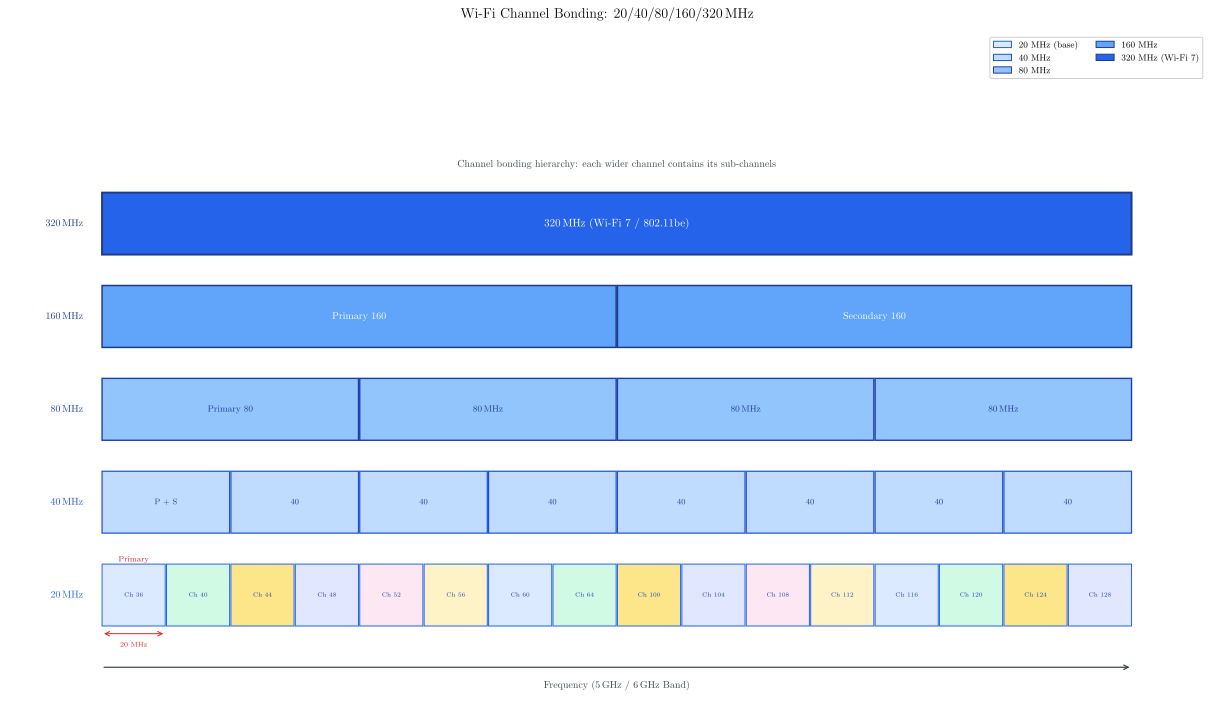
Channel bonding combines multiple contiguous 20 MHz channels into a single wider channel for higher throughput:
- 802.11n: Up to 40 MHz (two 20 MHz channels).
- 802.11ac: Up to 80 MHz (mandatory) or 160 MHz (optional, contiguous or 80+80 non-contiguous).
- 802.11ax: Same as 802.11ac (up to 160 MHz).
- 802.11be: Up to 320 MHz (contiguous or non-contiguous via puncturing).
The throughput scales linearly with bandwidth (approximately), but wider channels face higher interference probability in the unlicensed band. The primary channel (20 MHz) is always included; secondary channels are added if sensed idle.
For a bonded channel of bandwidth :
where accounts for DC and edge null subcarriers.
802.11be introduces preamble puncturing, allowing the AP to transmit on a 320 MHz channel while nulling specific 20 MHz sub-channels occupied by incumbents (e.g., radar in DFS bands). This is a significant advance over 802.11ac/ax, which required contiguous spectrum.
Definition: Modulation and Coding Scheme (MCS) Tables
Modulation and Coding Scheme (MCS) Tables
Each Wi-Fi generation defines an MCS table mapping an index to a modulation order , coding rate , and number of coded bits per OFDM symbol per stream.
802.11ax MCS table (per spatial stream, 20 MHz, 242 data tones):
| MCS | Modulation | Bits/symbol/stream | Data rate (GI=0.8s) | |
|---|---|---|---|---|
| 0 | BPSK | 1/2 | 242 | 8.6 Mbps |
| 1 | QPSK | 1/2 | 484 | 17.2 Mbps |
| 2 | QPSK | 3/4 | 726 | 25.8 Mbps |
| 3 | 16-QAM | 1/2 | 968 | 34.4 Mbps |
| 4 | 16-QAM | 3/4 | 1452 | 51.6 Mbps |
| 5 | 64-QAM | 2/3 | 1936 | 68.8 Mbps |
| 6 | 64-QAM | 3/4 | 2178 | 77.4 Mbps |
| 7 | 64-QAM | 5/6 | 2420 | 86.0 Mbps |
| 8 | 256-QAM | 3/4 | 2904 | 103.2 Mbps |
| 9 | 256-QAM | 5/6 | 3226 | 114.7 Mbps |
| 10 | 1024-QAM | 3/4 | 3630 | 129.0 Mbps |
| 11 | 1024-QAM | 5/6 | 4034 | 143.4 Mbps |
Data rate formula:
802.11be extends the table to MCS 12 (4096-QAM, ) and MCS 13 (4096-QAM, ). Each additional QAM doubling adds approximately 0.5 bits/symbol/stream but requires 3 dB higher SNR.
Definition: Wi-Fi MIMO Modes
Wi-Fi MIMO Modes
Wi-Fi MIMO has evolved through three phases:
1. SU-MIMO (802.11n, 2009): Up to 4 spatial streams using spatial multiplexing with MMSE or ML receivers. Requires antennas at both ends.
2. DL MU-MIMO (802.11ac, 2013): The AP transmits to up to 4 users simultaneously using beamforming, with up to 8 total streams. Requires explicit channel sounding (NDP + compressed beamforming feedback).
3. UL + DL MU-MIMO (802.11ax, 2020): Extends MU-MIMO to the uplink with trigger-based PPDU. The AP schedules uplink transmissions from multiple STAs that arrive simultaneously.
The beamforming feedback uses compressed beamforming matrices: the STA computes the right singular vectors of the channel and feeds back using Givens rotation angles .
The MU-MIMO sounding overhead in 802.11ac/ax is significant: an NDP (Null Data Packet) + NDPA + beamforming report sequence takes several hundred microseconds. This motivates the trigger-based framework in 802.11ax, which amortises sounding across multiple users.
Wi-Fi OFDM Parameters by Standard
Explore the OFDM parameters for each Wi-Fi generation. The plot shows the FFT size, number of data/pilot/null subcarriers, subcarrier spacing, symbol duration, guard interval options, maximum channel bandwidth, and maximum number of spatial streams. Observe the transition from 312.5 kHz SCS (802.11a/n/ac) to 78.125 kHz SCS (802.11ax/be).
Parameters
Wi-Fi Throughput vs. Distance
Visualise how the achievable throughput degrades with distance for each Wi-Fi standard. The simulation uses the IEEE TGax indoor path loss model and selects the highest sustainable MCS at each distance. Adjust the transmit power to see how link budget affects coverage. The step-wise throughput curve reflects MCS switching as the received SNR drops below each MCS threshold.
Parameters
Example: Computing 802.11ax Peak Data Rate
Compute the peak PHY data rate for 802.11ax with:
- 160 MHz bandwidth (2 996-tone RU = 1960 data tones after pilots)
- 8 spatial streams
- MCS 11 (1024-QAM, )
- Shortest guard interval: 0.8 s
Bits per OFDM symbol
Coded bits per symbol per stream: .
Data bits per symbol per stream: .
Data rate per stream
Symbol duration: s.
Rate per stream: Mbps.
Total peak rate
With 8 spatial streams: Mbps Gbps.
This matches the IEEE 802.11ax specification maximum PHY rate.
Quick Check
What was the most significant PHY-layer change introduced in 802.11ax compared to 802.11ac?
Increasing the maximum channel bandwidth from 160 MHz to 320 MHz
Reducing the subcarrier spacing from 312.5 kHz to 78.125 kHz
Adding support for 256-QAM modulation
Increasing the maximum number of spatial streams from 4 to 8
802.11ax reduced the SCS by (from 312.5 kHz to 78.125 kHz), which was the enabling change for OFDMA multi-user scheduling. The longer symbol duration also improves outdoor performance. 320 MHz channels are an 802.11be feature, 256-QAM was introduced in 802.11ac, and 8 spatial streams were already supported by 802.11ac.
Common Mistake: Peak PHY Rate vs. Real-World Throughput
Mistake:
Quoting the peak PHY rate (e.g., 9.6 Gbps for Wi-Fi 6) as the expected user throughput.
Correction:
Real-world throughput is typically 30--50% of the peak PHY rate due to: MAC overhead (DIFS, backoff, preambles, ACKs), channel estimation overhead (pilots), protocol overhead (headers, FCS), and MCS adaptation (the peak MCS requires very high SNR that most users do not experience). In dense multi-user scenarios, per-user throughput is further divided by the number of active users. A realistic expectation for a single Wi-Fi 6 user at moderate range is 500--800 Mbps on 160 MHz, not 9.6 Gbps.
Key Takeaway
The Wi-Fi PHY evolution follows a consistent formula: each generation increases throughput through wider channels (channel bonding), higher-order modulation, more spatial streams, and coding improvements. The most transformative change was the SCS reduction in 802.11ax (312.5 kHz 78.125 kHz), which enabled OFDMA — the shift from single-user contention to multi-user scheduled access.
Channel Bonding
The combination of multiple contiguous (or non-contiguous in 802.11be) 20 MHz channels into a single wider channel. Scales throughput approximately linearly with bandwidth but requires all component channels to be sensed idle before transmission.
Related: Preamble Puncturing
Preamble Puncturing
An 802.11be feature allowing transmission on a wide channel (e.g., 320 MHz) while nulling specific 20 MHz sub-channels that are occupied by incumbents or detected as busy. Avoids the all-or-nothing channel bonding limitation of earlier standards.
Related: Channel Bonding